What Is the PSLE English Oral Examination and Why Does It Matter?
Every year, the PSLE English Oral examination stands as a key checkpoint for all Primary 6 students in Singapore before they move on to secondary school. Think of it as the school version of an interview mixed with some good old-fashioned show-and-tell—except this time, it makes a difference in your secondary school posting!
This exam isn’t just about pronouncing words right (though, yes, clarity and a dash of dramatic flair help); it also puts students’ thinking and speaking skills under the microscope. You’ll be asked to read a short passage aloud, then tackle a conversation based on a picture prompt. The goal: show your ability to organise your thoughts and discuss ideas clearly—a skill that matters everywhere, from the classroom to group projects to, eventually, that nerve-wracking first job interview.
If you’re a parent, knowing what this exam measures is half the battle. The oral exam is more than a test—it’s a chance for students to shine by sharing their opinions and making connections to real-life situations. Preparing well can boost not just exam scores, but your child’s confidence for years to come.
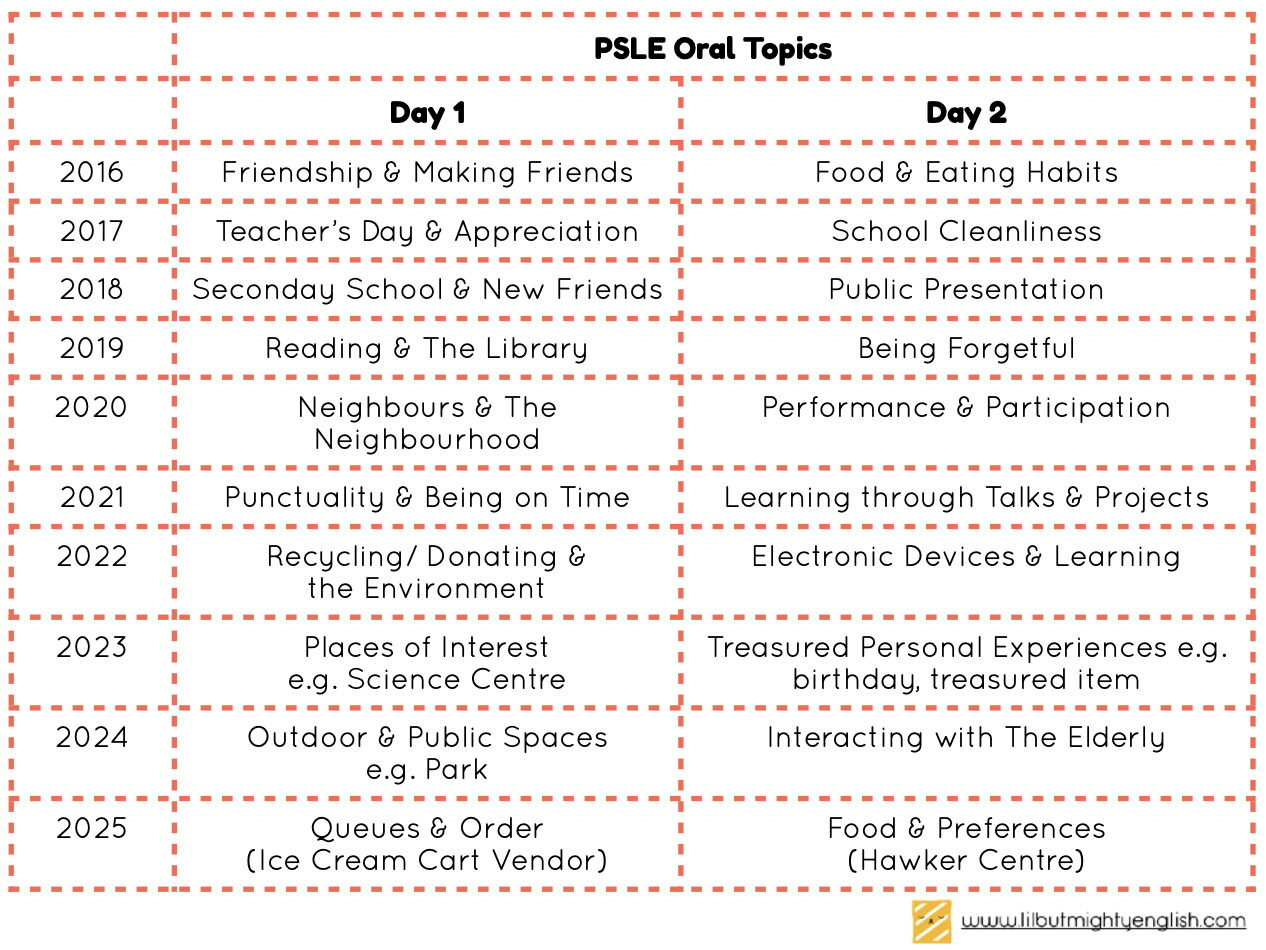
To help PSLE students prepare for their upcoming 2025 PSLE oral exams, we have taken note of the topics that have been selected as questions for the last 10 years – from 2016 to 2025!
Understanding the PSLE English Oral Exam
Before diving into the common topics, it helps to understand the structure of the PSLE English Oral examination. The exam is made up of two main components, each testing different aspects of spoken English and communication:
- Reading Aloud (10 marks):
Students are given a short passage to read aloud to the examiner. They have one minute to look through the text before reading. Marks are awarded for pronunciation, articulation, expressiveness, and reading pace. - Stimulus-Based Conversation (30 marks):
Students are shown a visual stimulus—usually a photograph or illustration—and are asked to describe it, share their thoughts, and respond to follow-up questions from the examiner. This part assesses fluency, coherence, vocabulary, and the ability to sustain a natural conversation.
The entire oral examination typically lasts around 10 minutes per student. While that may seem brief, regular practice is key to building the confidence and automaticity needed to do well under exam conditions.
For a broader overview of this exam component, visit our PSLE Oral guide.
Common Stimulus-Based Conversation Topics
Although the stimulus for the Stimulus-based Conversation component has been updated, we believe that the topics selected for the photograph-style stimulus will still fall into these 3 broad categories:
- everyday or school experiences that all students would have (e.g. Students crossing the road, hygiene practices in school etc.)
- essential and current general knowledge that every student should know as a primary school student (e.g. environmental issues, new modes of learning etc.)
- positive values and habits that we want to nurture in our children (e.g. showing support for fellow schoolmates, saving water and electricity used in school etc.)
This is to ensure fairness as the topics selected are not foreign to any child. Having said this, it means that nothing is considered too obvious or common to be tested.
Our teachers keep up-to-date with the latest SEAB trends and formats, ensuring that students are exposed to themes that commonly appear in PSLE oral exams. Lessons are carefully tailored so that students are well-prepared and never caught off guard by the types of questions or scenarios presented. This approach not only builds familiarity but also boosts confidence, helping students to express their ideas clearly—whether the topic is as ordinary as a rainy day at school or as timely as recycling initiatives in the community.
As the date for PSLE oral draws near, it would be good to have a chat with your child from time to time to find out what are some of the issues they had encountered during school practices and most recent oral examinations and school oral practices. In particular, were there times that your child had wanted to say something but just can’t find think of suitable vocabulary or expressions to convey the wonderful ideas that had appeared in his/her mind?
Laying the Foundations for Oral Success
By familiarising your child with common themes, building strong vocabulary habits, and creating regular opportunities for spoken practice, you lay the foundation for a confident and compelling oral performance. The earlier you start, the more natural it all becomes — and that naturalness is exactly what examiners look for.
Remember, the goal is not to produce a rehearsed, robotic speaker, but a thoughtful communicator who can engage authentically with any topic placed in front of them. With the right guidance and consistent effort, your child can walk into the oral examination room not with dread, but with genuine readiness.
We have just the right solution for this issue that many PSLE students face. =)
Why Go Beyond Just Describing the Image?
When helping your child prepare for the stimulus-based conversation, it’s tempting to stick to what’s in the picture—after all, that feels “safe”: “There’s a student helping another pick up books,” and so on. But here’s the thing: examiners aren’t just looking for “safe.” They’re actually hoping to see if a student can go deeper.
Going beyond the basic description allows your child to:
- Show thoughtfulness: Linking the image to broader ideas or personal experiences demonstrates maturity and an ability to relate real-life situations to the prompt. For instance, instead of “The student is helping,” your child could share about a time they helped a friend or why helping others is important in school.
- Provide reasons and examples: Adding explanations like, “This teaches us kindness, which is important because it makes our school community friendlier,” fleshes out answers and shows the examiner your child really understands the topic.
- Demonstrate language ability: Expanding beyond a single sentence helps show off fluency, coherence, and organisation—skills that examiners reward with higher marks.
In fact, the ability to elaborate, connect ideas, and give personal opinions or experiences is what lifts a response from “average” to “outstanding.” So, encourage your child to start with what they see, but then move beyond—to the “why” and “how” behind the image. This is a sure way to stand out.
Why Practising with Real Stimulus Images Matters
One of the most effective ways to prepare for the PSLE oral exam is to work with actual stimulus images, just like those used in the real test. By using sample pictures from past years or mock exams, your child gets a feel for the types of scenarios and questions they might face on the big day.
When your child practises describing real images, they learn to observe details carefully, pick out key information, and express their thoughts clearly under time pressure—much like in the exam hall. These practice rounds also help them get comfortable responding to follow-up questions on the spot, which builds both confidence and thinking speed.
If you’d like to take things a step further, try recording your child’s responses. It’s an easy way for them to hear their own speaking pace, tone, and phrasing, and spot areas to fine-tune. Over time, this method ensures that your child isn’t caught off guard by unfamiliar situations during the PSLE oral, and can answer calmly and fluently no matter what image pops up.
What Are Examiners Really Looking For?
If you’re wondering what exactly examiners keep an eye (and ear!) out for during the PSLE English Oral exam, the answer is reassuringly straightforward. They are on the lookout for students who are able to express their ideas clearly and naturally, and who can hold a conversation that feels spontaneous rather than scripted.
Here are some key qualities that examiners appreciate:
- Clear and confident communication: Speaking audibly, using proper pronunciation, and being confident—even if a little nervous!—goes a long way.
- Relevant vocabulary: Using the right words for the topic at hand shows understanding and effort.
- Originality and thoughtfulness: Examiners love it when students are able to express personal opinions, share experiences, or give examples—from a day at East Coast Park to a Science lesson on recycling.
- Natural flow and engagement: Rather than memorising full model answers, being able to converse about the topic—asking or responding to questions, pausing and thinking out loud—shows real language ability.
- Connection to the topic: Staying focused and relating answers back to the main theme demonstrates both comprehension and organisation.
In short, it’s not just about perfect grammar or big words. Examiners are hoping to meet a young communicator who is willing to share, listen, and interact—just as they might during a chat with a teacher or friend.
Rehearsed Speech vs. Authentic Communication in the Oral Exam
There’s a big difference between rattling off a memorised script and having a real, meaningful conversation during the oral exam. When students rely solely on memorised answers, their responses may sound stilted or unnatural—like a robot reciting lines for a play. This not only makes it harder for them to adapt if the examiner throws them a curveball, but it can also prevent their true understanding and personality from shining through.
On the other hand, authentic communication is about expressing original thoughts clearly and confidently, using appropriate vocabulary and expressions to support your ideas. It’s perfectly fine to draw on prepared phrases or examples (we all need a trusty safety net!), but the ability to adapt your answer on the spot is what helps examiners see your real strength as a communicator. In essence, what we want is for every student to be able to respond genuinely—engaging with the topic, rather than just reciting a prepared script—so their answers feel both natural and convincing.
For PSLE orals, bite-sized is always best
Today, we would like to share with you a way to boost your child’s vocabulary and remember content for various oral topics. It is simply to take down important vocabulary for the oral topic as your child practises. Instead of memorising an entire model answer, try remembering the key vocabulary related to each topic. You know that bite-sized learning is always easier.
Having rich vocabulary definitely helps to bump up your language score but in addition, remembering these phrases may trigger important content for your answers too. A list that is compiled for the topic of “health and fitness/ sports” may look like this:

Make Practice Count: Mock Sessions and Guided Discussions
Beyond just jotting down useful words, mock oral sessions, vocabulary building exercises, and guided discussions on age-appropriate topics are all part of how we prepare students for examination day. These interactive methods not only reinforce the vocabulary lists but also help your child apply phrases naturally in conversation. Regular practice helps students gain confidence, spot gaps in their knowledge, and become comfortable using new vocabulary in context—just like they would need to on the actual exam day.
The main point is to collect important vocabulary according to main topics so that it is easier for your child to revise at a glance during preparation. Here are some ideas of other topics that we feel are possible to be tested during the oral examination this year and which you should compile the vocabulary list for:
- leisure / hobbies / entertainment
- leadership, recycling / environment
- technology / internet
- neighbours and your neighbourhood
- road safety
- hygiene and cleanliness
- nutrition, fitness and health
- positive values and habits in the school context
Eventually, your list may look something like that:

How can your child use this list for the PSLE Oral Exam?
- Your child may wish to read up on one topic each day and share the vocabulary with someone such as you or a friend. (It is always nice to revise together!)
- Read up on the vocabulary for the related topic before practising questions on that topic. e.g. If the practice topic is about sports, read up the phrases for health and fitness/sports before you start the practice with someone. During the practice, make sure to apply the phrases as much as possible.
- Randomly choose a topic for your child and he/she should try and name 3 to 5 of the phrases recorded under that topic.
- Add on vocabulary that is relevant to each topic or even start a new topic e.g.
List of phrases for ‘Positive Values and Habits in the School Context’
- spare a thought for other students
- take up the responsibility of…
- everyone should be a role model for one other
- a simple gesture could make a huge difference
- the task of … would be so much easier if everyone plays his/her part
- teamwork is important to/for … to be accomplished
- My classmates and I can remind one other by…
- integrity and sincerity are more important than…
- having a heart of servitude is important to…
- I should practise … as instructed by my parents/teacher/ coach because…
- It is more meaningful to succeed as a team.
- Without the help from …., I could not have ….
- I would recommend … because
- knowledge does not only enriches our minds but also enables us to judge whethersomething is right or wrong
If there is a word or phrase which your child is not certain about, be sure to check out the dictionary so that he/she can use them accurately. For parents who would like to start this early with your child who is not yet taking the PSLE, it may be good to help him or her to get started by selecting a few phrases/ words which are easier and building from there.
In fact, starting early—ideally from Primary 5—can make a significant difference. Just 15 to 20 minutes of daily practice, even with a handful of new words or phrases, helps your child become comfortable and natural in using them. This steady, bite-sized approach is much more effective than cramming everything in at the last minute. Over time, your child will gain the confidence and fluency that examiners look out for, making the oral exam a far less daunting experience.
Remember, consistency is key. By weaving these short, daily sessions into your child’s routine, you’ll help them build up a strong vocabulary foundation, one step at a time.
Key Takeaways for PSLE Oral Success
- Oral is 40 total marks — a significant component that directly impacts your English Language grade and secondary school placement.
- Theme familiarity matters — students who know common topics can focus on expressing ideas rather than struggling for what to say.
- Elaborate, don’t just describe — examiners reward students who go beyond the image and connect to broader ideas with reasons and examples.
- Start early — from Primary 5 — consistent small daily sessions build the naturalness and confidence that examiners reward.
By focusing on collecting vocabulary and understanding possible themes, your child will be better prepared not just to answer, but to elaborate confidently and make connections during the oral exam. Small, consistent efforts truly pay off—and starting early helps these skills become second nature.
Tips for Building Stronger Oral Responses
When it comes to scoring well in the oral examination, it’s not just about listing out facts or short statements—the key is to show your thinking process and share your personal insights wherever possible. To help your child move beyond one-line answers, encourage them to expand on their ideas by explaining the “why” and “how” behind their opinions.
Here are some simple ways your child can elaborate during the PSLE Oral Exam:
- Give Reasons: Instead of stopping at a single statement, add on by explaining why they hold that view. For example, “I think teamwork is important because it allows us to help each other and achieve more together.”
- Share Personal Experiences: Encourage your child to connect the topic to their own life. For instance, “Last year, my classmates and I organised a class clean-up, and it really taught me the value of responsibility.”
- Provide Examples: Whenever possible, back up statements with relevant details or stories. “For example, recycling plastic at school has helped us keep our environment clean.”
- Use Linking Phrases: Phrases like “In addition,” “Furthermore,” or “This reminds me of…” can help your child string ideas together smoothly.
By practising these strategies, your child will grow more confident in developing fuller, more thoughtful responses—and that’s sure to impress the examiners!
Common Pitfalls in the PSLE English Oral Exam (And How to Avoid Them)
Let’s face it, even the sharpest students can stumble over surprisingly simple hurdles during the oral exam. To save your child from the classic “Oops, I wish I’d…” moments, here are some common slip-ups—and what to do instead:
- One-word or one-line wonders
Short answers may feel safe, but they actually limit your child’s chance to shine. Encourage them to explain their thoughts fully—think of it as painting a picture, not just dotting a few colours here and there. - Focusing solely on the picture
The oral component goes beyond identifying what’s in the image. It’s about connecting ideas, drawing on personal experiences, and even suggesting what could happen next. Nudge your child to let their imagination roam a little (within reason, of course). - Speaking in Singlish or being too informal
While we love our local flavour, the exam calls for clear, standard English. Practise at home by answering casual family questions in Standard English, so it becomes second nature. - Mumbling, whispering, or talking at lightning speed
Nerves can turn voices into whispers or have words tumbling out like a runaway train. Remind your child: it’s not a race. Breathing deeply before speaking helps, as does practising with a timer (at a normal pace, not supersonic speed!). - Drawing a blank when faced with curveball questions
Every student has faced a brain freeze at some point. Instead of panicking, it’s perfectly fine to pause, take a breath, and say something like, “That’s a good question, let me think…” This buys precious moments to organise thoughts and shows the examiner calm confidence.
Taking note of these simple but crucial reminders can turn a nerve-wracking experience into a winning performance.
Managing Nerves and Staying Calm During the Oral Exam
We know the jitters are real—especially when you want to wow the examiners! Here are some simple strategies you can use to stay cool and collected:
- Speak Up and Slow Down: When we feel nervous, our voices tend to get softer or faster without us noticing. Remind your child to take a deep breath before starting to speak. It helps to imagine you’re talking to a friend sitting at the back of the room; that way, you project your voice naturally and pace yourself rather than rushing your thoughts.
- Taking a Pause Is Okay: It’s perfectly normal to be stumped by a tricky question. Instead of panicking, encourage your child to use a filler phrase like, “Let me think about that for a moment,” or “That’s an interesting point.” This buys precious thinking time while showing the examiner you’re thoughtful and not just silent from nerves.
Remember, staying calm isn’t about never feeling nervous—it’s about managing those nerves with smart tactics. Practise these habits during mock orals at home so they become second nature when it matters most!
Simulating Exam Conditions at Home
To help your child feel confident and calm during the actual oral exam, it is a good idea to create practice sessions that feel just like the real thing. Here are some ways you can do this at home:
- Set a Timer: Practise answering oral questions within the same time limits your child will face during the examination. This helps them get used to thinking and responding quickly.
- Use a Quiet Space: Choose a quiet area at home, free from distractions, to mimic the exam environment.
- Record Their Responses: Let your child practise speaking while being recorded on your phone or another device. Listening back allows them to spot areas to improve, like pronunciation or pacing.
- Switch Roles: Take turns acting as the examiner. You can use sample oral prompts or questions, and occasionally throw in unexpected follow-up questions—just like real examiners do!
- Dress Rehearsal: Encourage your child to sit upright and imagine they are in front of the examiners. Even dressing in school uniform can help them take the practice more seriously.
With these little tweaks, your child will gain confidence and be ready to shine during the actual PSLE oral.
Practical Tips for the Reading Aloud Component
Just as with oral examination topics, being systematic in your reading aloud preparation makes all the difference. Don’t let this portion catch you off guard—it’s more than simply reading words off a page! To help your child approach this component confidently, here are some hands-on strategies:
- Make the most of the preparation minute: Encourage your child to quickly scan the passage for challenging words, circle (lightly!) anything tricky, and mentally note where sentences naturally pause.
- Pace is key: Rushing through can trip anyone up. Reading at a comfortable, thoughtful pace not only improves pronunciation, it also gives the examiner time to appreciate good expression.
- Use punctuation as your guide: Remind your child that punctuation isn’t just there for grammar checks. Full stops, commas, exclamation marks—all of these are clues for pausing and for how the voice should rise or fall.
- Vary practice passages: Mix up the material at home—short stories, news articles, simple dialogues—to build confidence and the ability to tackle any style that pops up during the exam.
- Practice reading aloud regularly: Reading to a family member, a friend, or even into a recording app helps children get used to projecting clearly and using lively expression.
With enough practice, reading aloud will soon become second nature, and your child will be less likely to fall into the monotone trap!
How is the Reading Aloud Component Assessed?
For the Reading Aloud section of the PSLE English Oral exam, your child will be given a short passage to read aloud to the examiners. They’ll have about a minute to look through the text before it’s their turn.
When assessing this component, examiners pay careful attention to four main aspects:
- Pronunciation: Are words spoken clearly and correctly?
- Articulation: Is each word enunciated so the listener understands every part?
- Expressiveness: Does your child bring the passage to life with appropriate intonation and emotion, rather than reading in a flat or monotone voice?
- Pace: Are they reading at a comfortable speed—not too rushed, but not too slow?
A maximum of 10 marks is awarded here, so it’s important to practise reading a wide variety of passages, focusing on clarity and natural speech. Getting feedback from teachers or even doing simple recordings at home can work wonders in building up confidence and fluency.
Check out more resources like this here!
All the best, Primary Six warriors and impress the examiners with some golden vocabulary!
Why Small Class Sizes Matter for Oral Language Development
One of the key benefits of small class sizes—think groups of 4 to 8 rather than a bustling classroom of 30—is the chance for every child to find their voice. With fewer students, teachers have more time to engage personally with each learner, offering targeted feedback and encouragement during oral activities. This extra attention also creates a safe space where even the quieter ones feel comfortable to participate and practise aloud.
In a smaller group, your child is far less likely to get lost in the shuffle. They receive more opportunities to speak, answer questions, and try out new vocabulary in real conversations. This focused setting helps to identify and address unique strengths and weaknesses, building up confidence one chat at a time. Over time, you may notice your child growing bolder and more fluent, as they receive specific, constructive feedback—just like a supportive study circle among friends.
Why Individual Attention Matters in English Oral Preparation
Ever wished you had a “personal coach” by your side while tackling tricky oral questions? That’s the magic of small classes! When each student receives focused guidance, it’s easier to address personal strengths and work on weaker areas—like improving pronunciation or conquering nerves before an examiner. One-on-one feedback means your answers get sharpened, mistakes get spotted earlier, and your confidence gets a huge boost.
So, whether it’s learning to express opinions clearly or handling unexpected questions gracefully (think of it as your very own English training montage, Rocky style), that individual spotlight makes all the difference when it comes to acing your oral exams.
Explore our full PSLE Oral guide for help with Reading Aloud, Stimulus-Based Conversation, and oral confidence.
The Lil’ Chatterbox Course
If you are still looking for a way to do better for your oral and need a structured approach to craft your answers in the stimulus-based conversation section, we are happy to share with you that our online oral course, “Lil’ Chatterbox” is now available!
For families who prefer flexible, online learning options, our e-lessons offer targeted support that can be tailored to your child’s unique needs and schedule. Whether your child thrives with independent study or needs extra guidance to gain confidence, you can choose the format that best fits their learning style. The focus remains the same: helping every student communicate with clarity and confidence, one conversation at a time.