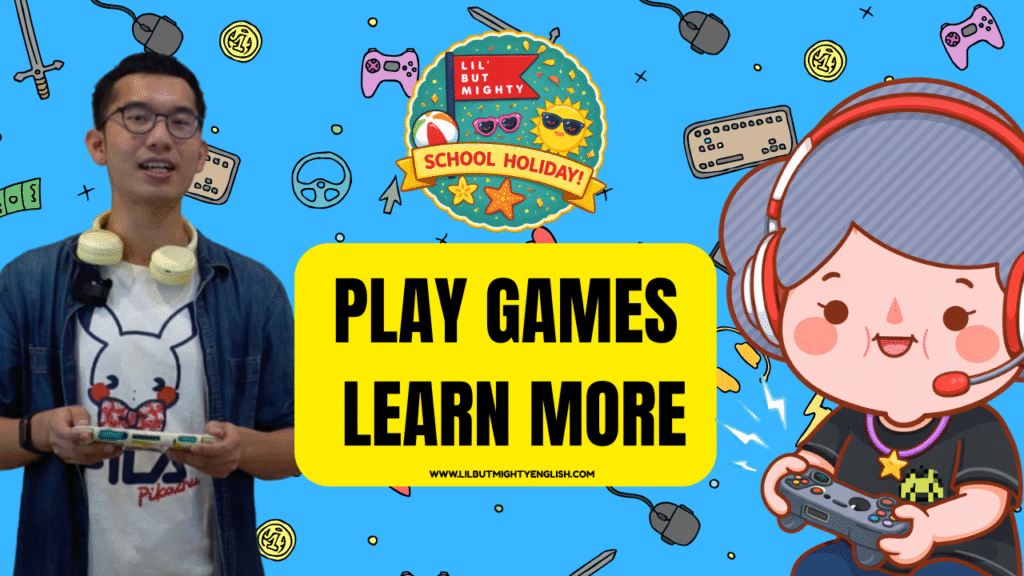
Hi everyone! Welcome back to another video post by me, Teacher Wen Hee, an English Teacher at Lil’ but Mighty. This video post will focus on why games can be helpful tools to help enhance students’ learning and I am sure it would be of interest to many of you, especially the students.
Learning has evolved so much over the years. As such, many kids consider it a chore or even monotonous to use traditional methods of language learning. One suggestion to overcome this is to infuse games, whether video, computer, board and even card games, into language learning. Although some people may feel that playing games can be bad for children (especially if they are played for extended periods of time with no parental supervision), it actually has many benefits. The most obvious benefit would be that integrating games into educational processes allows educators and parents to turn language practice into an exciting journey for the kids since it makes language learning fun and engaging. I mean, who doesn’t enjoy playing games?
With that in mind, let’s look at some skills that can be enhanced through video gaming!
Like what you are watching? Please subscribe to our YouTube channel to receive our tips and strategies fresh from our studio!
Communication skills
Games are much more fun when played with others. Did you know that collaborating with others online actually helps to encourage cooperation between students which play an important role in their social development? Whether it is coordinating attacks to take down a boss, or deciding upon which strategy to use to overcome the opposing team, players can make their intentions known and execute their plans quickly when they are able to give clear and concise instructions to other team members. As such, multiplayer games offer kids the opportunity to improve not just their teamwork, but their communication skills as well.
A type of game where communication skills are especially important is in real-time strategy games like Overcooked, which I’m sure many people have heard about and is a fan favourite no matter the age. In this game, where time is of the essence, players take on the role of chefs and need to communicate clearly as well as work together to complete as many dishes as possible so as to earn as many gold coins as possible.Alternatively, Brawl Stars — a fast- paced, multiplayer online game — is a favourite among kids, where players work together as a team as they attempt to bring down the opposing team through active communication and strategic planning.
The bottom line is, multiplayer games encourage the players to express their ideas, share resources and coordinate movements with others. When students play games that require them to interact, strategise and carry out plans as a team, they are also developing effective communication skills.
Reading skills
A skill that is more closely related to English would be one’s reading skills. This is especially crucial for playing games, because just like reading a book, you would need to understand the complex rules, objectives and even narratives of the game. Good graphics and controls may draw people to a game initially, but if you happen to be an avid reader, I’m sure that you would be captivated and motivated by the story and character interactions. Furthermore, reading the onscreen text, including instructions for quests, character dialogues and item descriptions, may be the key to solving challenges and puzzles in the game.
How about those of us who do not like to read? The interactive nature of video games may increase our motivation and interest in reading. We may find ourselves using reading skills as we solve problems, overcome challenges and achieve goals as during the game-play! We may also learn new vocabulary but in a more engaging way since difficult concepts and words are often explained using graphics and story presentation.
Examples of games that can help to develop reading skills would be Role-Playing Games (RPG) like Final Fantasy and the Kingdom Hearts series which have rich narratives and well-written dialogue that may inspire students to strive for realistic and logical writing in their compositions. In such games, possessing strong reading skills will enhance your understanding, decision-making andenjoyment, making the whole gaming experience a fulfilling one.
Analytical skills
Let’s talk about another important skill that can be acquired through games. Elements of problem-solving are incorporated into most games, especially Role-Playing Games which often require puzzles to be solved. That being said, simple games like Tetris should not be overlooked, as analytical skills are also required to determine the best location to place each block. Believe it or not, analytical skills are crucial even in fighting games like Street Fighter, where top players often “read” their opponents’ actions and plan several moves ahead, and even coming up with contingencies for various scenarios.
If you are looking for something more child- friendly, even competitive Pokémon battles require you to analyse and think critically about the moves you want the Pokémon to know as you are only limited to 3 moves for Pokémon GO!. Not only that, you will also apply analytical skills for making other decisions, such as managing the items and Pokémons in your inventory and knowing how to use limited resources effectively.
Even card games such as UNO and Sushi Go or Trading Card Games like Pokémon TCG and Happy City require you to think on your feet as you play out the various strategies that help you achieve victory. In short, playing games teaches you strategic thinking, logical reasoning and problem-solving skills; skills that are transferable to society when you need face real-world challenges.
Well, I hope you had fun learning about how playing games can actually be beneficial for developing not only language skills, but also higher-order thinking and communication skills.
That being said, parents do remember to exercise discretion in choosing games that are age-appropriate and in limiting the hours of gaming time. And kids, listen to your parents and use this opportunity to exercise self-discipline and practise time management. You work hard and you do deserve to play hard but don’t forget that too much of anything is never a good thing! 🙂
Now that the holidays are approaching, perhaps you might consider playing some of the games mentioned in this video in your free time. Of course, make sure you get Mummy and Daddy’s permission first! Who knows? It might even become a bonding activity for the family! Have fun and stay healthy! And remember to keep a lookout for my next post!
Oh before I head off, if you like our content, do remember to check out our other topics / posts/videos! Don’t forget to like, share and subscribe for more from us at LBM!