
O Level Oral Talking Points [Part 1]: Self, Education, Technology, Media
- O-levels, Oral, Secondary School English
Home » PSLE Oral
PSLE Oral tests more than just pronunciation or confidence. To do well, students need to read aloud clearly, respond thoughtfully, and communicate ideas in a natural, well-organised way. Many students know what they want to say, but struggle to express themselves clearly under pressure.
This guide brings together the key skills, strategies, and next steps students need to become more confident and effective in PSLE Oral.
PSLE Oral assesses how well students can communicate in spoken English. Students are expected to read a passage aloud clearly and express their ideas in response to a visual prompt and related questions.
A strong oral performance usually includes:
PSLE Oral is not about giving perfect or memorised answers. It is about communicating clearly, showing understanding, and responding in a way that is relevant and well developed.
A strong understanding of PSLE Oral helps students:
Many students find Oral difficult because it requires them to think and respond immediately. They may know the topic, but still struggle to organise their thoughts, speak clearly, or extend their answers meaningfully.
Students often struggle because they:
This is why Oral can feel stressful. It is not only about language knowledge. It is also about calmness, clarity, confidence, and practice.
A strong PSLE Oral performance is not about sounding advanced or overly polished. It is usually the one that is clear, relevant, and well communicated.
Strong oral responses often have these qualities:
Students usually do better when they understand that Oral is about clear communication, not just speaking more.
Students usually improve faster in Oral when they focus on specific speaking skills instead of trying to sound better in a vague way.
Students also benefit from learning how to avoid one-word answers, organise their thoughts quickly, link ideas smoothly, and use topic-based vocabulary naturally.
Reading Aloud tests whether students can read a passage clearly, accurately, and expressively. Students need to show that they understand punctuation, phrasing, and tone, not just pronounce the words correctly.
A strong Reading Aloud performance usually includes:
Students often lose marks when they rush, read word by word, ignore punctuation, or sound too flat. Reading Aloud becomes stronger when students learn how to read meaningfully instead of mechanically.
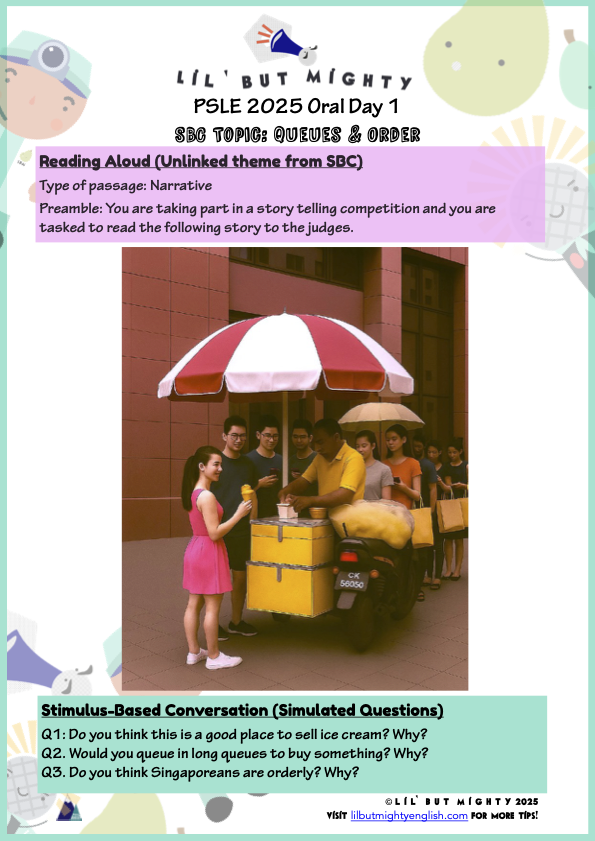
Stimulus-Based Conversation tests whether students can respond meaningfully to a visual prompt and related questions. Students need to show that they can express opinions, give reasons, and develop their ideas clearly.
A strong SBC response usually includes:
Students often struggle because they answer too briefly, repeat the question, or give ideas without support. SBC becomes easier when students learn how to extend their answers in a simple and structured way.

Build stronger Oral skills through our Primary English regular classes, where students receive structured guidance in reading aloud, speaking clearly, and developing stronger SBC responses.

Build confidence step by step with guided lessons, worked examples, and focused practice in Reading Aloud and Stimulus-Based Conversation.

Get targeted support in pronunciation, expression, idea development, and oral response strategies to help students perform more confidently.

A clear method helps students respond with more confidence and less panic. Instead of rushing into an answer, students should work through each question step by step so they can organise their thoughts, speak more clearly, and give fuller, more natural responses.
Students should first observe the visual prompt and think about what is happening, what the main idea is, and what themes may come up in the questions. This helps them prepare their thoughts before they start speaking.
Students should begin with a clear answer instead of circling around the point. A direct opening helps them stay focused and gives their response a stronger structure from the start.
After answering, students should explain why they think that way. This makes the response clearer and shows that they can develop their ideas instead of stopping at a short opinion.
A relevant example or personal reflection helps make the answer fuller, more natural, and more convincing. It also shows that the student can connect the question to real-life situations.
Students should finish the response in a complete way instead of trailing off or stopping abruptly. A clear ending helps the answer feel more confident and well organised.
This step-by-step approach often helps students speak more clearly, develop their ideas better, and feel more confident during PSLE Oral.
Students often lose marks in Oral because of repeated habits that make their responses weaker.
Some students also think they need to use very advanced vocabulary to do well. In reality, clear and natural communication is usually much more effective than forced or unnatural language.
A stronger approach is to combine:
Oral becomes much easier when students break it down into smaller, more manageable skills.
Students usually improve most when Oral practice becomes structured and purposeful.
Regular speaking practice with guidance is usually more effective than last-minute preparation.
Oral does not only help students in the exam room. It also strengthens broader English skills.
When students improve in Oral, they often become better at:
That is why Oral is best viewed as a core communication skill, not just one exam component.

Build stronger Oral skills through our Primary English regular classes, where students receive structured guidance in reading aloud, speaking clearly, and developing stronger SBC responses.

Build confidence step by step with guided lessons, worked examples, and focused practice in Reading Aloud and Stimulus-Based Conversation.

Get targeted support in pronunciation, expression, idea development, and oral response strategies to help students perform more confidently.
Students who want to improve in PSLE Oral often also benefit from focused help in related areas.
PSLE Oral can feel stressful when students have ideas but do not know how to express them clearly and confidently. The right support helps students learn how to respond with stronger structure, clearer language, and better control under pressure.
At Lil’ but Mighty, support in PSLE Oral can help students strengthen:
Students are tested on Reading Aloud and Stimulus-Based Conversation. They need to show clear pronunciation, suitable expression, and the ability to respond to questions meaningfully.
It is difficult because students need to think quickly, organise ideas, speak clearly, and stay calm under pressure at the same time.
Students improve through regular practice in reading aloud, speaking in full responses, building topic vocabulary, and reviewing their responses with feedback.
Confidence helps, but clarity, relevance, answer development, and natural language use are just as important.
Students usually benefit most from improving clear delivery, direct answers, and simple answer development before trying to sound more advanced.
Whether your child needs help with Reading Aloud, Stimulus-Based Conversation, or overall speaking confidence, the right support can make Oral clearer, more manageable, and more effective.
Explore our full PSLE English guide for help with grammar, writing, oral, listening, and other key exam components.