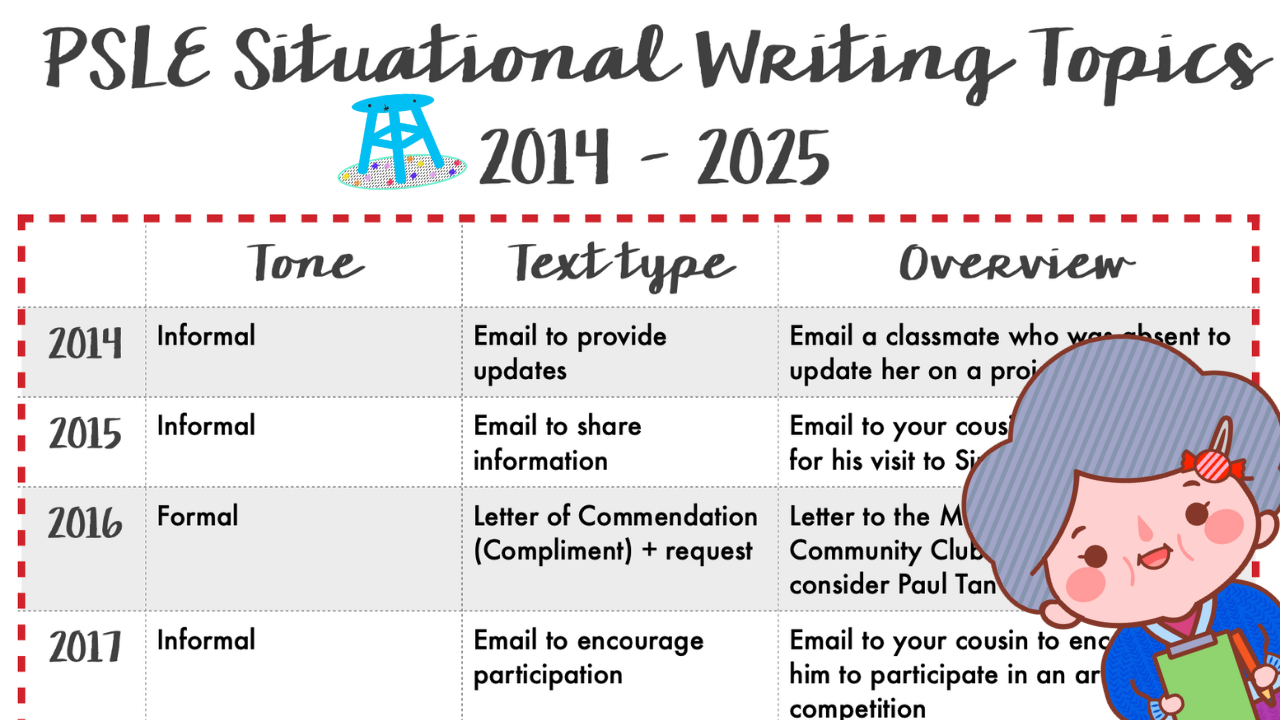
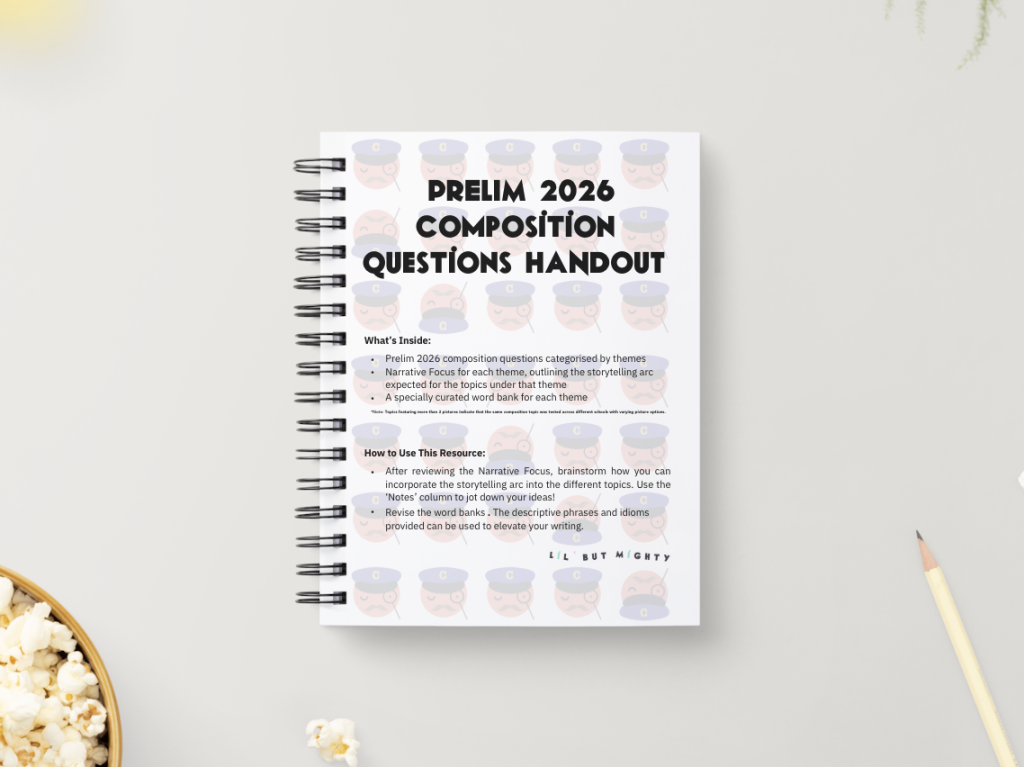
Kudos to all P6 students for the hard work you’ve done this year. We’re almost on the home stretch. Now, let’s make the last lap of your revision count! We have compiled this year’s prelim composition questions to sharpen your ability to unpack topics and the pictures provided. While no resource can predict the exact PSLE question, we hope that this handout can help build your agility to think of a suitable plot when faced with a new composition, so you are fully prepared for whatever topic appears on examination day.
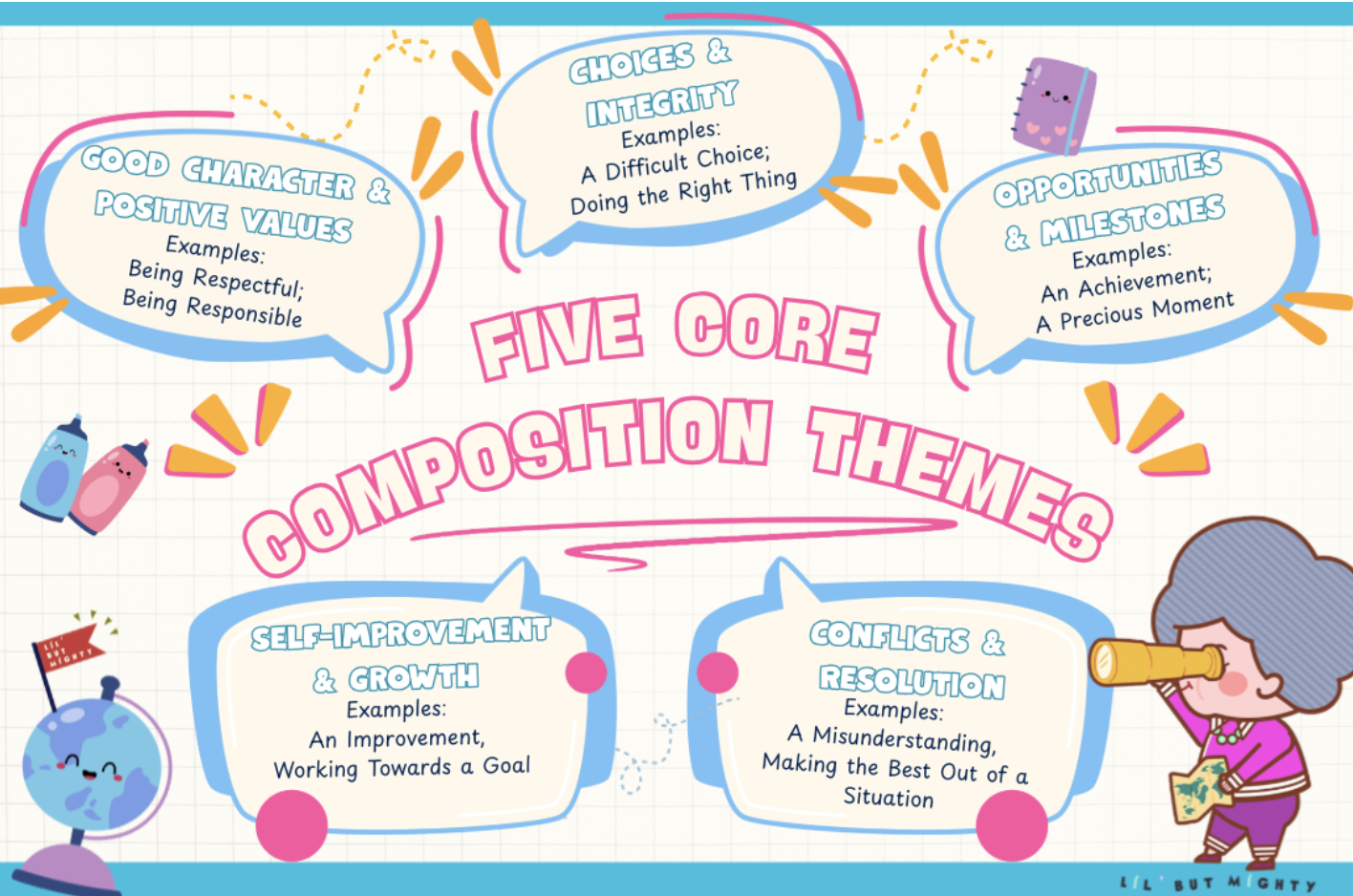
After analysing this year’s prelim topics, we recognised that the topics can be organised according to 5 broad themes: Good Character & Positive Values, Choices & Integrity, Opportunities & Milestones, Conflicts and Resolution and Self-improvement & Growth.
In the handout, it is common to see similar topics or identical pictures. However, a single story plot will rarely fit every topic!
Before planning, ask yourself: “What must my story demonstrate to address this specific topic?” Even when two topics share the same central event, subtle differences in wording require you to focus on different details. For instance, a topic like ‘A Difficult Choice’ demands a plot centred around a dilemma, whereas ‘Making a Choice’ simply focuses on the decision-making process.
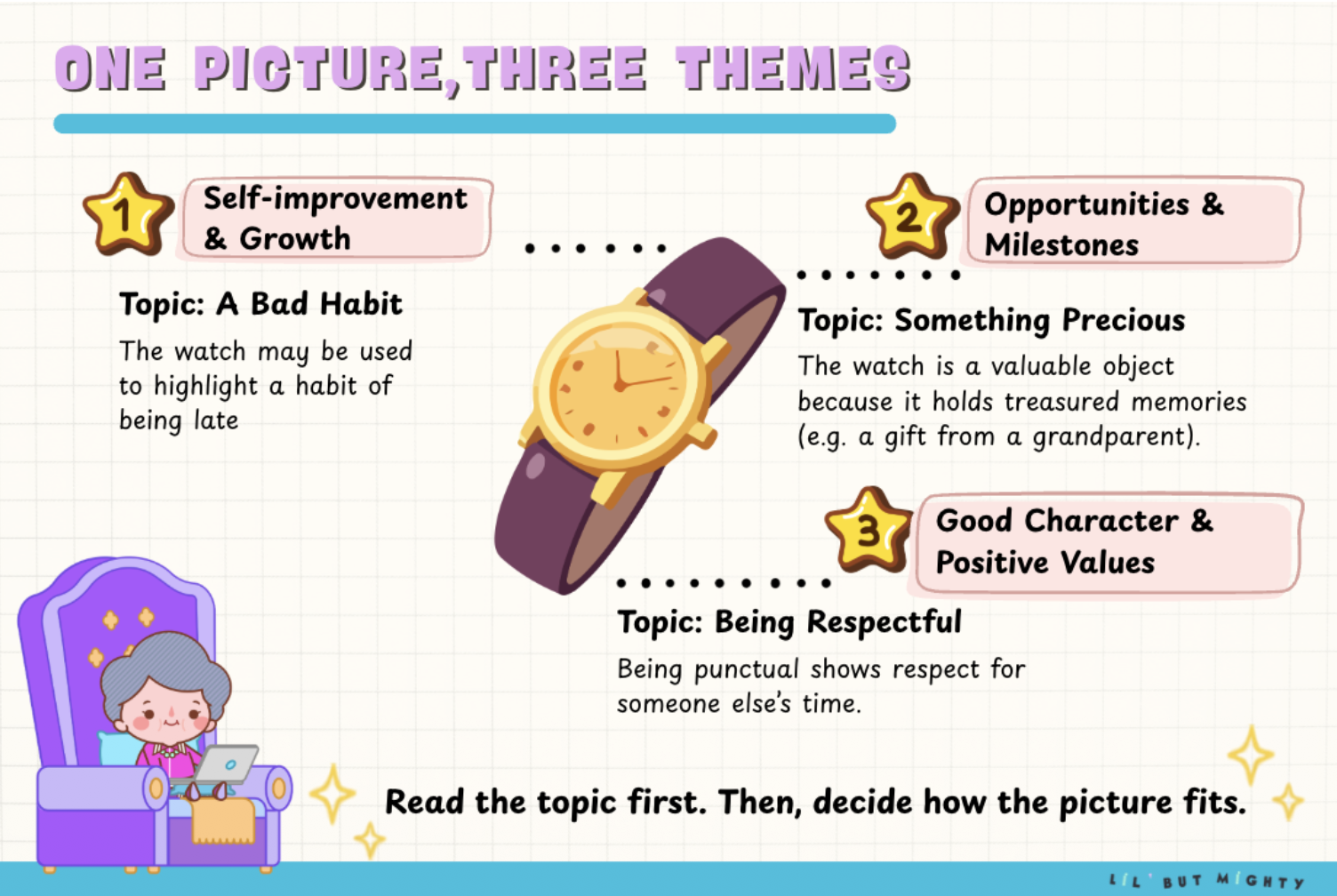
Similarly, when a picture is reused across different topics, you must tailor how you integrate it into your story. Consider the humble watch: it is featured across three distinct themes this year! Depending on the theme and topic, the same picture may require a completely different interpretation.
A Trend Spotted: Positive Topics
Looking at the questions tested across various school prelim papers, one thing stands out: an increasing number of schools are testing positive topics. Some topics require the character to show a positive quality (e.g. Being Considerate) or to have undergone a meaningful experience (e.g. A Special Memory). This aligns directly with recent PSLE trends. such as the 2025 PSLE Paper 1 topic “Being Thankful”.
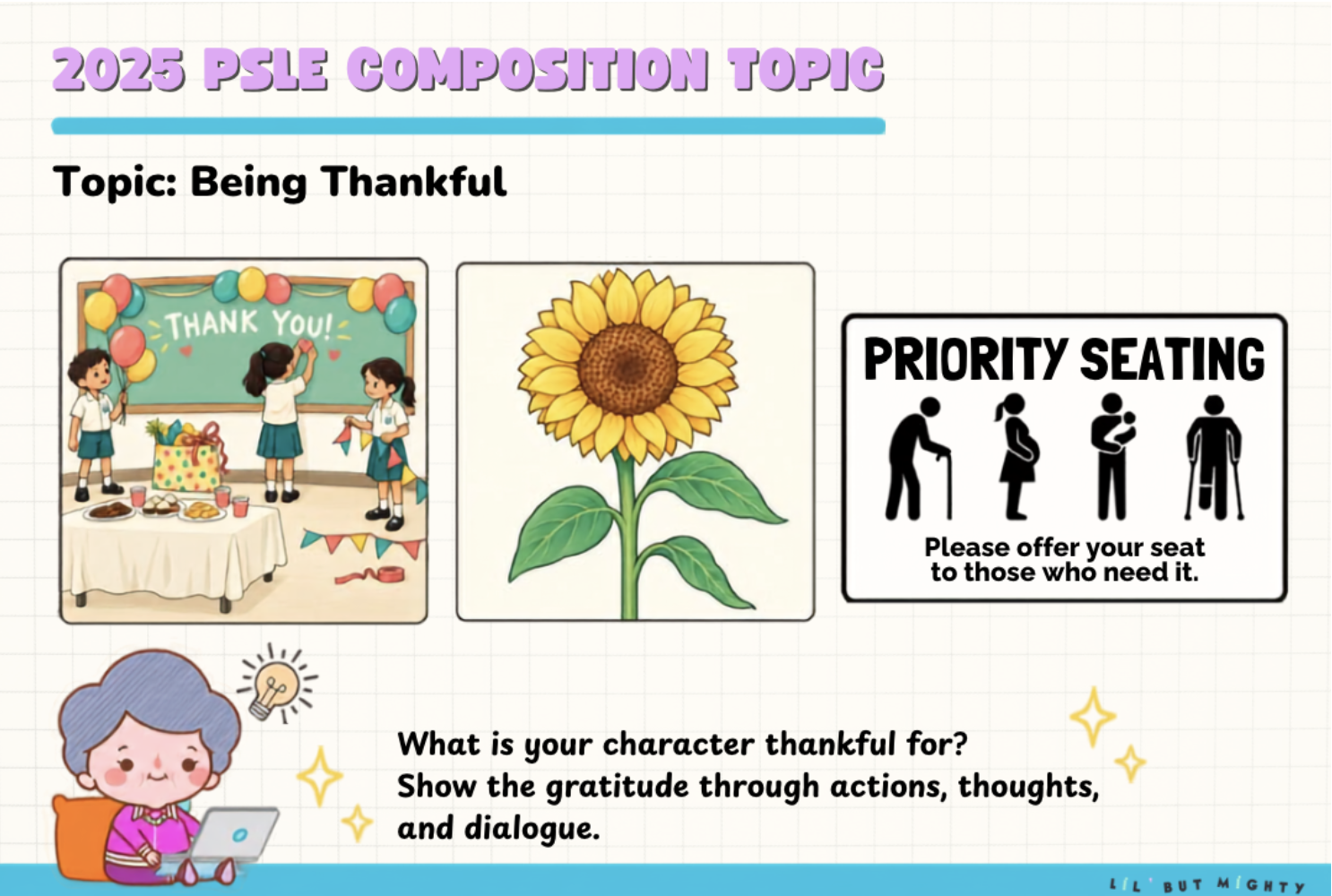
The Big Question: How to Tackle Positive Topics Well?
One of the common questions parents and students ask us is:
“How do I write a full, engaging story when nothing ‘bad’ or dramatic happens?”
The short answer: A positive topic still needs a problem and clear turning point.
Without a challenge, effort or realisation, everything goes smoothly and there is little for your character(s) to do in the story. This in turn makes the story flat instead of engaging.
At the same time, this doesn’t mean that your story requires a massive crisis in order to be exciting. To effortlessly build narrative tension when writing stories about positive topics, use ACT:
- A – Awareness Gap (The Blind Spot): Positive stories rarely start positive. Instead, they start with a blind spot. Have your character overlook or take something for granted, such as a parent’s sacrifice, a cleaner’s hard work or the amount of time left to complete a task. This will set your story up for the demonstration of the positive value or action later.
- C – Conflict (The Internal Struggle): Don’t rely on just the physical problem. Use your problem as a trigger to spark a choice. True conflict is the tug-of-war between doing what is easy (e.g. saving face, avoiding effort, giving in to temptation) and doing what is right.
- T – Turnaround (The “Proof” Action): This is typically in the climax or falling action where your character steps up. What specific action does the character take to turn the situation around or do what is right, and in doing so, proves the positive topic? Whether it’s returning to clean a mess they have created or sprinting to submit a form before its deadline, this decisive moment is where your story truly shines and proves the topic.
Deep Dive: 3 Positive Topics Featured in Prelims 2026
If your revision has focused solely on conflicts and resolutions, it is time to broaden your scope.
Most students are used to using the story curve to quickly plan their stories prior to writing. This is good practice and we encourage students to continue doing so. Remember that even if the topic is positive, you don’t need a new story structure. You just need a way to build tension within your existing plot. That is where ACT comes in. It is a targeted framework to help students build organic tension and deliver a meaningful climax for positive prompts.
To help you see how the ACT framework works in practice, let’s unpack 3 specific positive topics from this year’s school prelim examinations.
Positive Topic 1: Being Respectful
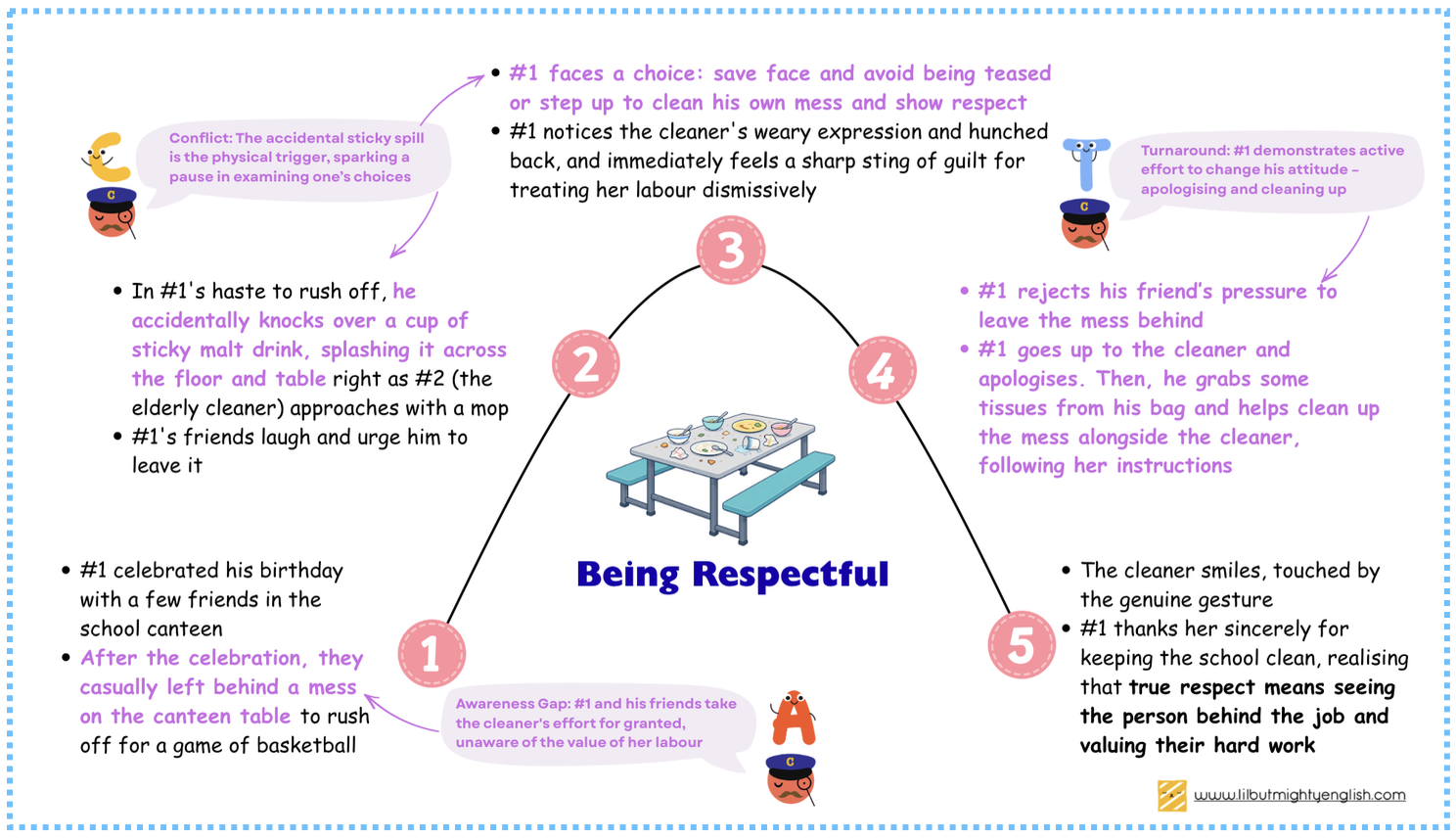
To tackle the topic ‘Being Respectful’, your story must show a deliberate shift in how your character values another person and their effort. Rather than writing a simple story about being kind or responsible, use the ACT framework to create character growth, moving from thoughtless disregard to showing respect through action.
Here is how you can layer ACT directly onto a standard story curve:
Common Pitfalls to Avoid for “Being Respectful”
– Showing kindness without making the respect clear. An act of kindness is not the same as showing someone respect. Helping someone can show kindness; to make the respect explicit, show your character listening to that person, speaking politely or thanking them for their effort.
– Setting up too much disrespect. Leave enough room for a meaningful and respectful response to the situation. Spending a large part of your story on developing rude or entitled behaviour only to wrap it up with a rushed, two-line apology at the end weakens your narrative arc. Keep the initial thoughtlessness brief so the character’s growth feels earned!
Positive Topic #2: A Precious Moment
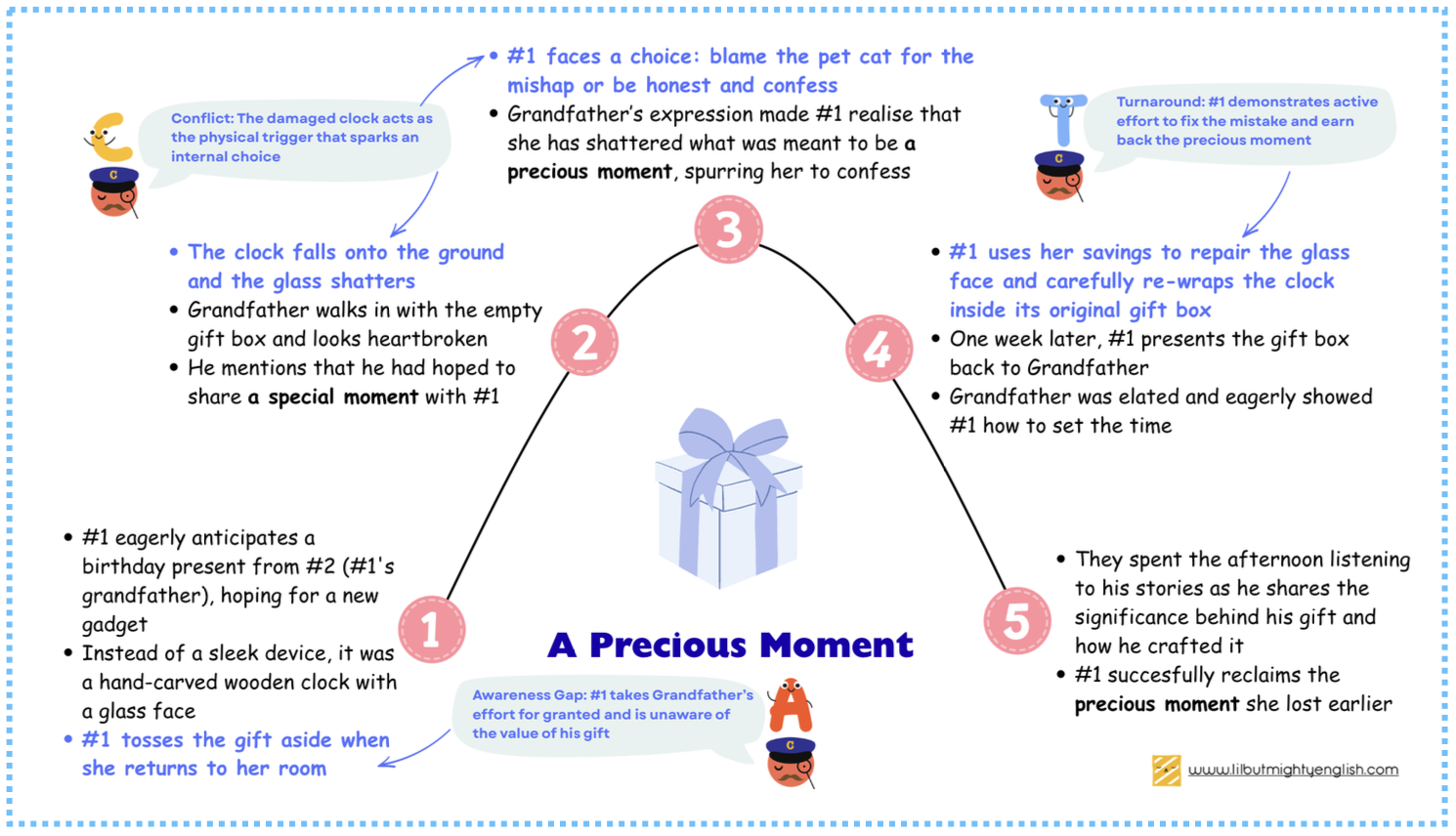
To tackle the topic ‘A Precious Moment’, your story must show why a specific moment becomes personally meaningful. Instead of just describing a heartwarming scene at the end, use the ACT framework to build character growth throughout the plot.
Here is how you can layer ACT directly onto a standard story curve:
Common Pitfalls to Avoid for “A Precious Moment”:
– Confusing monetary value with emotional value. “Precious” does not mean expensive. Focus on the character’s relationship, regret, and personal connection, and not the price tag of the gift.
– Over-focusing on the mishap. Avoid going into excessive detail about the physical accident or problem. If you spend three paragraphs describing falling glass and loud crashes without explaining what was precious, you lose the topic. Keep the mishap brief and spend more time describing the emotional connection and shared warmth that made the moment truly precious!
– Saving the topic for the very end. Even though the main “precious moment” is fully realised only in the resolution, you should plant seeds of this topic as early as possible. This may be done through dialogue, foreshadowing or retrospective narration (e.g. “Looking back, I didn’t realise that opening that gift was supposed to be a precious moment.”).
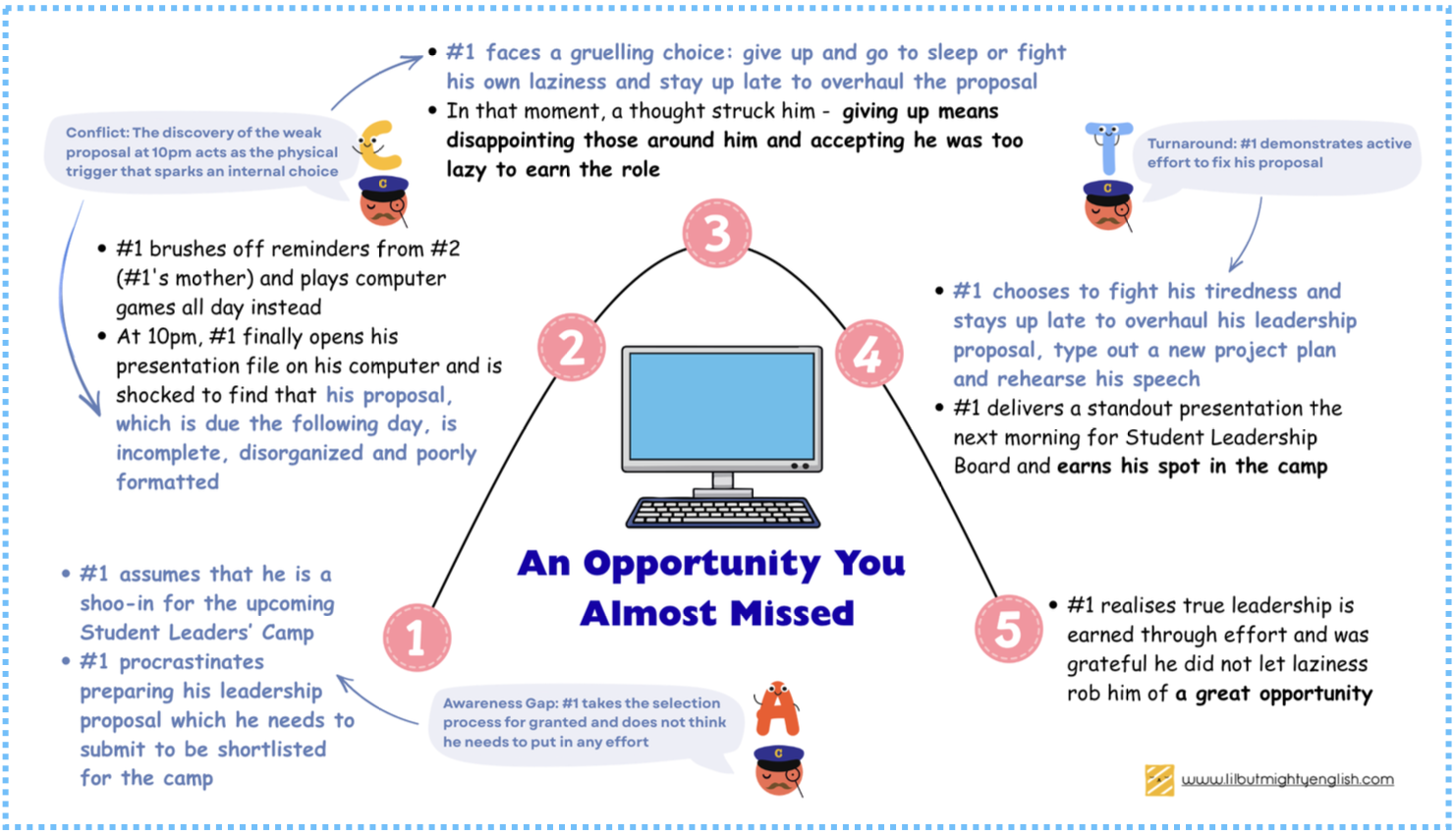
Positive Topic #3: An Opportunity You Almost Missed
To tackle the topic ‘An Opportunity You Almost Missed’, your story would need more than just a last-minute rush. You must establish why the character was about to miss the opportunity and show the exact moment they choose to turn it around. Using the ACT framework ensures that “almost missing” the opportunity drives genuine character growth rather than just frantic plot movement.
Here is how you can layer ACT directly onto a standard story curve:
Common Pitfalls to Avoid for “An Opportunity You Almost Missed”:
– Misinterpreting the topic and writing about an opportunity that is completely missed. If your character loses the chance completely and ends the story in regret, it fails to fulfil the keyword in the topic: “almost”. Ensure the opportunity is salvaged in the end!
– Making the “opportunity you almost missed” purely accidental. If your character almost misses the opportunity because the computer broke down or they missed their alarm, there is little room for personal development. A more compelling story would link the reason to a personal character flaw (e.g. fear of failure, procrastination) as turning it around demonstrates greater character growth and maturity.
– Resolving the conflict without true urgency or high stakes. The tension in an “almost missed opportunity” story relies heavily on urgency or limited resources. If your character has hours to spare or endless safety nets, the story loses the narrative tension. The character must stand right on the edge of a serious loss so that their decision to step up feels convincing and earned.
– Glossing over the turnaround or letting eventual success take over. A long account of securing the opportunity with only a thin focus on the near-miss or what was actually done to fix it gives the core theme too little attention. Equal weight must be given to the internal turning point and the concrete effort spent salvaging the opportunity, rather than just the final reward.
Writing a standout PSLE composition isn’t about memorising complex storylines or inserting fancy phrases into every sentence. It comes down to one thing: character growth. Your story must show how the main character overcomes a personal flaw or oversight and actively takes ownership of their actions.
With that, I’ll conclude my sharing for today. I hope you’ve all learnt something new! Here are the main key takeaways to remember before you put pen to paper:
- Break down the topic carefully: Address the composition topic effectively. If the topic is a positive one and you are stuck, use the ACT Framework in your planning to ensure your story has genuine narrative tension.
- Feature the pictures: Although we focused heavily on story structures and character arcs in this post, always remember that it is of utmost importance to clearly feature at least one of the given pictures in your composition on top of addressing the topic.
- Keep the balance right: Limit background setup so that you can pace your writing effectively. Dedicate the bulk of your word count to the internal decision, the turning point, and the active effort.
We’re just days away from the examination. It’s time to let your preparation shine! Trust in the skills you have built. Stay calm, give each question your best effort and believe in yourself. You’ve prepared for this, so go into each paper with confidence. Wishing you all the best!