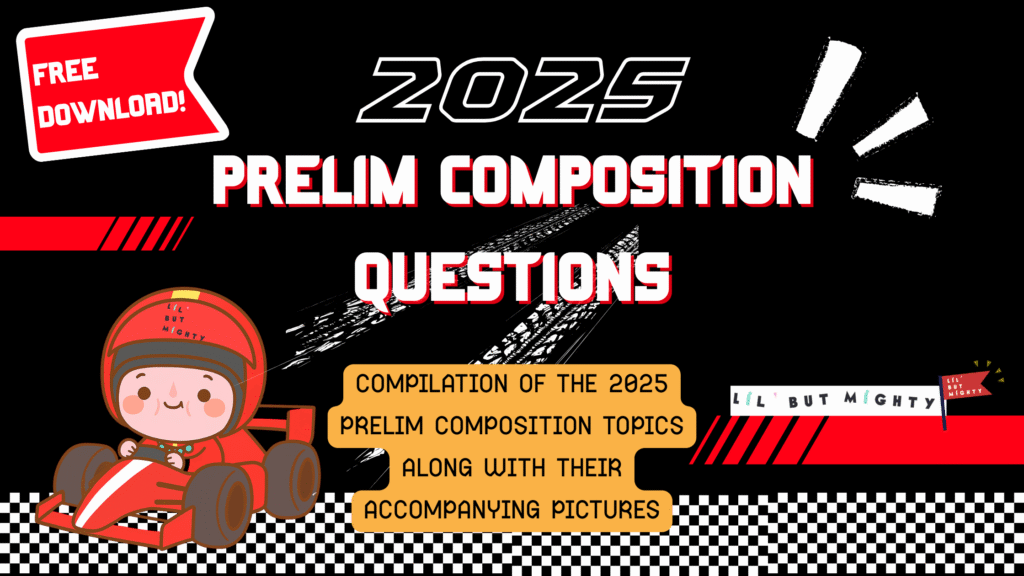
Hello, everyone! I’m Ms Genevieve — you might remember me from some of my earlier blog posts. How time flies! As we approach the final stretch before PSLE 2025, I hope your revision is progressing well. To support your preparation for Paper 1, I’ve put together a compilation of 2025 Prelim Composition Topics along with their accompanying pictures. This list is based on what our students from various primary schools across Singapore have shared.
Compilation of 2025 Prelim Composition Topics:
In addition to the compilation, I’ll be sharing key insights and trends I’ve picked up from this year’s composition questions. I’ve also added some practical tips to help you tackle this section of the English paper with greater confidence and success. Ready? Let’s dive into the 3 important takeaways together!
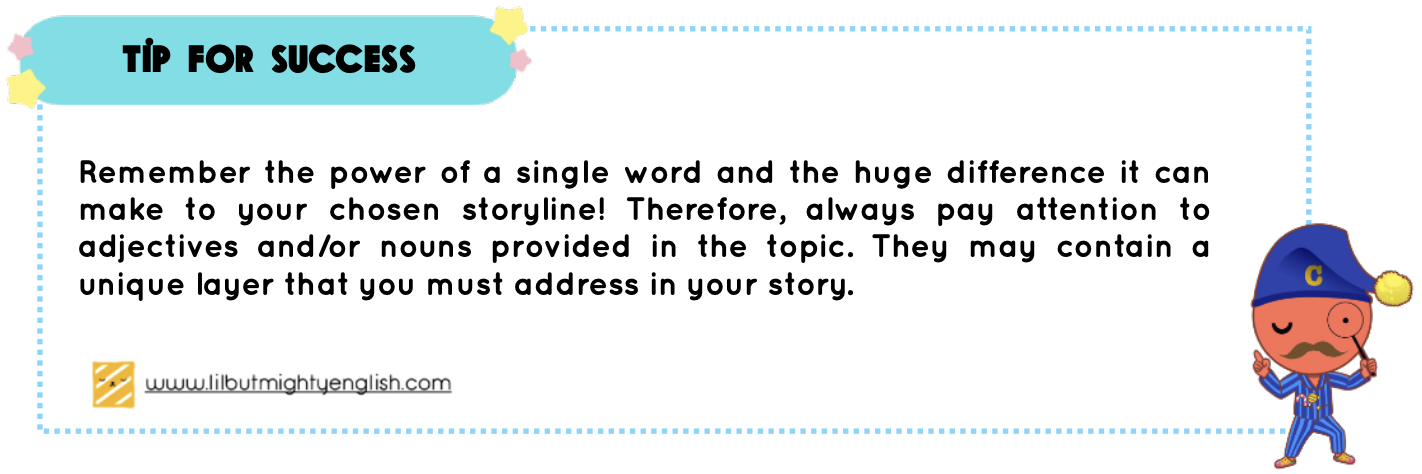
1. Understand the Nuances of Similar-Looking Topics
Across the various questions tested in different schools, I’ve noticed numerous topics that appear nearly identical but require distinct narrative approaches. This is evident by the differences in adjectives or nouns used. Let’s look at an example:
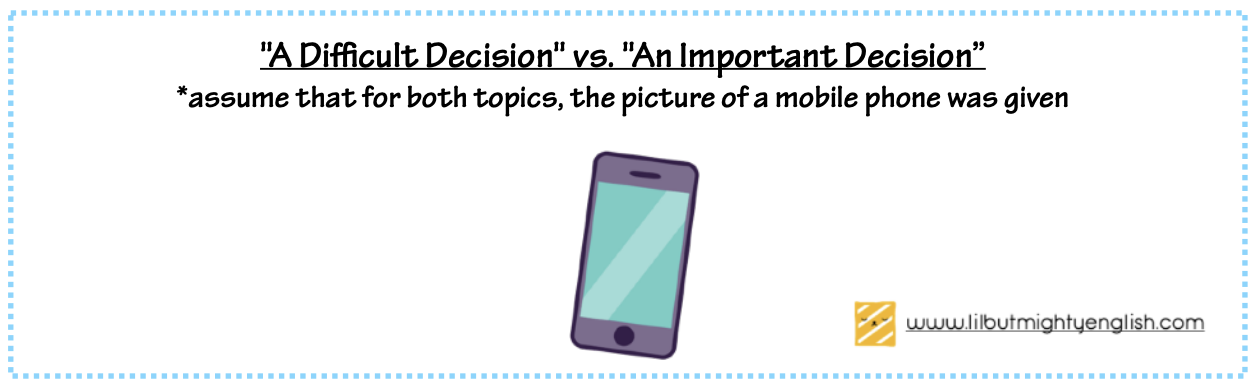
While both topics centre on decision-making, the emphasis differs significantly.
“A Difficult Decision” focuses on the internal struggle and emotional challenge of choosing between two equally good or equally bad options. As such, you will need to include a well-elaborated dilemma in your story to show how difficult it was for the main character to make the final decision. The story should highlight the character’s uncertainty, conflicting feelings and the mental effort required to arrive at a decision.
On the other hand, “An Important Decision” emphasises the weight and consequences of the choice the character makes. Although it may still show the internal struggle and emotional challenge, the narrative should focus on demonstrating why this particular decision matters significantly and how it impacts the situation, character’s life or others around them.
Let’s take a look at a sample storyline for “A Difficult Decision”:
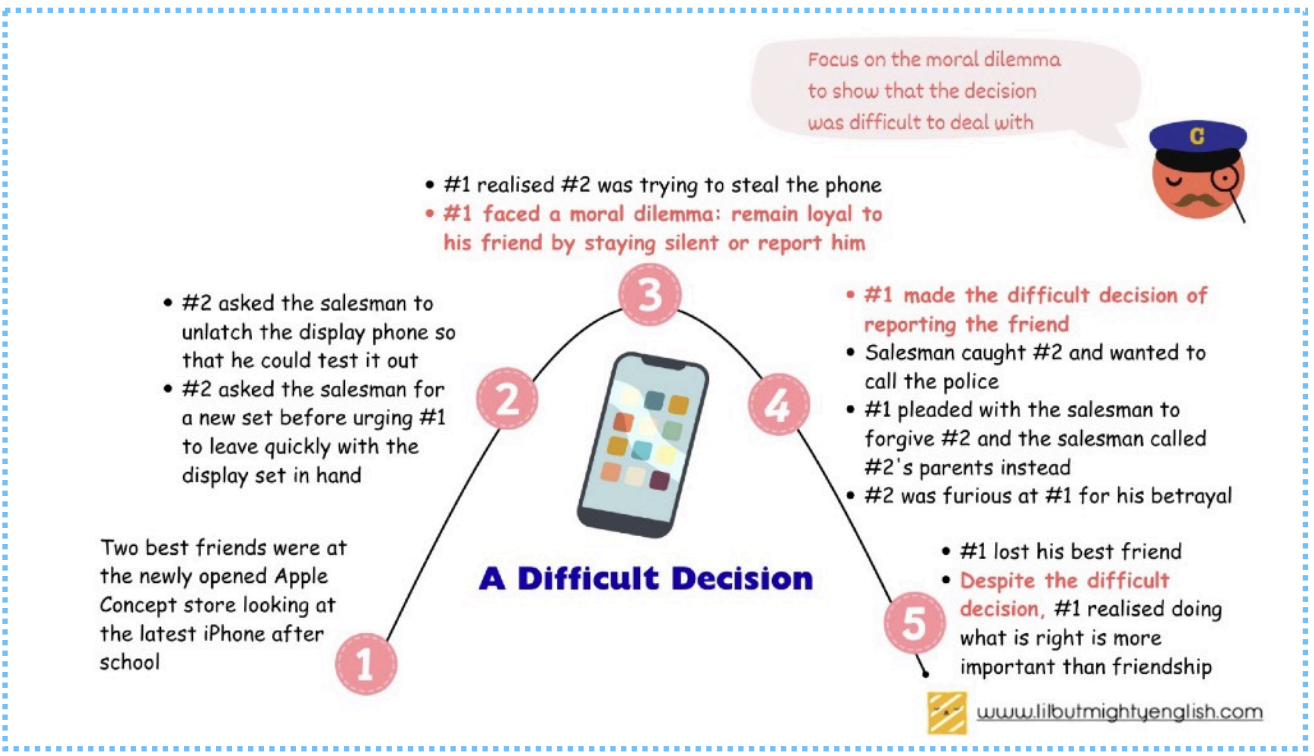
In the sample storyline, we can clearly see the main character’s internal turmoil when confronted with choosing between friendship or honesty.
Can the same storyline be used for “An Important Decision”? While it is possible, using this exact storyline might not fully convey the significance of the decision, as it currently focuses more on internal conflict. To address the topic of “An Important Decision”, be sure to place more emphasis on the weight of the choice and the consequences.
Let’s take a look at a different sample storyline for “An Important Decision”:
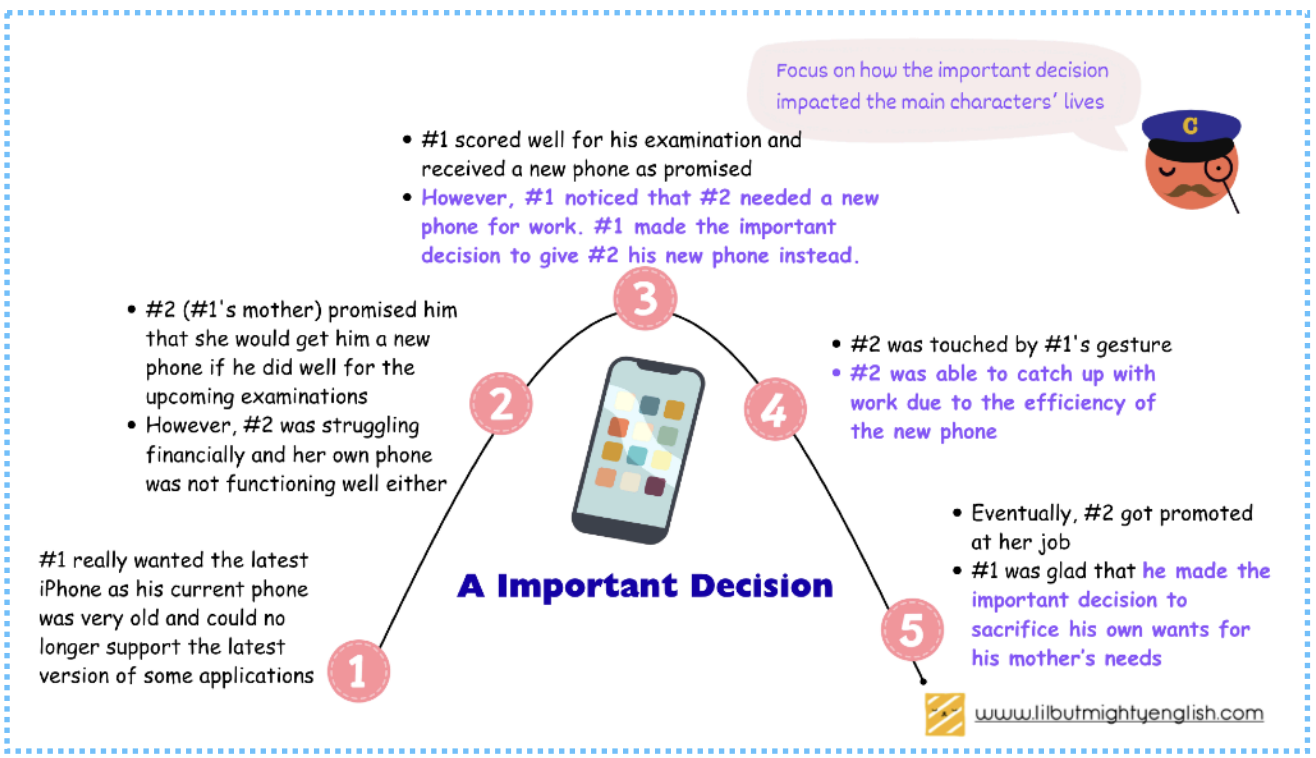
The storyline above works better for the topic “An Important Decision” as it emphasises the significance of the main character’s decision to sacrifice his new phone and the impact of the choice.
2. Integrate Pictures Effectively
Unlike what we’ve seen in previous years, where pictures often depicted isolated objects, the 2025 Prelim Composition questions included pictures that featured a more detailed situation or scene. These pictures can be used as powerful tools to help you develop a stronger and richer plot.
For example, the topic “A Misunderstanding” was accompanied by the following pictures:
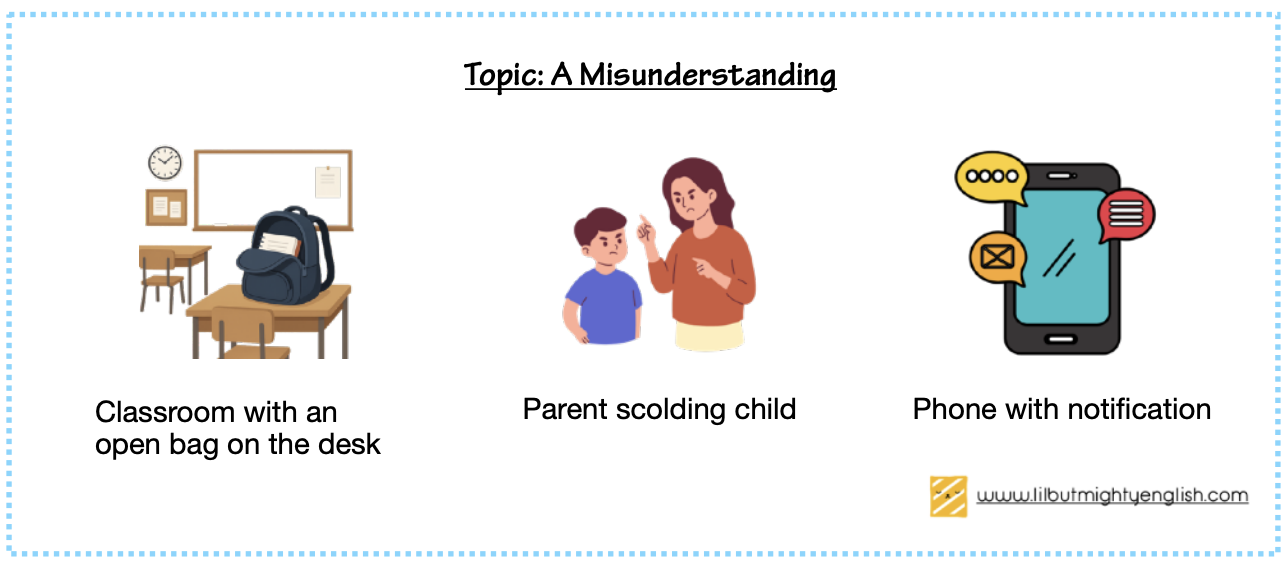
At Lil’ but Mighty, we often tell our students that they need to ensure that the chosen picture plays a meaningful role in their story. Rather than merely mentioning it, the picture should be used to drive the narrative forward.
Here are some ways to use the given picture(s) meaningfully for the topic “A Misunderstanding”.
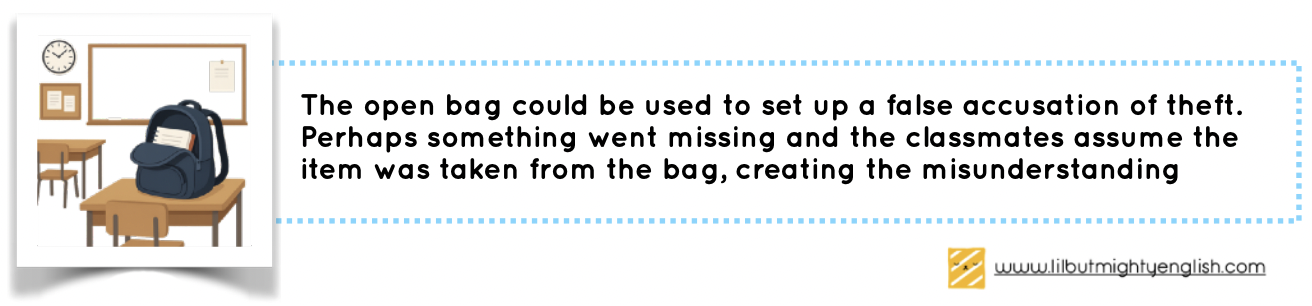
• Use Setting pictures to introduce the problem (classrooms, kitchens, parks, community centres), establish story location and atmosphere. These can often be used to set up the initial problem or conflict situation. For example,
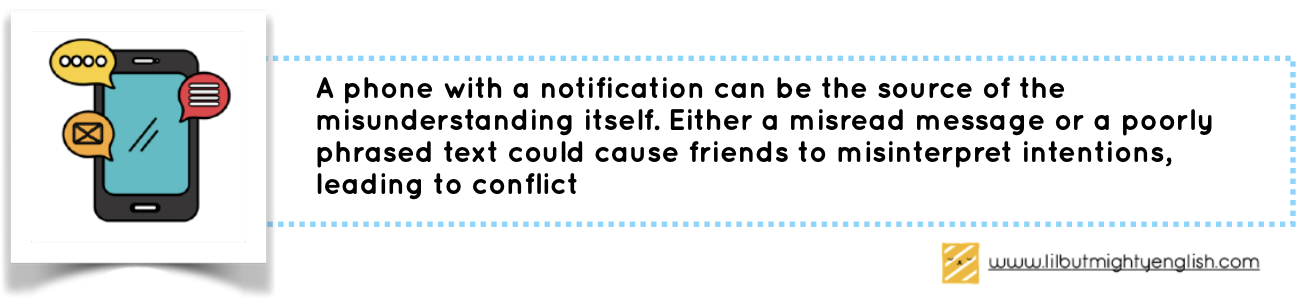
• Use Object pictures as plot devices (mobile phones, clocks, medals) that can help to push the main story idea forward. For instance,
• Use Action pictures to demonstrate the topic and character development (scolding scenes, people having an argument, someone helping another, celebrations). These pictures often include specific actions by key characters that can be fleshed out during the climax or resolution scenes. For a topic like “A Misunderstanding”,
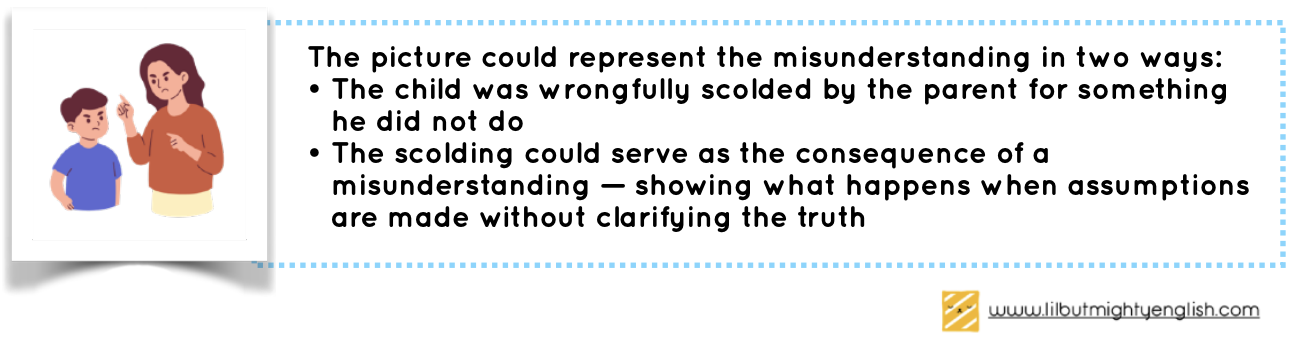
In each of the examples above, we can see that the pictures are used meaningfully in that they play an important role in shaping each storyline. Without the picture, the story would either fall apart or lose its focus.
3. Build Versatile Story Banks for Common Themes
Now that we’ve seen how pictures can support your storytelling, let’s explore how understanding common themes can further boost your preparation.
While you should never attempt to “spot” exact topics that might appear for PSLE, it is useful to recognise recurring themes that have surfaced in this year’s prelim questions. This awareness can help you with your exam preparedness. One effective method is to build story banks. Story banks are essentially flexible story frameworks that can be applied to different themes. This allows you to have polished plots and accompanying sets of rich vocabulary ready to be adapted to a variety of topics.
Here are 4 main themes that I have observed based on the composition topics we have collected from our students:
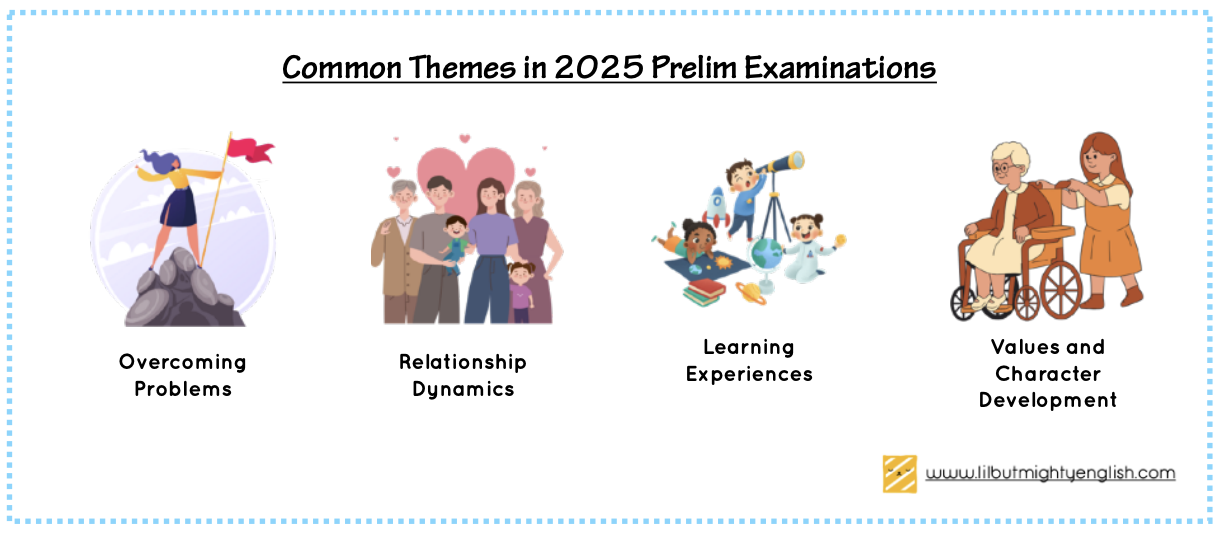
1) Overcoming Problems
Topics that fall under this theme consistently revolve around a character facing a significant challenge and developing as a person by overcoming it.
The storyline for such topics should trace the journey of struggle, overcoming the odds to achieve a specific goal or finding solutions, which lead to character development.
Examples of Composition Topics: “Solving a Problem”, “A Plan that Backfired”, “Learning from a Mistake” and “A Time When You Did Not Give Up”
2) Relationship Dynamics
The theme of relationship dynamics focuses on how characters connect, manage conflicts and support one another. It could involve making a new friend, solving problems between people, or helping someone in need of assistance or support.
The storyline required for such topics often explores conflict, reconciliation, and the formation or strengthening of bonds.
Examples of Composition Topics: “An Unexpected Friendship”, “A Second Chance”, “A Meaningful Encounter” and “Making Things Right”
3) Learning Experiences
When it comes to topics related to learning experiences, the emphasis should be on the character’s journey of growth. This may involve them picking up a new skill or learning a new lesson.
For such stories, the character is typically required to step out of their comfort zone, face uncertainty, and grow in confidence or experience as a result.
Examples of Composition Topics: “A Rewarding Experience”, “A Project”, “Taking a Risk”, “A Time When You Did Not Give Up” and “Working towards a Goal”
4) Values and Character Development
Last but not least, the theme of values and character development focuses on how the character demonstrates or develops positive character traits and moral values such as kindness, empathy, honesty, resilience or responsibility.
The storyline you develop should highlight the actions that showcase the positive value and the emotional satisfaction that comes from performing a virtuous act or accomplishing a task.
Examples of Composition Topics: “Helping Someone in Need”, “Giving an Encouragement”, “A Race Against Time”, “A Time When You Did Not Give Up” and “Working towards a Goal”
While we can categorise composition topics under specific themes, it’s important to remember that many topics can be versatile and fall under more than one theme (e.g. “A Time When You Did Not Give Up”). As such, a single story from your story bank can often be adapted to answer a variety of composition questions.
Before I wrap up today’s “Compilation of 2025 Prelim Composition Topics” blog post, I’ll leave you with this quote that stuck with me when I was working on a challenging task.

P.S. In case you were wondering what the “challenging task” was, it was not a composition topic!
The key insight that will serve you well is taking those few precious minutes to carefully break down the composition topic and plan your story before you begin writing. Having a well-thought-out game plan is a skill that will serve you far beyond this exam.
As we approach the final stage of your Primary School journey, I want you to know that effectively addressing the composition topic and meaningfully incorporating those pictures isn’t just about technique – it’s about telling stories that matter to you, too!
Finally, I hope you carry this thought with you: you’ve worked hard, you’re well-prepared and you have everything within you to succeed. Trust in the preparation you’ve done and the growth you’ve experienced this year. I’ll be cheering for all of you every step of the way. Take care and all the best!