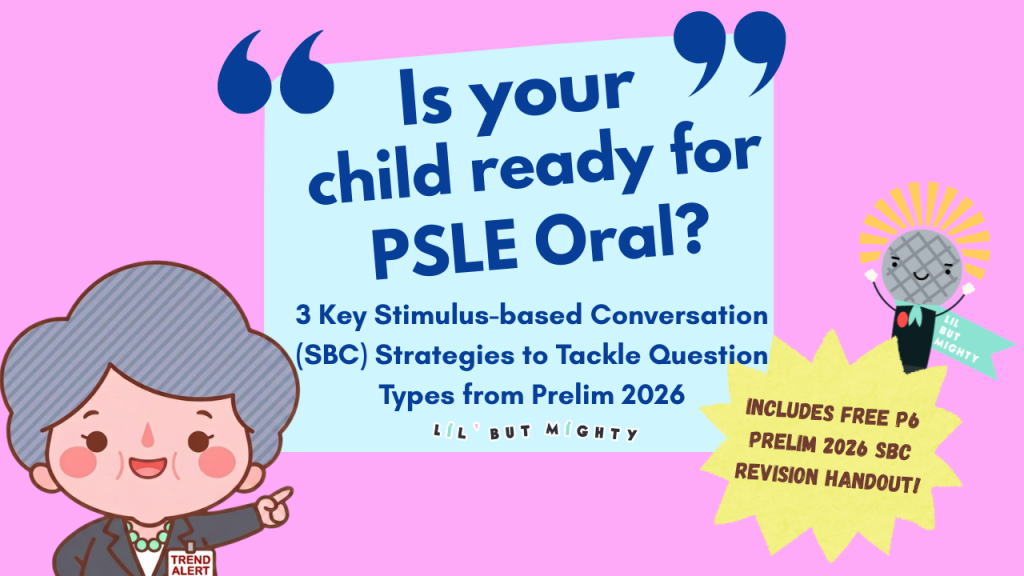
Congratulations on clearing the Preliminary Oral exams! As we head into the final stretch for the PSLE 2026 Oral Examinations, our curriculum team has compiled and analysed the Stimulus-based Conversation (SBC) questions from the recent school prelim papers to share key examination trends.
With the photograph stimulus format still being relatively new to many students, it is completely normal for candidates to find SBC a little overwhelming or unpredictable. Not to worry — to help you navigate this section with clarity and confidence, we have compiled 3 crucial takeaways for SBC. Derived from a deep dive into the Prelim 2026 oral trends and compared side-by-side against the PSLE 2025 examination, these insights will give you the strategic edge you need to tackle the examination.
🎁 Bonus: FREE Downloadable 2026 Prelim SBC Compilation
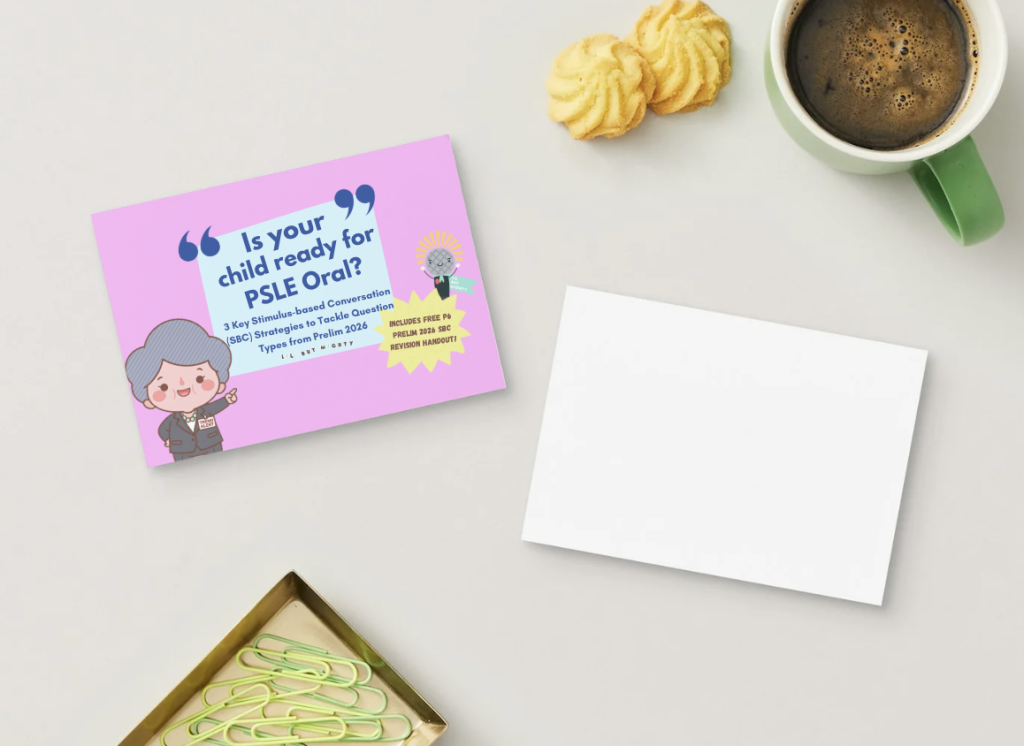
To supercharge your child’s revision, we’ve put together a FREE downloadable resource featuring curated P6 Prelim 2026 SBC questions categorised by theme!
How to use it:
- Practise Q1 with Visuals: Use the sample photograph stimuli to train active observation
- Learn to Infer: Reference the callout boxes to see how visual clues link directly to logical inferences
- Master Spontaneous Responses: Attempt Question 2 & 3 to boost vocabulary, sharpen idea generation and build natural exam confidence.
3 Crucial SBC Strategies to Help You Ace PSLE Oral
1) Adopt the perspective of an Active Judge for Question 1
In the previous year, Question 1 primarily tested a student’s ability to analyse the visual scene and infer how the people in the photograph were feeling or acting (e.g.“Look at the photograph. What do you think the people are doing?”). This year, we’ve noticed that examiners want students to step into the photo, evaluate the situation and share their personal stance.
We believe this trend gained momentum after PSLE 2025, where Question 1 on both examination days required students to evaluate choices and situations:
- PSLE 2025 Day 1: “Is this a good place to sell ice cream? Why or why not?”
- PSLE 2025 Day 2: “Why do you think people choose to eat at this hawker centre?”
What does this trend mean? Students cannot simply rely on memorising “feeling words” or basic action descriptions. They must act as an Active Judge. When taking on the role of an Active Judge in Question 1, you can use the L-A-P [Location, Action and Purpose] framework to evaluate the scene.
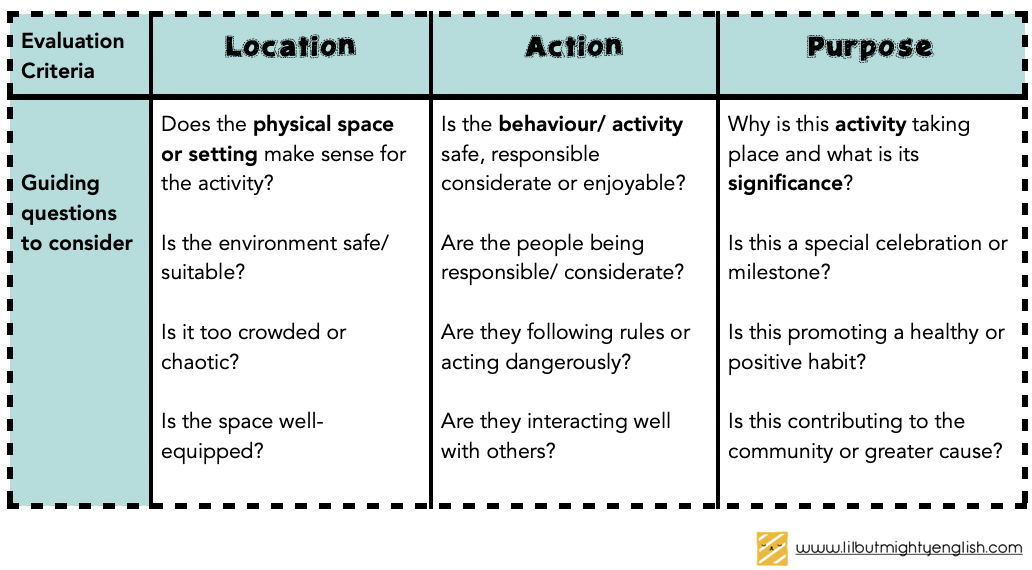
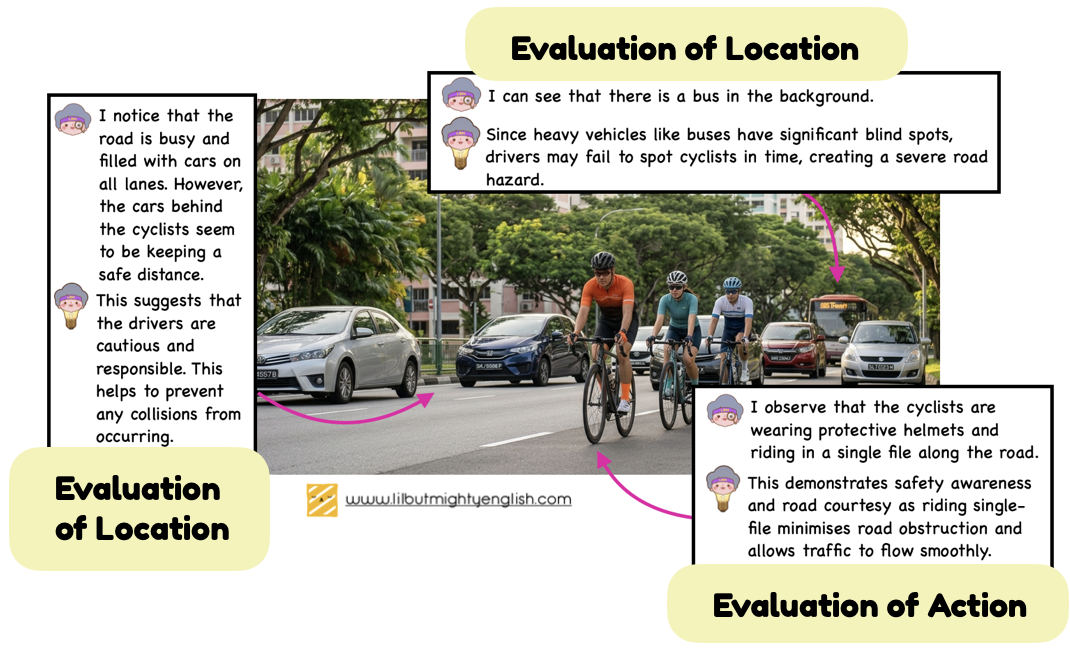
A L-A-P judgement without evidence is ineffective! Every judgement must be anchored to a specific detail in the photograph using this format:

Here is an example of how this works in practice:
2) Be prepared to take a stance for opinion-based prompts (commonly in Question 3)
While Question 1 tests how well a student evaluates the photograph through visual evidence, Questions 2 and 3 move beyond the image. Question 2 typically anchors the student in their habit, preference or experience, and Question 3 tests students’ ability to build a persuasive, well-structured argument.
For reference, in PSLE 2025, Question 3 challenged students to judge societal norms or the necessity of life skills:
- PSLE 2025 Day 1: “Do you think people in Singapore are orderly? Why or why not?”
- PSLE 2025 Day 2: “Do you think children should learn how to cook? Why or why not?”
Across Prelim 2026, we also observed that Question 3 is where students most frequently encounter questions that require taking a clear side:
(i) Position Questions: This requires students to take a position on Singaporean societal norms or real-world behaviours (e.g. public orderliness, consideration, environmental habits, digital addiction)
(ii) Necessity Questions: This requires students to argue the necessity of life skills and character values (e.g. safety, helpfulness, volunteerism, teamwork, sportsmanship)
What sets students apart for Question 3 is more than just language ability. In fact, what is valued here is argument structure. Treat Question 3 like a mini-oral essay, providing a clear stance sound reasoning and real-world examples.
Though both questions require students to take a clear side and provide sound reasoning for it, the questions do differ in what examiners are looking out for. Having the awareness of what each question demands helps you to structure a sharper argument.
| Question Type | Position Questions | Necessity Questions |
|---|---|---|
| Sample Question | Do you think people in Singapore are considerate? Why or why not? | Do you think it is important to be considerate in public places? Why or why not? |
| What are examiners testing? | Observational Reasoning & Current Reality | Deductive Reasoning about Value & Necessity |
| What should the answer include? | Concrete real-life examples, contexts and trends | Cause-and-effect chains & outcomes |
| Sample Response Structure | Stand + Societal Observation/ Personal Example | Stand +
*Impact on Self/ Family/ School/ Wider Society *Prioritise the impact you want to include in your answer based on the question/topic |
| Sample Response | Stand Yes, I think most Singaporeans are considerate in their daily lives. Societal Observation #1 For instance, whenever I take the MRT during peak hours, I frequently observe commuters giving up their seats to the elderly, pregnant women, or injured passengers without needing to be asked. Societal Observation #2 On top of that, in hawker centres, it has become a widespread habit for diners to return their food trays and clear their tables so that the next person can have a clean space to sit. Personal Example I also see this in my own neighbourhood, where residents hold lift doors for one another and keep noise levels down at night. | Stand Yes, I think it is important for everyone to be considerate in public spaces. Impact on Self Being considerate to others provides a positive atmosphere for all. On a personal level, when I show consideration to others, such as holding the door, making way for them or lowering my volume, I feel that I am contributing to creating a caring society. This is because even small acts of consideration can brighten people's day and make routine daily interactions much more pleasant. Impact on Wider Society On a broader level, widespread consideration strengthens our civic society. Since Singapore is a densely populated city-state, we live in close quarters. If everyone were self-centred, public life would become chaotic and stressful. Being mindful of others fosters mutual respect among diverse groups of people and builds a safer, kinder, and more united community. |
3) Bring personal stories into your answers
Regardless of Question 1, 2 or 3, adding personal stories is the absolute secret ingredient to scoring well! Examiners look forward to personal anecdotes because they prove the student isn’t just reciting memorised points. Instead, they are sharing authentic, lived experiences. A good story makes the student’s response more memorable and engaging.
Having said that, it is worth highlighting that a story only adds value if it directly serves as evidence to support a point or argument.
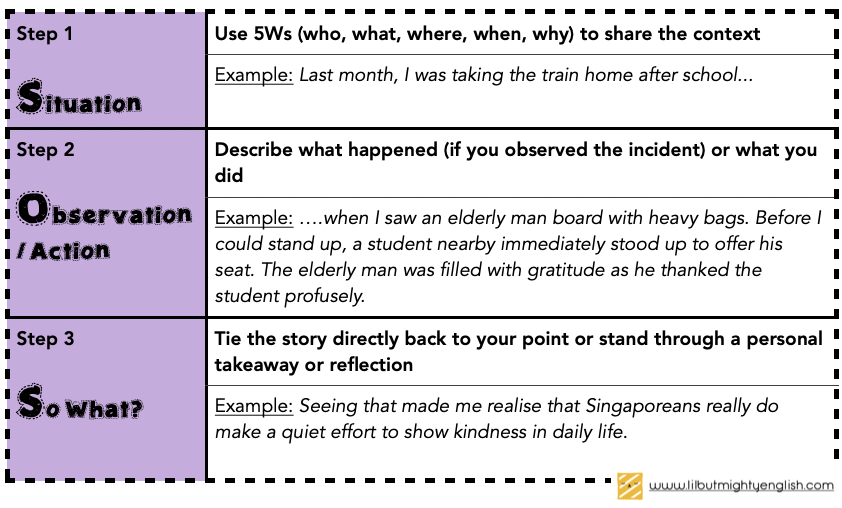
To keep stories crisp and relevant, students should follow the S-O-S structure.
With the right frameworks in place, from stepping up as an Active Judge in Question 1 to structuring sharp Position and Necessity arguments in Question 3, and weaving in personal stories to elevate your answers, the Stimulus-based Conversation no longer needs to feel unpredictable. Oral success is ultimately a matter of consistent practice, structured thinking and knowing how to communicate your ideas effectively.
Don’t forget to download our FREE 2026 Prelim SBC Compilation above to start putting these strategies into practice today! We wish all PSLE 2026 candidates the absolute best in their final stretch of preparation. You can do it!