Hello, everyone! I am Ms Su Xin, a teacher at Lil’ but Mighty (Novena). A piece of writing is never final! Do you agree with that? Revisiting our writing again to see how we can make it better will allow us to grow as writers! When we talk about making our writing better, what do we actually mean? Perhaps, we can make our writing even more interesting with vivid details. Or we can even remove details that might not be necessary or those that are repeated. Or maybe, we have more ideas we would like to put into our composition to make it fit the topic better.
Watch the video below!
In today’s video, I want to share with you how you can edit your writing effectively. Learning how to edit and revise your writing allows you to produce good writing and be more critical of what you write. Through editing your work meaningfully, you will acquire the skills to write appropriate details too!
So how can we edit our writing meaningfully? Here’s an easy acronym to help you:
ARMS
It simply stands for:
Add dialogue, image, emotions
Remove repetitive details/words/phrases
Move the story logically with minimal gaps
Substitute generic words/phrases with more vivid and precise vocabulary
Let’s take a closer look at each component of ARMS!
A: Add dialogue, image, emotions
As you read through each segment of your composition/story, identify the parts of the story where it may be lacking in details. You may add in dialogue, increase the vivid details of the scene or even write about your character’s thoughts and feelings about the situation happening in the story.
For example:
Jack and Jill were at the playground. They found a bucket of toys by the slide. They looked at each other. Then, they decided to play with the toys.
While this short paragraph here describes the main action happening, there are gaps to be filled in with more relevant details. Here’s an example:
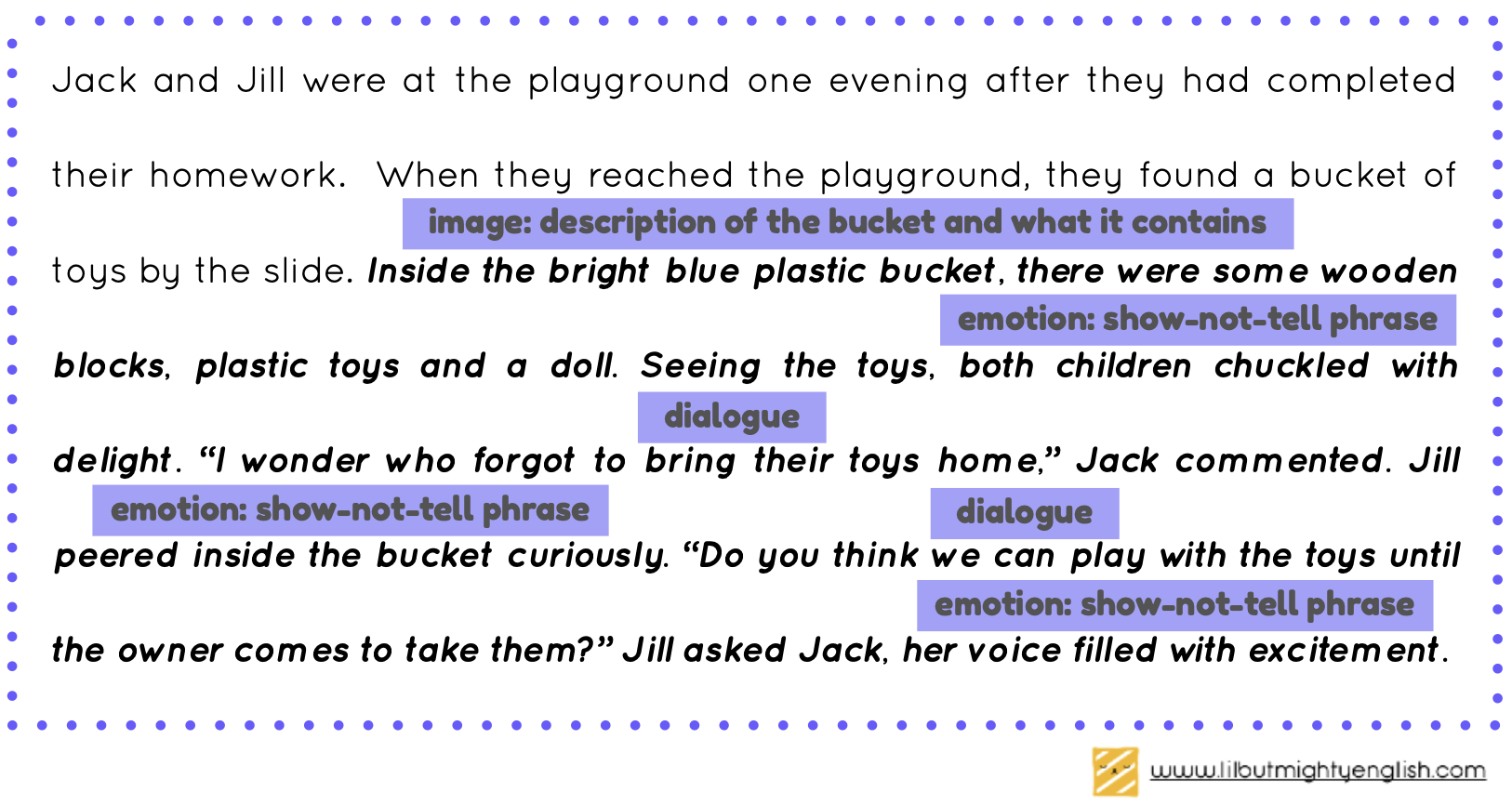
In this edited version, you can see that the image of the bucket of toys is described more vividly. There are dialogues added to show the interaction between the two characters and the emotions related to the scene are mentioned as well! Just adding a few more details using Dialogue, Image and Emotions will give you a more interesting paragraph for your readers to enjoy!
R: Remove repetitive details/words/phrases
Sometimes, we may end up repeating the same details, using the same words repeatedly or describing the same sequence in a paragraph. We should do our best to reduce all of these when editing our writing. With little variety in the words we use in our sentences, our writing can end up becoming a dull read. Some examples of repetition are shown below:
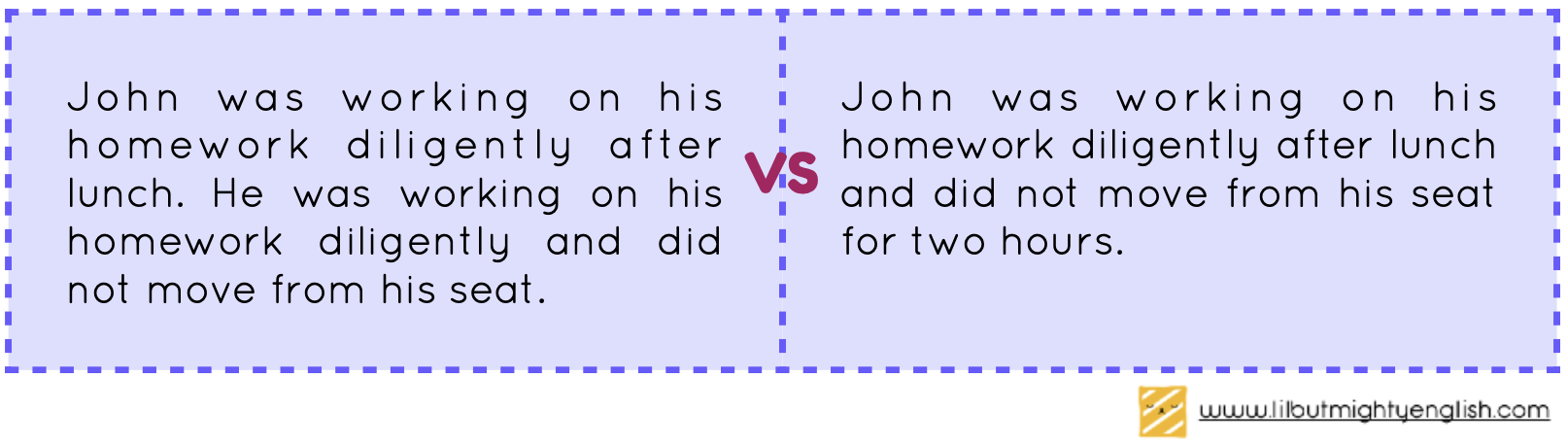
In the left column, the phrase ‘working on his homework’ and the word ‘diligently’ have been mentioned twice. To avoid repetition, the sentence should be combined together to show his diligence in completing his work, just like what is shown in the right column. (Also, this is when the Synthesis and Transformation skills come in handy!)
Next, let’s look at sentence starters in the paragraph on the left. Sometimes, we may unknowingly start consecutive sentences in the same manner and it may feel ‘monotonous’ to our readers. Take a look at these two examples:
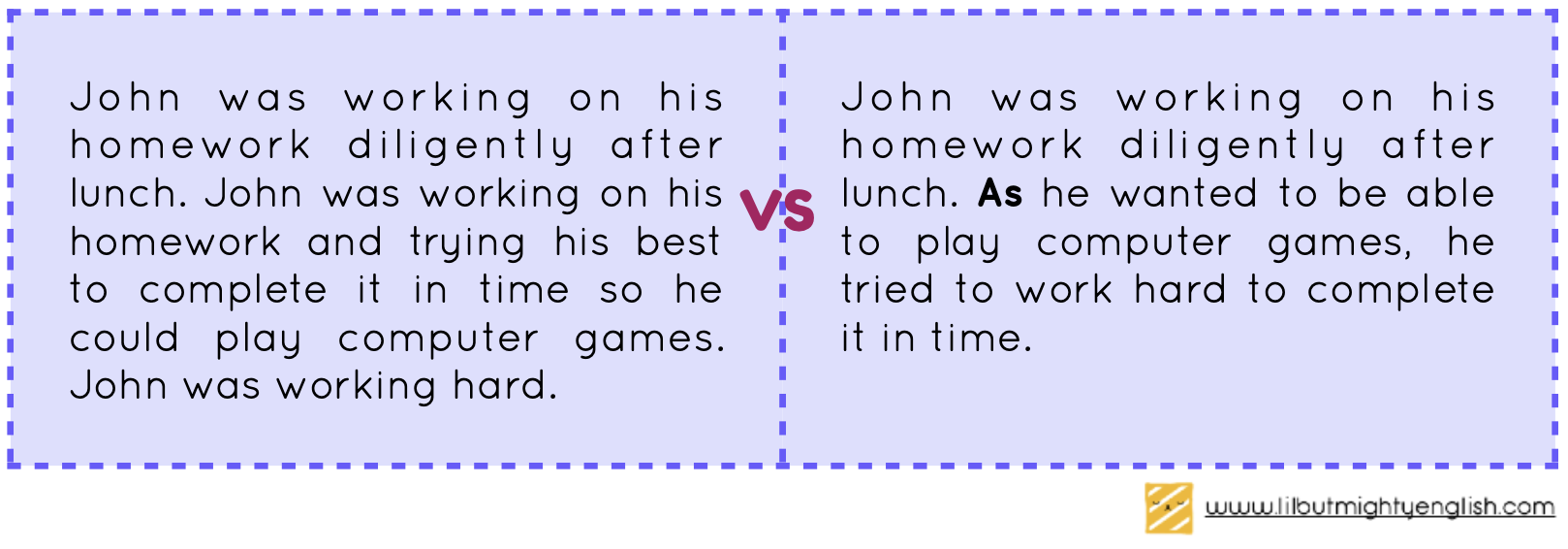
In the left column, the sentence starter ‘John was working’ is repeated 3 times in a short paragraph and this is not advisable as it does not provide variety in your sentence structures.
In the edited paragraph on the right, notice how none of the sentences started the same way and yet it conveys the same situation described on the left. The connector ‘as’ is used to replace ‘John was working’ in the second sentence. It is also not necessary to even include the last sentence because the word ‘diligently’ in the first sentence conveys the same idea as ‘working hard’. The next time you are checking through your writing, take note of how you start your sentences!
M: Move the story logically with minimal gaps
The story needs to have a smooth and logical flow so that your reader is able to follow and enjoy reading it. Sometimes, in the haste of completing a story, we may not be able to write a logical flow of sequence. As you read through your story, take note of what you are describing and see if the flow of events makes sense. Visualise the actions taking place as you read your story. Ask yourself ‘What happens next?’ and if what you have written fits what you have thought about, then your story has a logical flow. If it doesn’t, you can try re-writing the paragraph to make the events flow better. Take a look at the example below:
It was after recess. John tapped me on my shoulders and announced, “Tag, you’re it!” I turned around and was about to set after John when I heard a loud voice commanding us to stop. Our teacher marched over to us, a frown etched on her face. She started lecturing us about the consequences of playing on the stairs. My classmates and I were going up the stairs to head back to class.
Here, the scenario described showed the main character going back to class after recess and that was when his friend decided to play with him, resulting in him getting scolded. The paragraph ends with the writer telling us he was heading back to class.
A more logical flow would be for the writer to inform us he was heading back to class via the stairs and it would have made sense for the teacher to scold him because it was dangerous to play on the stairs. This should have been established first before describing what his friend was going to do to him. Let’s see how shifting the sequence of events can give this part of the story a better flow:
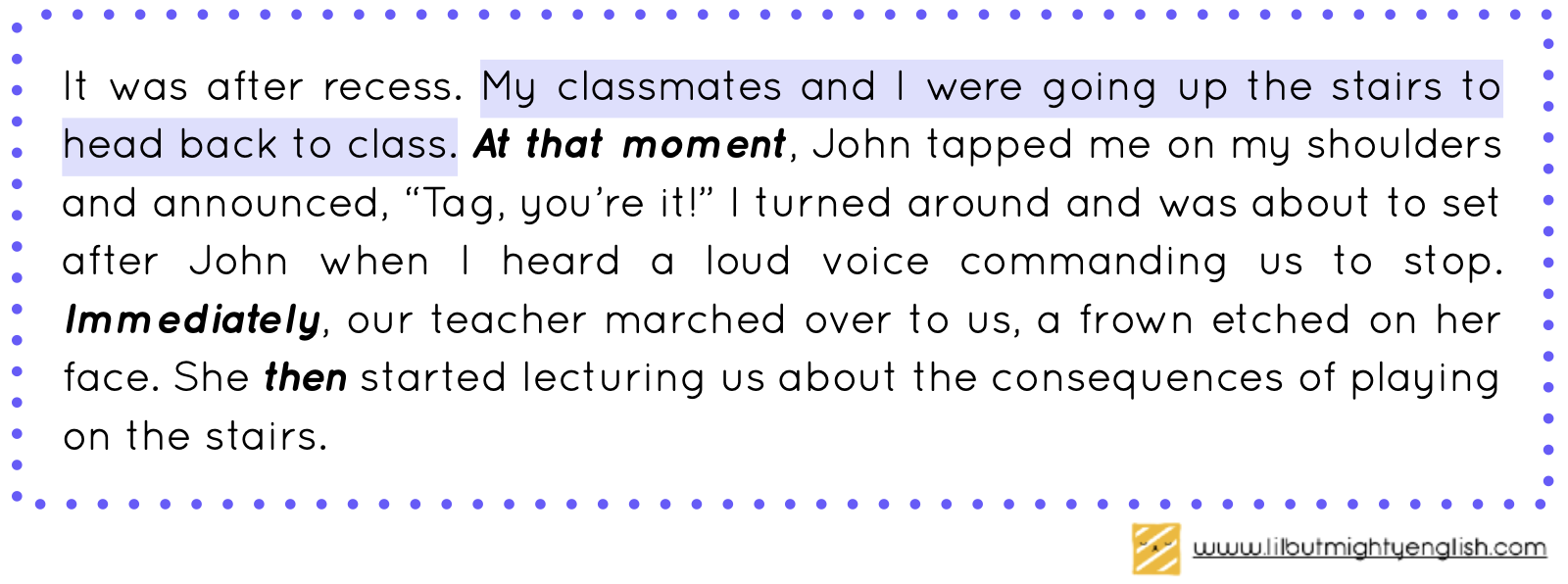
The highlighted sentence shows how shifting it earlier in the story makes it clearer to the reader by setting up the context for what was to occur next. Also, it would be useful to add adverbs and sentence starters that helps to show when an event occurs like ‘immediately’, ’then’ and ‘at that moment’.
S: Substitute generic words/phrases with more vivid and precise vocabulary
As you are reading through your writing, take note of words like said, stuff, people, things. Do you also use good, nice or bad when describing something? Try to stay away from generic words like these. Substitute these words with more specific vocabulary that fits the theme of what you are writing about. This will help you to score in your language component! And this is where all the time spent on learning vocabulary comes in! The more specific you are with your vocabulary, the more vivid your image shall be to your readers.
Below is a short and simple example to show you the difference between generic and specific vocabulary:
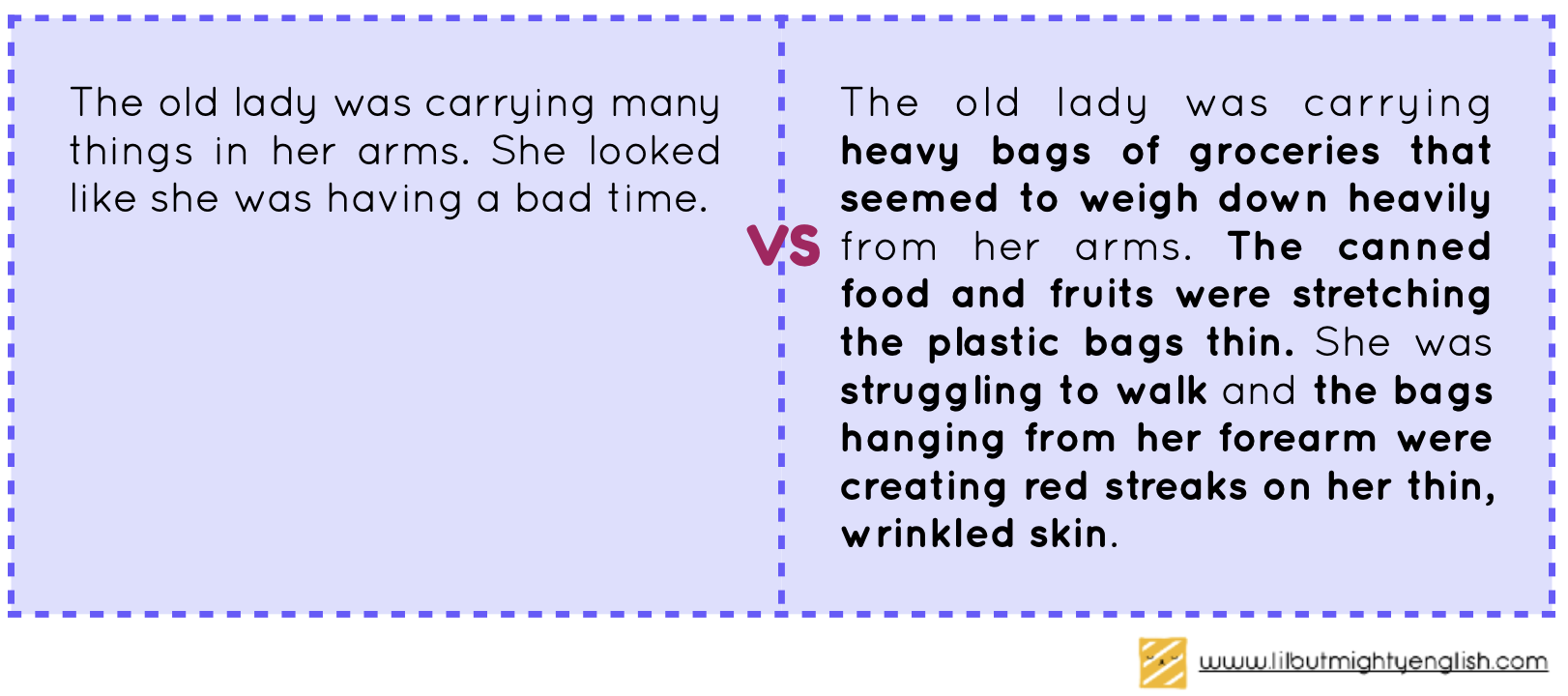
See how a more vivid image is created with the addition of some specific vocabulary appropriate for the scenario being described? Instead of just writing that the old lady was carrying ‘many things’, be more precise and describe what these things were and use show-not-tell phrases to indicate how heavy they were. Again, instead of telling the reader that the old lady ‘looked like she was having a bad time’, show how the heavy bags of groceries were affecting her physically. So, the next time you edit your work, look out for generic words and see how you can improve them.
Before I go, let’s summarise what we have learnt today. It is important to check a piece of writing we have done to see how we can improve it. To edit and revise your work effectively, try using ARMS, which means you should:
Add dialogue, image, emotions
Remove repetitive details/words/phrases
Move the story logically with minimal gaps
Substitute generic words/phrases with more vivid and precise vocabulary
Carrying out these steps will definitely help to make your writing more meaningful and vivid! For more writing and editing tips, be sure to check out other videos on our Youtube channel.
If you have enjoyed this video, don’t forget to like, share and subscribe!
You can also find our English Tuition at 1 Goldhill Plaza, #03-47, Singapore 308899