Hi, everyone! I am Ms Jenani from Lil’ but Mighty (Clementi) and today, I’m going to focus on tips and tricks to overcome writer’s block!
Imagine this: you are staring at a blank page, your brain is fried and you feel a slight throbbing pain in your head. You wish you could transfer your ideas from pen to paper but your well of inspiration is empty. Suddenly, everything else feels more interesting than the work in front of you. Your deadline is looming and you have yet to start writing a paragraph. Have you been in this situation? If you have, you might have what is known as writer’s block. So, what is writer’s block and why do some of us face it?

Writer’s block is a common challenge in creative writing that causes writers to stagnate while drafting their work. It occurs when a writer struggles to generate new ideas or to continue writing where they left off. Whether you have a composition, a report or a project you need to get started on, writer’s block affects everyone at one point or another and can greatly affect your quality of writing. In this case, in order to find a solution for writer’s block, one needs to start with the root of the problem. What is the cause of writer’s block?
Some causes of writer’s block may include:
- feeling constrained by the requirements of the topic / theme – this is often true when the topic/theme is set by someone else and not something you are passionate about, for instance a composition assignment given by your teacher.
- having a lack of motivation – this can stem from the fact that you do not find the process of writing enjoyable or because you are distracted by external sources like social media.
- being critical of one’s own ideas – often, we are our own worst critics and tend to judge the ideas that we have as being too simple or not good enough, and such feelings of self-doubt can be debilitating as it prevents us from getting started or making progress in our writing.
- having unreasonable expectations – this happens when we hold ourselves to high standards and want our writing to be as flawless as possible. When we feel that the work we produce falls short of these expectations, it may cause us to feel anxious and even lose self-confidence, making it harder to focus on developing our own writing.
- comparing your writing with the works of other writers – like the previous point, this will also affect our self-esteem as we feel that we cannot match up to them, and in turn makes us lose the motivation to start or continue writing.
Knowing the common causes of writer’s block, how do we then go about overcoming them? Let me share the following tips:
1. Set S.M.A.R.T. Writing Goals:
Have you heard of S.M.A.R.T goals? It is a goal-setting technique that can be used in various situations, and I would definitely recommend using it to set your writing goals. Below, I have provided a breakdown of how you can use S.M.A.R.T. to prevent you from getting writer’s block:
S is for Specific
Instead of saying “I want to write a composition”, try “I want to write a composition of 150 words with 3 TRPs (topic-related phrases) to link the story closely to the given topic, and 2 PRPs (picture-related phrases) for the picture to ensure it is used meaningfully.” Can you see the difference in the statements? Being specific with your goal means focusing on a particular aspect to make it clearer what you need to achieve, which makes it easier for you to take action.
M is for Measurable
To know if you are making progress in your writing, you need to make sure your goals are measurable. It could be word count, number of paragraphs, or the amount of time you dedicate to start your writing. Decide which unit of measurement you would like to use to keep track of your progress. Seeing the numbers increase can fuel your productivity! Don’t forget to celebrate each time you manage to reach an important benchmark or milestone!
A is for Achievable
We all wish we have super abilities to write super quickly within a short frame of time but we know it is not possible. Your goal should be able to challenge you, not make you break into a sweat! “Write 150 words” in a day is achievable. “Writing 5000 words in a day” is less achievable, especially if your schedule is also filled with CCA and tuition classes. Remember to also consider the resources and time needed for each goal, and you will be able to set goals that stretch you but are still realistic and achievable with the effort that you put in.
R is for Relevant
Your goal should fit into your bigger picture. You might want to ask yourself: why are you setting the goal you are setting? Other than helping you to overcome writer’s block, how is your goal relevant to what you want to achieve in the near future? For instance, perhaps part of setting the goal is because you want to ensure that you will be able to write easily and confidently, even in stressful situations such as when sitting for the English Paper 1 examination.
T is for Time-bound
Deadlines – the one thing we hate but which secretly helps us. For a goal to be successful, it needs a specific time deadline. This is so that it creates a sense of urgency to help you stay on track, knowing that you have to accomplish the goal within the time period given. It really helps to give yourself a realistic and definite timeframe: instead of saying “Someday this week I will start on my composition”, tell yourself “I’ll finish my first draft by 3 June 2025”.
2. Free Writing: Use the Pomodoro Technique [25 minutes block]
Free writing refers to a creative and powerful exercise in which you sit down and write continuously for a certain amount of time or till your desired word count. During free writing, you do not need to worry about grammar, structure or clarity. This exercise helps in two ways:
• it loosens your creative energy, and
• it keeps words flowing.
Engaging in free writing ensures that you are able to generate new ideas or breakthroughs by allowing yourself to think freely. These words can then be later restructured into a proper document. Since you are unencumbered by the need to ensure that you are using proper grammar structures, punctuation or spelling, you are able to bypass any mental blocks and focus solely on the flow of ideas and words.
Pro-tip: Use the Pomodoro Technique for an added boost: work for 25 minutes on your task and take a 5 minute break. After every 4 pomodoros, take a longer break for 15-30 minutes!
3. Develop a character:
If you are having trouble starting your story, you can start by creating your characters first! Who is in your story? Are there multiple characters? If so, what do they look like, what are their characteristics and what are some things they might do/say?
Use these questions to help you develop your characters! Let’s imagine that an old man is the main character you want to write about. Think about how he carried out the action and what details you can add to his physical description. Take a look at the example below:
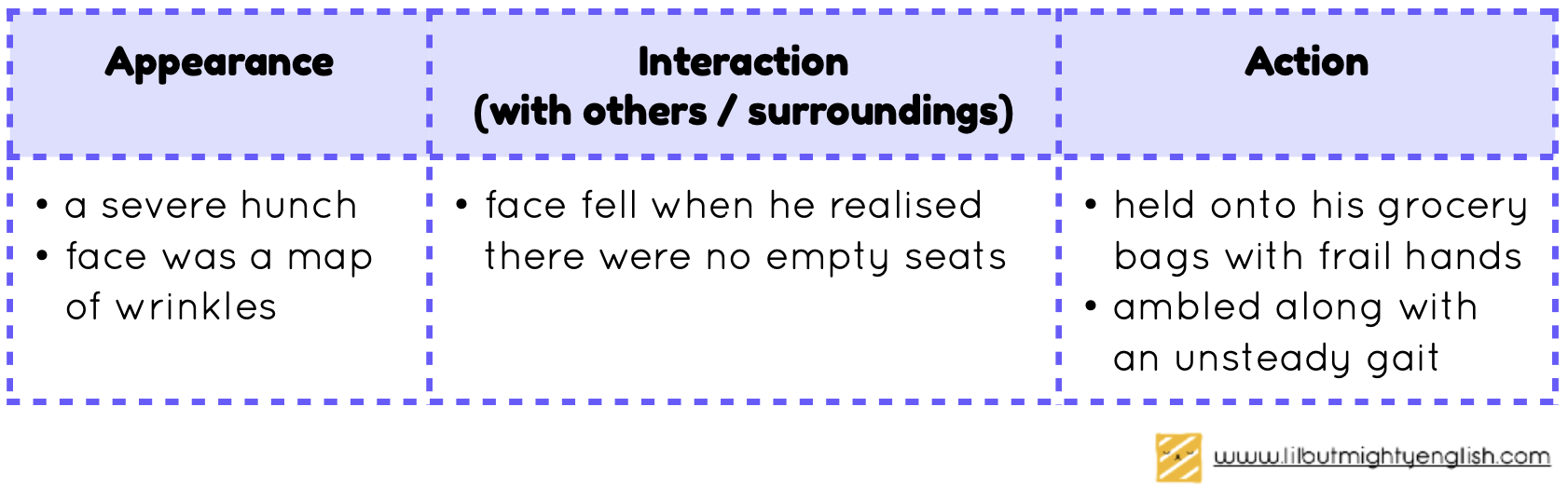
Instead of simply writing: The old man walked up the bus. He carried many grocery bags. He was upset when he realised there were no empty seats on the bus.
We can re-write the description to: The severely hunched old man, whose face was a map of wrinkles, hobbled onto the bus. Ambling along with an unsteady gait, he held onto his grocery bags with frail hands. His face fell when he realised there were no empty seats.
Do you see how this is better? You have a more detailed explanation of your character which you can now use in your writing! If you are looking for ways to bring your characters and composition alive, do check out The Write Recipe: AIM!
4. A change in environment:
A change in environment can work wonders for your writer’s block! If you usually write at your desk or in your room, try moving to a park or a library for a change of scenery. Even something as simple as changing the direction you are sitting in can spark creativity and aid in breaking free from monotonous thinking patterns. If you find that the environment that you are working in is full of distractions that prevent you from focusing, you can try looking for a quieter or more conducive space, like the library, so that your ideas can flow freely. This also includes tidying up your workspace and ensuring that it is free from clutter so that you can focus better.
5. Read:
You must be wondering why there is a need to read when you are already having trouble coming up with words! Let me share with you why. Reading actually reduces the pressure you feel because instead of having to come up with words, you are consuming words. This mental break can help to rejuvenate your mind so that you can focus better afterwards. Reading also feeds your creativity, because as you read the words of writers, you may find new ideas to draw from. This could then fuel your motivation to continue writing. Imagine your creativity as an empty well; it gets filled up with every sentence and paragraph you read as they offer new perspectives and ideas that differ from your own.
I hope that with these suggestions, you are better able to combat writer’s block. Remember that it is natural to experience such a mental block when you are writing, so do not be too hard on yourself! Take comfort in the fact that it is only a temporary state and there are definite ways to overcome it. With the right mindset and attitude, you will soon find yourself ready to write again. Till my next post, take care!
Find our English Tuition classes at Block 432 Clementi Avenue 3, #01-282, Singapore 120432.