O Level Preparation

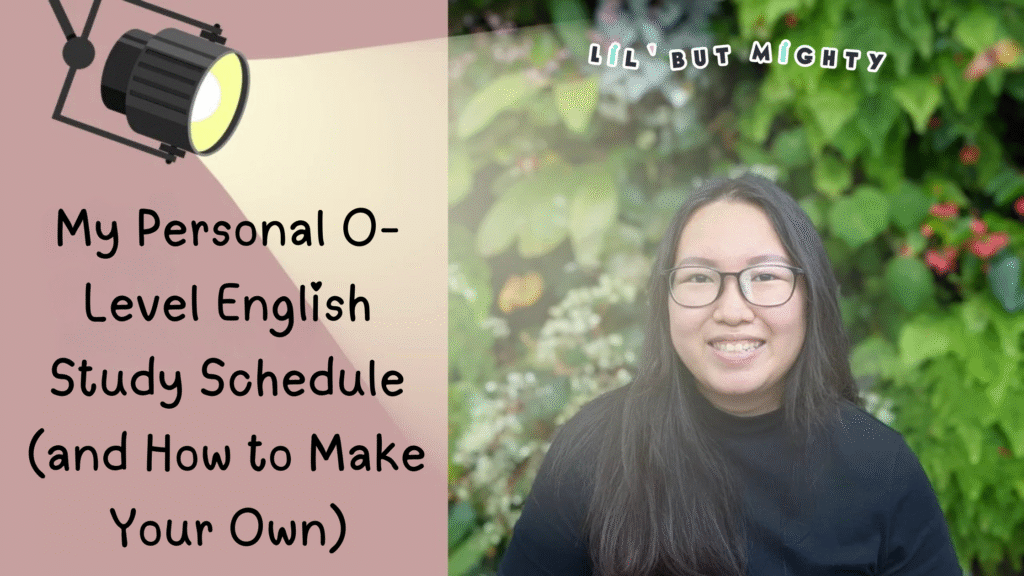
My Personal O-Level English Study Schedule (and How to Make Your Own)

It has been a while since I took my O Level examinations. I still remember those two gruelling years of upper secondary, where all I did was bury my nose in textbooks, go for CCA, and battle all the issues that come with adolescence. It can be a lot! Therefore, today, I am sharing with you how I studied, my top tips for time management, and ways to study smart for the English O Level! This guide is specifically tailored to aid in your O Level preparation.

Find Out Your Learning Style

O Level Preparation

First of all, and most importantly, you need to get to know yourself and your learning style. Take a learning style quiz here: https://www.learningstylequiz.com/. This is because at the beginning of upper secondary, my school conducted a workshop where external trainers taught us study skills. I found those really helpful, as knowing my learning style helps inform how I should study so that I retain the most information from the content. Study smart, not hard! I am personally a mix of visual and auditory learner, so I personally love watching videos and documentaries! Understanding your learning style is a crucial first step in effective O Level preparation.

Plan, Plan, Plan

O Level Preparation
O Level Preparation

Ever heard of the phrase “fail to plan, and plan to fail”? Although this is overused, I believe there is some truth to every cliché saying. At the beginning of the year, our teachers would run through the syllabus and rubrics for every subject. Similarly for English, we were briefed on what was tested and what to do to score the best marks. I always found it useful to refer to the syllabus and rubrics so I know what to study for! You can find the syllabus documents for all your subjects on the SEAB website. Effective planning is essential for successful O Level preparation.

Time Management

Create a Study Timetable

A structured timetable helps you allocate time efficiently. Divide your study sessions into manageable chunks, such as 45-minute or one-hour study blocks with 10-minute breaks in between. Also, because you would be juggling six, seven, or even eight subjects, be sure to plan ahead which subject or subjects you want to focus on for the day. Dedicate specific days to different components of the English exam (e.g., one day for comprehension, another for writing practice). A well-organised timetable is a cornerstone of good O Level Preparation.

Prioritise Weak Areas

Be honest with yourself—what part of English do you struggle with the most? Is it summary writing, comprehension analysis, or essay structuring? Spend extra time refining those skills while maintaining a balance with other areas.

Set Achievable Goals

O level preparation

Instead of vague goals like “improve in English,” set specific ones, such as “write two practice essays per week” or “memorise 10 useful phrases for composition writing.” These clear targets will make your progress more measurable during your O Level preparation.

Study Tips for O-Level English

Practise Past Papers

The best way to prepare is by familiarising yourself with past exam questions. The SEAB website provides past papers (if your school does not get the ten-year series for you), and you can also source additional practice from assessment books. I did a lot of timed practices, and I found that those were very helpful for exam prep. You can also access other schools’ papers on grail.moe to get more practice. Mark your own work using official answer keys to understand what examiners are looking for.

Read Widely

Reading newspapers (e.g., The Straits Times, The Washington Post), opinion pieces, and well-written articles can help improve your comprehension skills and essay writing. I personally enjoy reading. I read voraciously throughout my primary and secondary school years, allowing me to live in many stories and gain perspectives about the world. My teacher also used to give us loads of articles to read, some even GP essays (e.g., from KS Bull). You don’t necessarily have to write like them (you are not required to!), but pay attention to sentence structures, tone, and argument styles.

Develop Good Comprehension Skills

To develop good comprehension skills, start by reading the questions carefully before looking at the passage. This helps you understand what to focus on while reading. As you go through the passage, highlight keywords in both the questions and the text to make it easier to locate relevant information. When answering, ensure your responses are written in complete sentences and avoid lifting directly from the text without proper explanation. Instead, rephrase the information in your own words to demonstrate a clear understanding of the passage.

Improve Writing with Feedback

Writing regularly is crucial, but getting feedback is even more important. Show your essays to teachers or tutors and take their suggestions seriously. If possible, form a study group where you can critique each other’s work.

Final Thoughts

Studying for O Level English doesn’t have to be overwhelming. With proper time management, structured study methods, and consistent practice, you can improve your skills and achieve great results. Remember, it’s about studying smart, not just hard. Good luck with your O Level preparation!

profile kimgan
Ms Kim Gan

Growing up, I enjoyed learning the English Language, as I had met many inspiring teachers along the way. They have used many creative methods to make me love the language more. I hope to influence my students the same way my own English teachers inspired me.

Have something to share? Drop us a comment below!

Leave a Reply

Share

Other related posts

Creative Writing | 3 Easy Steps to Write Your Own Haiku!
Verbs: More than Just Action Words! | Part 3: Changes in Verb Forms
Ketchup on English! – is, are, was and were!
Audience In Visual Text | Visual Text Comprehension
Exploring Points of View (POV) in Composition Writing
Metaphors For? | Part II – Implied Metaphors
10 Beautiful Vivid Verbs to Boost Your Writing and Oral! | Primary School English
Metaphors For? | Part I – An Introduction to Metaphors
3 Family-Friendly Shows on Netflix (Educational & Entertaining)!
Verbs: More than Just Action Words! | Part 2: Tenses
2021 Father’s Day Contest Winners
Verbs: More than Just Action Words! | Part 1: Subject-Verb Agreement
10 Beautiful Words You Can Use in Narrative / Descriptive Writing | Secondary School
Ways To Create A Well-Rounded Character | Creative Writing
Understanding Purpose-Related Questions in Visual Text Comprehension
How Playing Video Games Can Improve Our English (With Practical Tips for Parents!)
Primary School Composition | Onomatopoeia – What’s That?
2021 Mother’s Day Contest Winners + Our Founder’s Journey (Mother’s Day Special)!
Composition Revision: Using Your 5 Senses in Your Writing
How to Create A Dynamic Piece of Writing Using Idioms
Ketchup on English! – Subject-Verb Agreement
4 steps to Create Suspense
That Simile Though 2 | Using Stronger Similes
PSLE ORAL | Compiled Prelim 2021 Oral Topics + Questions!
If you’re looking at getting recent PSLE Prelim Oral topics and practice questions, this will be an excellent resource for you!
5 Steps to Convert a Newspaper Article into a Cloze Passage
I would like to share with you 5 steps on how authentic articles can be transformed into cloze passages easily. Read on here!
PSLE English | Oral Conversation: Free SG50 Sample Practice + Model Answers
In this blogpost we will be touching on the oral stimulus-based conversation topic of National Day and SG50! Read on here!
PSLE English | Oral Conversation: Filling your Story with Details Easily + Free Revision Cards
By simply using the 5W1H, your children will be able to lengthen their stories (hence, the conversation!). Read on here!
Primary School Situational Writing: Q&A + Formal vs Informal Writing Comparison Chart
To aid you in your situational writing revision, here is a comparison chart that shows the differences between formal and informal writing!
PSLE English Tips | Oral: Stimulus-Based Conversation Checklist
To help my children handle the Stimulus-Based Conversation examination, here are some instructions again about using the checklist!
A Little Encouragement | DIY Motivational Bookmark (Easy to personalise too!)
A bookmark with a quote to motivate is also a chance for them to see the power of words and how words can mean more than what they seem.
Situational Writing: Step-by-Step Guide + Free Revision Card
I believe a walkthrough on the process of doing situational writing is in order. Here are the requirements for content and language!
I Love Reading | 5 Ways to Motivate Reluctant Readers
One of the most important ingredients necessary for a child or anyone learning English is the habit of reading. Get motivated to read now!
PSLE English | Printable Ultimate Grammar & Synthesis Summary
Today, we are sharing two lists of essentials in our Ultimate Grammar and Synthesis Summary Printable. Download them free here!
How Well Do You Know Your Past Participles?
While we are familiar with the past, present and future tenses, the little less known but equally important tense is the past participles.
Primary Composition Writing | Starting Sentences with Introductory Clauses
Today, we'll be revising the use of sentence starters to help you create variety in your sentence structures. Read on here!
The Sentence Train | Lower Primary English
Today, we are going to learn what makes up a sentence. It will come in handy when you do the word order activity in school! Read on here!
PSLE English Tips | Oral: Reading Checklist
This Oral Reading Checklist can be used by children when they practise reading on their own. Download it now!
Language of COVID | 10 Words Added to the Dictionary
Using Personification to Show, Not Tell!
Expressing Character Feelings Too! | Using Show-Not-Tell (Part 2)
How to Choose a Book to Read: 8 Ways
How to Dress Up A Boring Paragraph | Creative Writing
Ketchup on English! – Halloween Special: Prepositions of Time!
Ketchup on English! – Verbs Are Not Just Action Words!
Expressing Character Feelings | Using Show-Not-Tell
Which Picture Should I Use? | Choosing the Best Picture to Use for Composition!
Oral: Reading Passage | Long Vowels – Have You Been Reading Your Vowels Correctly?
Previous
Next

Like what you are reading?

Subscribe now to receive news and tips hot off the press!

shape icon 06
shape icon 05