Hi everyone! I am Ms Jenani, a Specialist English Teacher at Lil’ but Mighty (Clementi), and welcome to my very first video post. If you ever wonder how to ace the stimulus-based conversation component of the Oral Communication paper, look no further!
Like what you are watching? Please subscribe to our YouTube channel to receive our tips and strategies fresh from our studio!
Changes to PSLE Paper 4: Oral Communication
Amongst all the changes in the PSLE English format, the changes to the oral component have grabbed the attention of students and parents alike. In a bid to encourage critical thinking and improve communication, greater emphasis has been placed on the oral component. The weighting for Oral has gone up from the previous 30 marks to the current 40 marks, with 15 marks allocated for reading aloud and 25 marks are allocated to the stimulus-based conversation section.
With more marks allocated to the SBC component, there is a greater need to prepare our children on how to respond effectively to the questions posed. But first, let’s understand this particular section and what its demands are.
Understanding the Stimulus-based Conversation (SBC) Component
The SBC component is where the student engages in a conversation with the examiners on a topic based on a photo stimulus. There are typically 3 questions that will be asked and they fall into these categories:
- Directly-linkedThis question is directly-linked to the stimulus – usually a photograph depicting a real-life situation involving a few people. It is often opinion-related, for instance: How do you think the people in the photograph are feeling?
- Broadly-linkedThese questions are broadly-linked to the theme in the stimulus, and often require students to talk about a personal experience or give their opinion or advice, such as Have you ever been ill before? or What do you think schools can do to encourage healthy eating habits?
This section can be a demanding one, as students are not only expected to express their personal ideas and opinions clearly and appropriately but also do so using clear pronunciation, grammatically accurate sentences as well as a wide range of vocabulary. As such, it is important that students try to master one of the answering techniques that I will be going through in the next part.
3 Oral Frameworks to Consider
In this part, I will explore the various Oral frameworks available,with a special focus on the Oral framework that we use at LBM! My focus will be on the directly-linked question, which is typically the first question to be asked for the section. For each framework, I will explain how it works and then show how it can be applied when answering the directly-linked question type.
Framework 1: Using TREES
TREES is an acronym which stands for:
Thought – share your thought or opinion about the topic
Reason – explain your thought or opinion
Example – offer an example to support your thought or opinion
Experience – share a personal experience that further supports your thought or opinion
Suggestion – conclude with a suggestion that shows your reflection on the topic or you can even recommend an improvement
Example 1: Look at the picture. Would you be interested to participate in this activity? Why or why not?

Using the TREES method, your answer should pan out this way:
Thought: Yes, I will be interested to participate in this activity. The students in this picture are taking turns to use the computer with their teacher guiding them, and it is an activity which appeals to me.
Reason: This is because this activity differs from our usual lessons, where we use pen and paper. It is definitely more interactive to learn in this manner.
Example: From the picture, I can see that there are two laptops available for use and the teacher is guiding the students on how to use them for their learning. From the way the students are leaning towards the laptops and the concentration on their faces, I can tell that the students are engaged and enjoy the activity.
Experience: Last December, I attended a science camp. The teachers in the class allowed the use of computers for watching science experiments! My classmates and I watched a video that showed how to build a lava lamp from scratch using vegetable oil and food colouring. After watching the video, we carried out the experiment, and my teacher allowed us to use a torchlight to shine through the lava lamp, so we could see the food colouring interacting with the oil more easily. It was so fun! Being allowed to use the computer did help to make the lesson more engaging for all of us.
Suggestion: It will be a great idea for my school to incorporate more computer lessons into our daily learnings to make it more fun!
Framework 2: Using PEEL
PEEL is also acronym and it stands for:
Point – state your main idea on the topic clearly
Evidence – provide examples to support your point
Explanation – explain your point by elaborating on the evidence
Link – link your response back to the topic
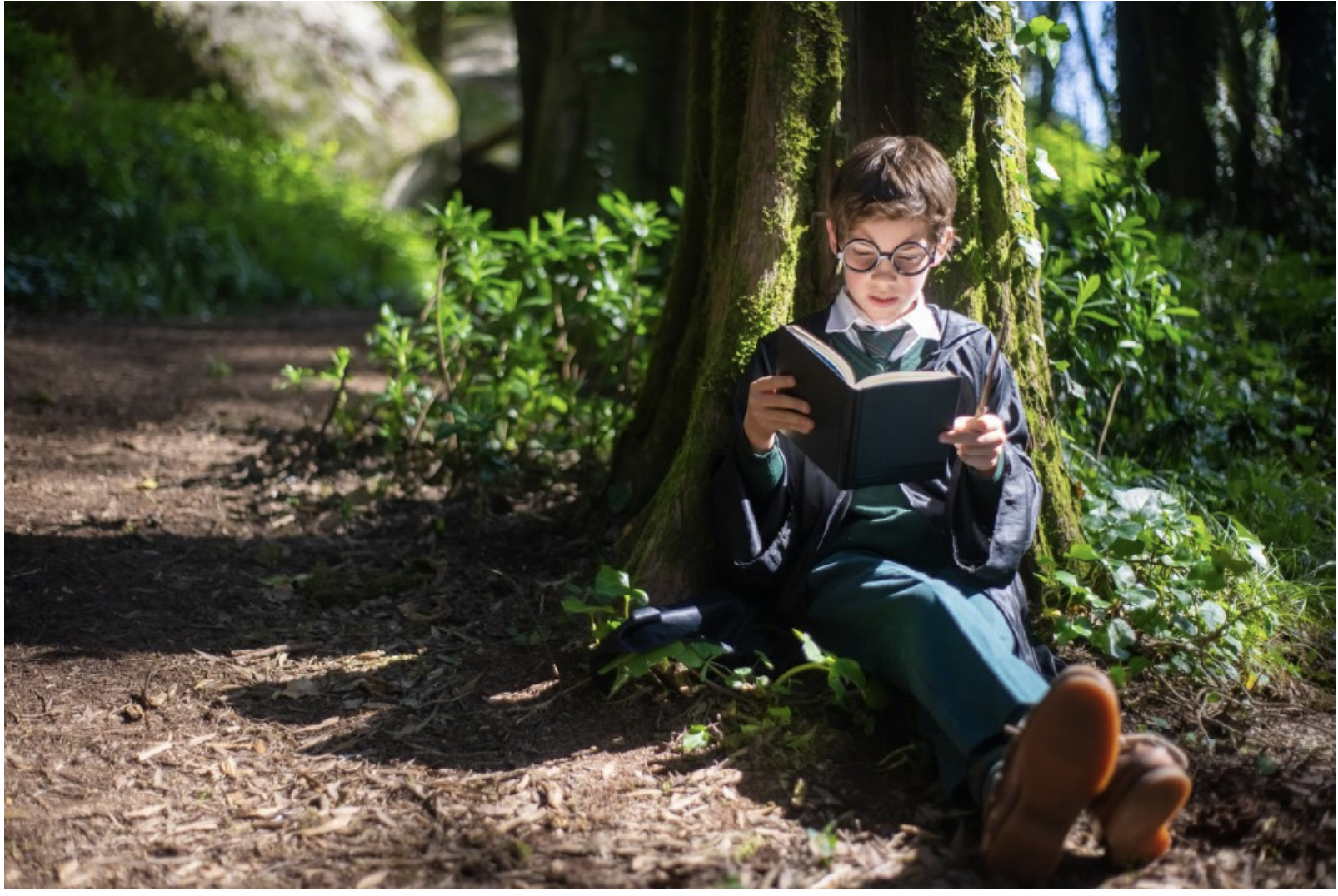
Example 2: Are you like the boy in the picture? Why or why not?
Let us look at how we can answer the question using the PEEL method:
Point: Yes, much like this boy sitting in the park, I thoroughly enjoy reading books! However, unlike him, I do not spend my time outdoors reading books.
Evidence: The way he is sitting with his eyes glued to the pages tells me that he is truly engrossed in the story. I think he is enjoying a fantasy book, judging by the wand he is holding in his hand! He might be reading one of the Harry Potter books, which takes place in a wizarding school called Hogwarts. From the relaxed manner that he is seating, I could tell that he loves reading in the open surrounded by nature.
Explanation: I am a bookworm as well! Just like this boy, I always get lost in a good book. Seeing this boy reminds me of myself when I am engrossed in my favourite genre, which is the fantasy novel, which is another similarity that we share. Recently, I finished a new fantasy series called The Chronicles of Narnia, which I thoroughly enjoy. I believe the boy in the picture would enjoy it as well as the series is filled with mythical beasts and talking animals. However, unlike him, being in the outdoors is a time for me to destress. As such, I enjoy spending my time outdoors running about and chasing my friends in the open spaces, rather than being seated and still.
Link: In conclusion, although I am quite similar to the boy in the picture because of my reading habits, we differ in how we choose to spend our time while we are in the outdoors.
Framework 3: Using RASE
Lastly, let us look at how we can use the RASE framework to develop our answer. RASE is a strategy that we use here at Lil’ But Mighty. Just like the previous two, it is also an acronym and it refers to:
Response – answer the question directly and offer 2 to 3 main points
Apply to Self – share a personal habit or preference related to the topic
Story – narrate a specific incident that is related to one of the main points
Ending – conclude by restating the response and add a reflection, hope, wish, suggestion, or advice
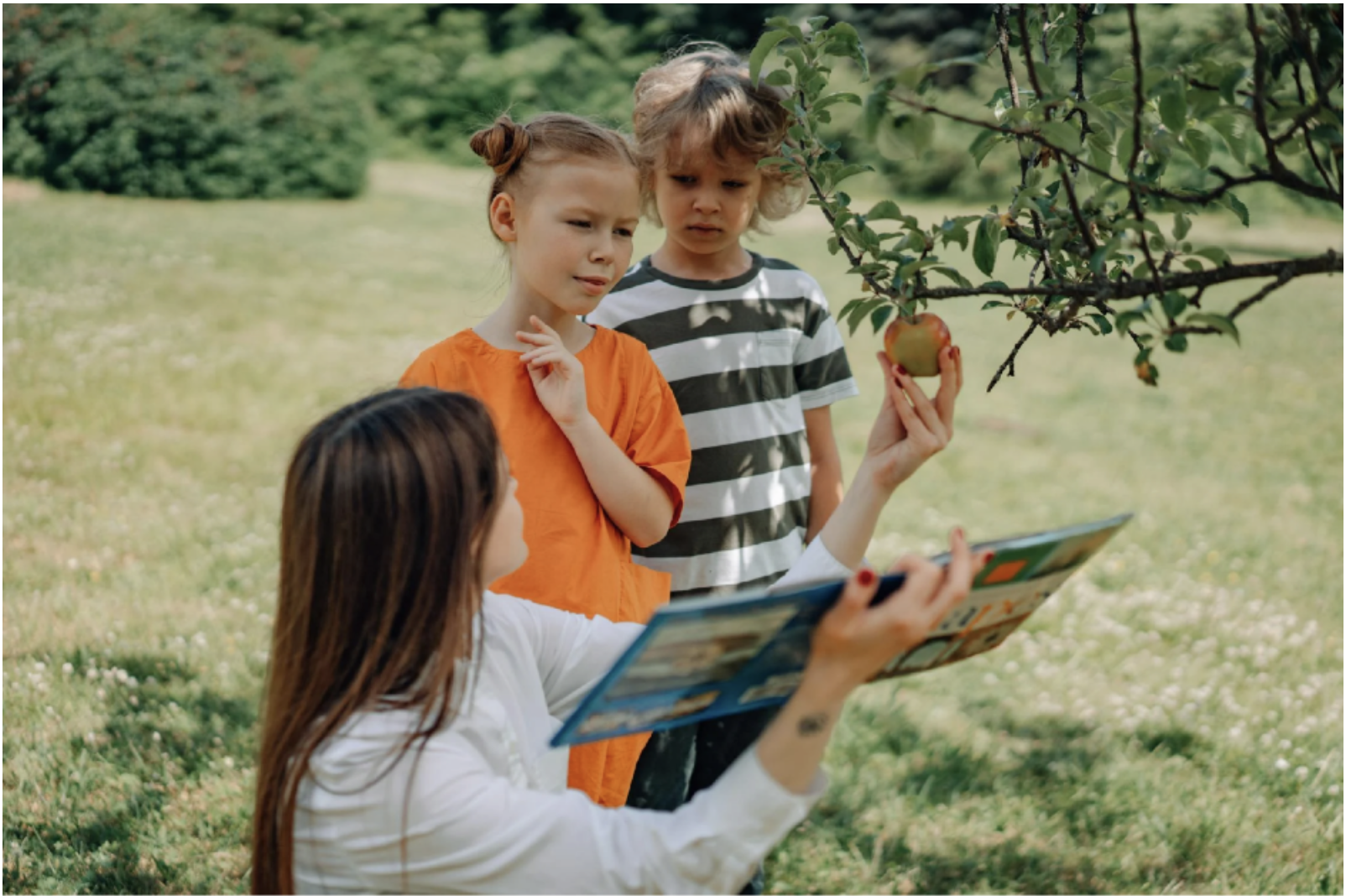
Example 3: How do you think the people in the photograph might be feeling? Why do you say so?
So how do we use the RASE framework to craft our answer? Let’s see this example:
Response:
Direct answer: The photograph shows a scene of two children listening to an adult while they are in a garden. I think that both the children in the photograph are feeling eager to learn while the adult is focused on teaching them.
Main points: Firstly, the children’s keen interest to learn is evident in their facial expressions. The girl is focusing on the apple while the boy in the stripe shirt is looking intently at the book. This shows that they are paying close attention to what their mother is telling them. Perhaps they are getting a hands-on lesson on how apple trees are grown and both of them are interested to know more. Furthermore, their mother seems eager to teach them as she is holding the apple and the book while bending down, so that her children can understand her explanations easily.
Apply to Self: For me, I love learning new things and applying what I have learned outside of the classroom. My parents have signed me up for science holiday workshops so that I can have a try at hands-on experiments. When I visit the Science Centre, I am often fascinated by the various exhibitions they have ongoing and aspire to be a scientist one day.
Story: Last December, my parents took me to the ArtScience Museum. When I stepped into the museum, I was bursting with excitement at the sight of an exhibition titled Future World: Where Art Meets Science. My eyes sparkled when I saw the digital interactive art instalments from teamLab, a well-known art collective, as I am a big fan of their work! It was truly an exhilarating experience at the ArtScience Museum as I was able to learn many new things through the hands-on activities provided.
Ending: In conclusion, I think that the children in photograph are feeling eager to learn. Just like them, I too, will feel thrilled whenever I get to have lessons which allow me to experience concepts firsthand. I hope that my school incorporates more hands-on lessons into our school curriculum to aid in students’ learning.
Conclusion
And there you have it, the 3 techniques that you can apply in order to help you navigate the directly-linked question in the SBC portion of the oral paper. Remember that each of them is meant to help you provide a well-elaborated response to the question, and it really depends on which one you are most comfortable with. As with all aspects of life, each of these strategies requires time and practice to master, so it is ideal that you start using and practising your chosen method a few months ahead of the PSLE oral exam.
For more English tips, check out our YouTube channel. Take care and keep a lookout for my next video!