Hello! I am Teacher Alexandrea from Lil’ but Mighty (Clementi Branch). In this blog post, I will be sharing with you three key differences between Secondary Situational Writing and Primary Situational Writing. If you are about to enter Secondary 1 or are still unfamiliar with what is expected of you when completing the SW task at the secondary level, do read on!
As you may already know, SW is part of PSLE English Paper 1, where you are tasked to write a short functional piece that suits the purpose, audience and context of a given situation. This may be in the form of a letter or an email written to a particular recipient, such as a family member or the school principal. As such, this piece of writing can be formal or informal, depending on the recipient.
Similarly, for the O Level, Secondary Situational Writing remains as a component of Paper 1. Much like the SW task given in the PSLE English paper, the O Level SW task will also require you to craft a text that satisfies the purpose, audience and context of a given situation. It can also be in the form of a letter or email, or sometimes even a report or speech, and can be either formal or informal.
Despite these similarities, there are significant differences between the two, so let’s now take a closer look at the three main ones:
1. Weighting
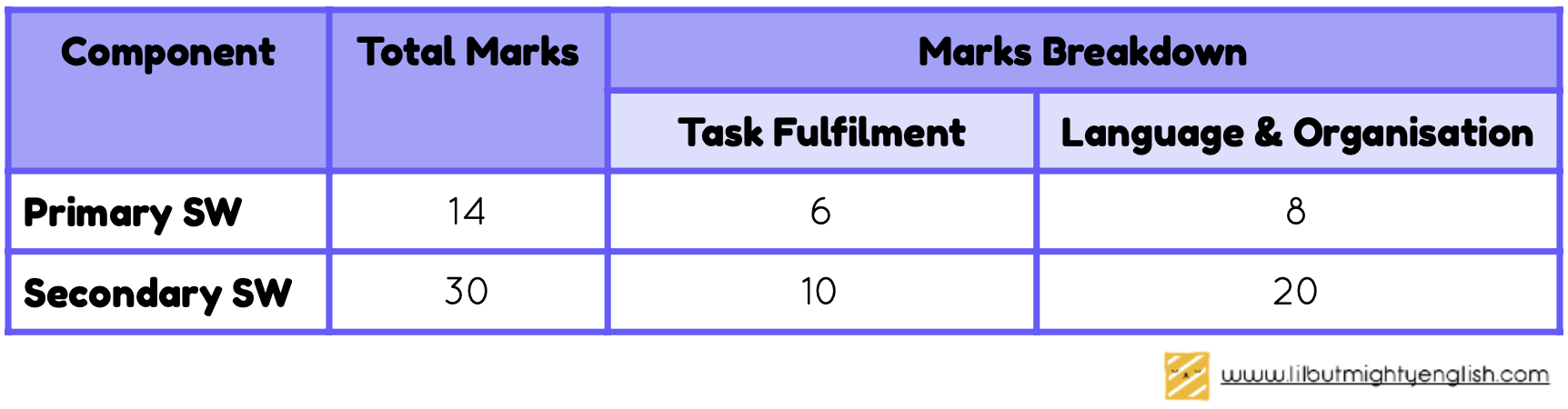
At the primary level, the SW component is worth 14 marks, split into 6 marks for Task Fulfilment and 8 for Language and Organisation. For Secondary Situational Writing, 10 marks goes to Task Fulfilment while 20 marks are awarded for Language and Organisation. This means that more content development is expected in order for you to fulfil the task requirements at the secondary level. This is reflected in the word count too, as you are also expected to write longer, between 250 to 350 words. Not only that, more weightage is also given for Language and Organisation, which means that more emphasis is placed on using language accurately and organising your ideas properly.
2. Assessment Criteria for Task Fulfilment
For Task Fulfilment, you will need to show awareness of purpose, audience and context for both Primary and Secondary Situational Writing. However, in order to achieve the top band of 5-6 marks at the primary level, you are only expected to select relevant ideas from the visual text provided, and as long as these points are phrased accurately, you will be awarded the
marks. There is only one point that requires you to come up with your own idea or suggestion. As long as the idea is logical and reasonable, the content point will be awarded to you. At the secondary level, you are not only expected to address the required points but you must also elaborate further with your own points and examples. Below are the band descriptors for Task Fulfilment for Secondary Situational Writing:
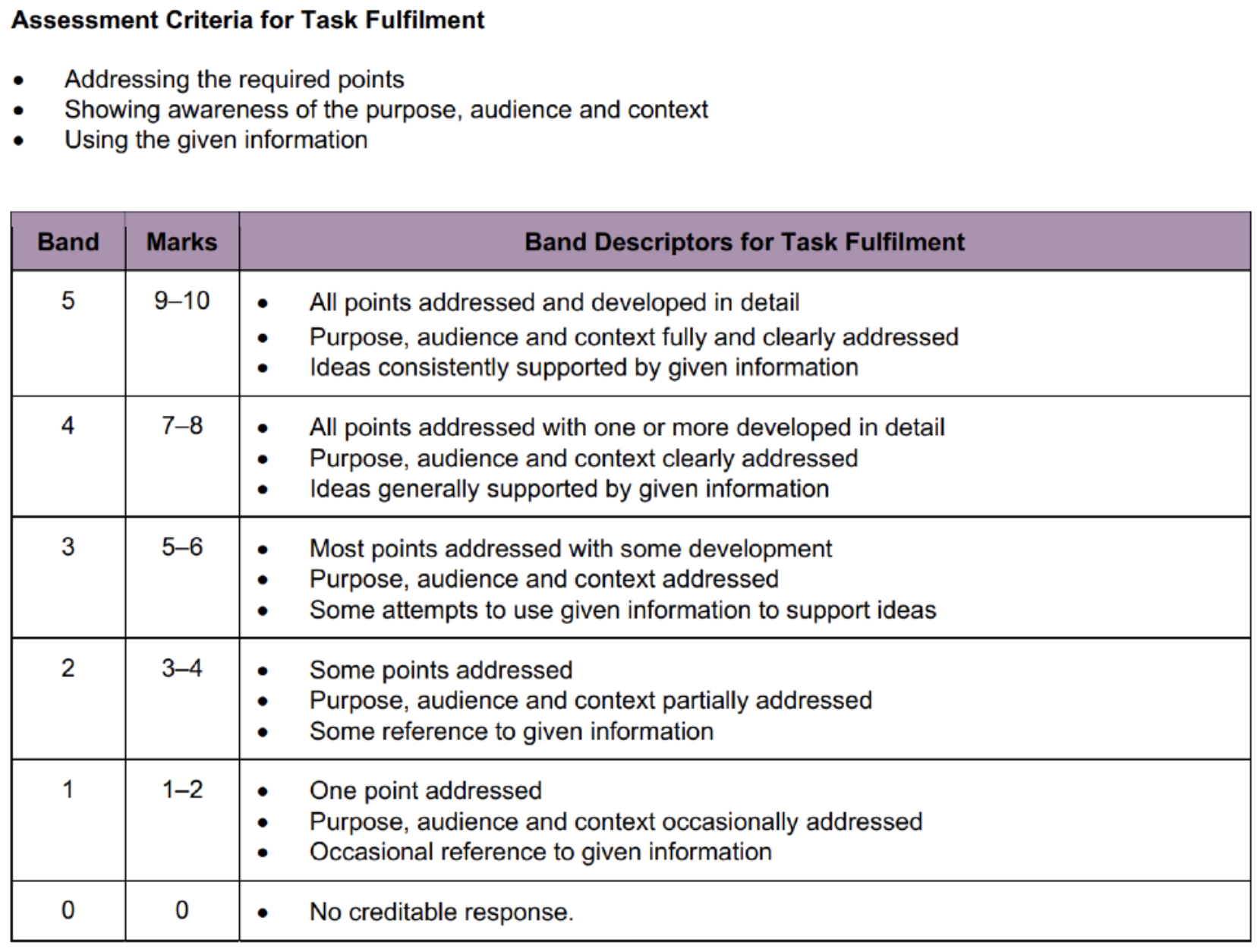
In order to achieve the top band of 9-10 marks, the points that you put across have to be developed in detail, with ideas consistently supported by the visual stimulus provided. What this means for you is that you must be able to elaborate each point clearly using general knowledge, beyond information you can find in the text.
3. Addressing the Content Points in Your Own Words
To illustrate this, let’s compare a PSLE SW sample with an O Level SW sample.
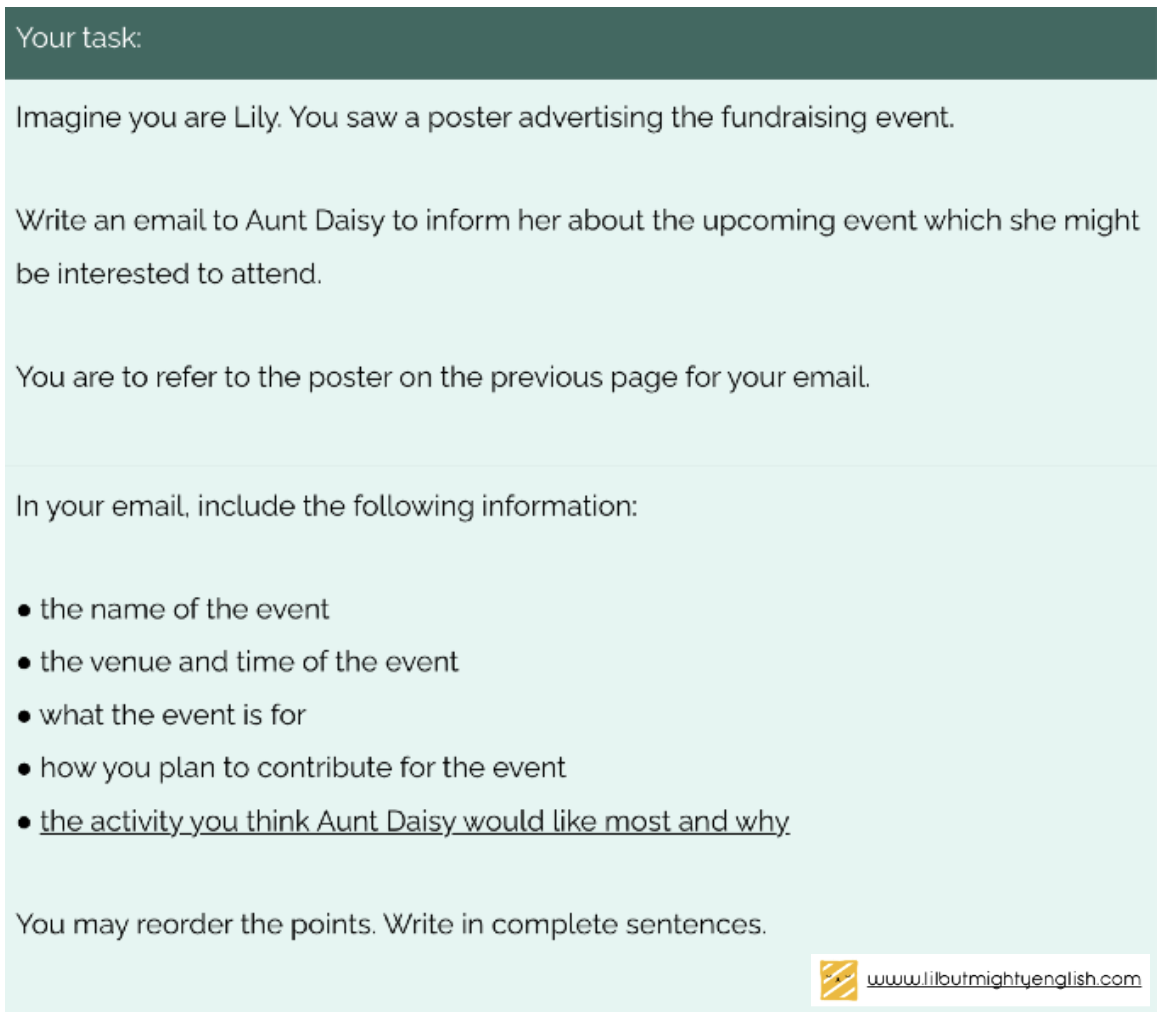
PSLE SW Question
O Level SW Question
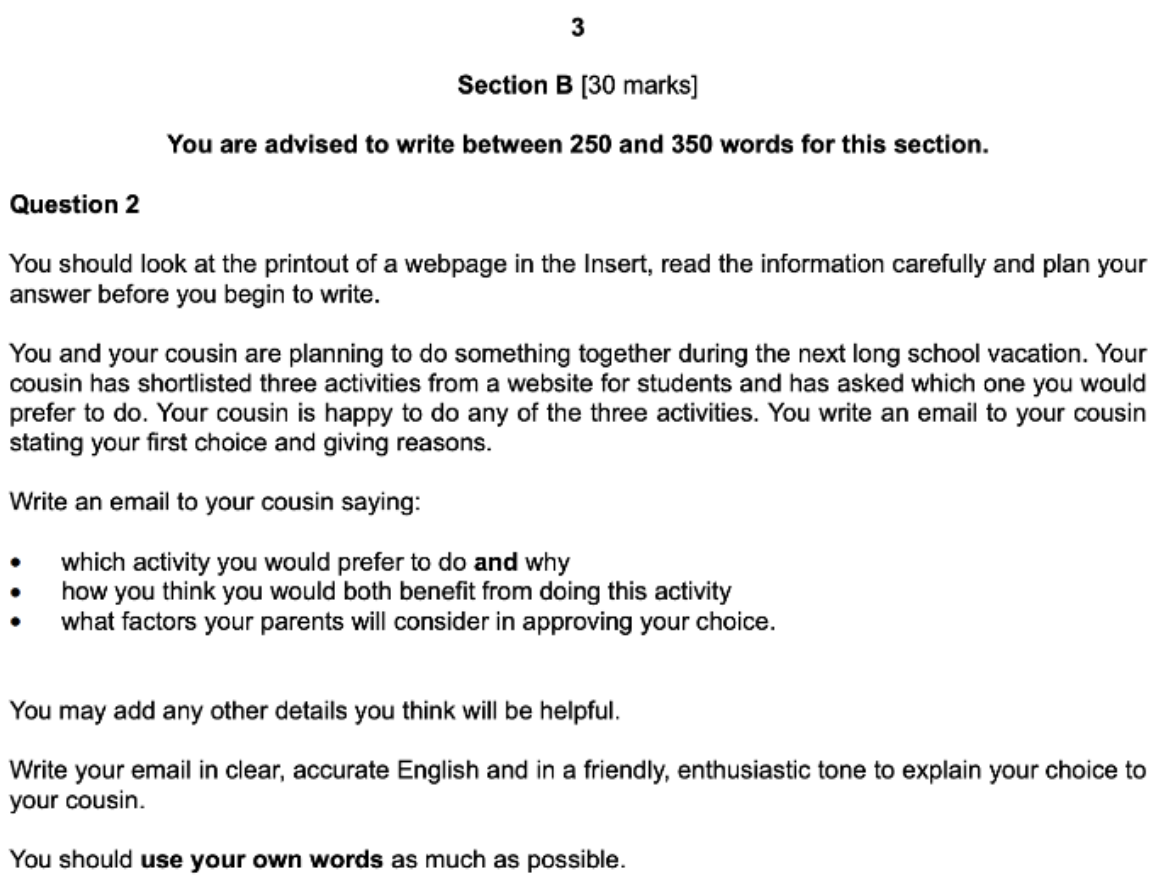
Apart from the number of bullet points given, we can also see clear differences in how these content points are addressed. At the PSLE level, the content points are directly related to the text and you should be able to find five out of the six content points there. You are not expected to paraphrase the information found in the visual text, nor are you expected to add your own details or elaboration for each of these five points.
However, at the O Level, candidates are expected to think deeper. More often that not, you will need to make a choice from the options given in the visual stimulus. You can expect to see questions asking you to explain the benefits or reasons for your choice to convince the reader, as well as other questions that require you to develop your points further. Take note of this important instruction in the task: You should use your own words as much as possible. This means that unlike Primary SW, you are expected to paraphrase the information from the visual text when using it to support your choice as well as use your own words to develop the content points.
Now that you are aware of the requirements of Secondary Situational Writing, let’s take a look at what it means for you in order to be able to do well for it:
- Time Management
For PSLE SW, you usually need 15 to 20 minutes to complete this section. However, since the task is now more complex and the word count is longer, a good rule of thumb is to use at least 50 minutes of the total 1 hour and 50 minutes given for this paper. This is so that you have enough time to complete the other sections too. Ensure that you set aside time to plan as well as to check your essay. - Planning
Planning for SW is crucial because you need to ensure that you have addressed and elaborated on all the required points. You should plan what you are going to write in each paragraph – where each content point will be addressed – and having a general outline of the essay will certainly help you to organise your ideas and save time when you write. - Annotating the Task Box and Visual Stimulus
Identify and mark out the purpose, audience and context in the question to ensure that you are clear on the task. Highlight any information that supports the content point and paraphrase them in your own words in the visual stimulus itself. Jot down your own elaborations in point form in any empty space in the visual stimulus. All these annotations will come in handy when you are writing out the essay later.
Final note: Though the increase in difficulty may seem daunting, I hope the tips I have shared will help you tackle this component of the English language paper with ease. With the right materials and adequate practice, you can be well on your way to mastering the SW. I hope that you have found this blogpost informational. Do look forward to more posts about tackling O Level English!
Find our English Tuition at Block 432 Clementi Avenue 3, #01-282, Singapore 120432