The O Level English Language examination is not just about grammar and comprehension; it is also about your ability to communicate effectively in real-world scenarios. This is where O Level English Situational Writing comes into play. If you are feeling a bit overwhelmed, don’t worry! Hello everyone! I’m Ms Vani, a Specialist English Teacher at Lil’ but Mighty (Bukit Timah) and I am here to demystify this crucial component and help you ace it.
What Exactly is O Level Situational Writing?
Situational Writing tests your ability to respond appropriately to a given scenario, much like you would in everyday life. You will be presented with a prompt that outlines a specific situation, your role, and your intended audience. You will then need to write a piece that fulfills the requirements of the task, demonstrating your understanding of context, purpose, and audience. I am sure that you have come across this section before in the English PSLE paper, and for a comprehensive explanation of how O Level English Situational Writing is different from that, do take some time to check out this article.
What Skills are Required to Master O Level English Situational Writing?
Essentially, Situational Writing assesses your practical communication skills. It evaluates the following areas:
- Understanding of Context: Can you grasp the nuances of the given situation?
- Purposeful Communication: Can you write with a clear objective in mind?
- Audience Awareness: Can you tailor your language and tone to suit your intended readers?
- Clarity and Conciseness: Can you convey your message effectively and efficiently?
- Format and Conventions: Can you adhere to the appropriate format for the given task (e.g. letter, email, report)?
- Language Accuracy: Can you use correct grammar, vocabulary, and spelling?
The Diverse Purposes of O Level English Situational Writing
A Situational Writing task is purpose-driven, and it is important that you understand that there are a variety of purposes. Being clear on the purpose ensures that you include relevant information and organise it in such a way that best achieves the purpose. Knowing the purpose will also enable you to use the appropriate tone, language and register. Some of the common purposes include:
❖ To Inform:
- This involves providing clear and accurate information.
- You must focus on facts and clarity.
- Examples of writing: a report, a set of instructions, or a notice.
❖ To Persuade:
-
- Here, you aim to convince your audience to adopt a certain viewpoint or take a specific action.
- You must use persuasive language and logical arguments.
- Examples of writing: a letter to the editor, a proposal, or a promotional email.
❖ To Advise:
-
- This includes giving useful suggestions or recommendations.
- You must show a clear understanding of the situation and provide helpful advice.
- Examples of writing: a letter of advice or a report with recommendations
❖ To Request:
-
- This involves asking for something, whether it’s information, assistance, or permission.
- You must be polite and clear in your request.
- Examples of writing: a letter of request or an email asking for a favor
❖ To Express Feelings:
-
- This might involve expressing gratitude, sympathy, or concern.
- You must use appropriate tone and language to convey your emotions.
- Examples of writing: a letter of thanks or a letter of condolence
Why Is It Important to Know the Different Types and Formats?
One of the main things to be clear about is the difference between purpose and format. While the purpose tells us the reason for writing (for instance persuading a friend to sign up for a cooking class with you), the format refers to the conventions of writing, i.e. what form does this writing take – a letter, an email, a report, a proposal etc? There are many different formats and it is crucial that you know the different ways to structure your information due to the following reasons:
- Real-World Relevance: Situational writing mirrors real-life communication, such as sending formal emails, writing letters, drafting proposals, or delivering speeches. The skills developed here will be useful beyond examinations, in both academic and professional settings.
- Exam Success: The O Level English exam assesses not just grammar and vocabulary but also a student’s ability to write appropriately for different contexts. Understanding the requirements of each format ensures that students do not lose marks due to structural or tone-related errors.
- Audience Awareness: Each format requires a specific tone and level of formality. Writing a casual letter to a friend differs greatly from drafting a report for a principal. Recognising these differences helps students convey their messages effectively.
- Effective Communication: Whether it’s persuading an audience in a speech, making a request in a formal letter, or providing information in a report, different formats require different approaches. Mastering these ensures students can communicate ideas in a clear, structured, and persuasive manner.
- Time Management in Exams: Understanding the structure of each type allows students to organise their thoughts quickly during exams, ensuring they complete their writing tasks efficiently and effectively within the given time limit.
Situational Writing Formats Overview
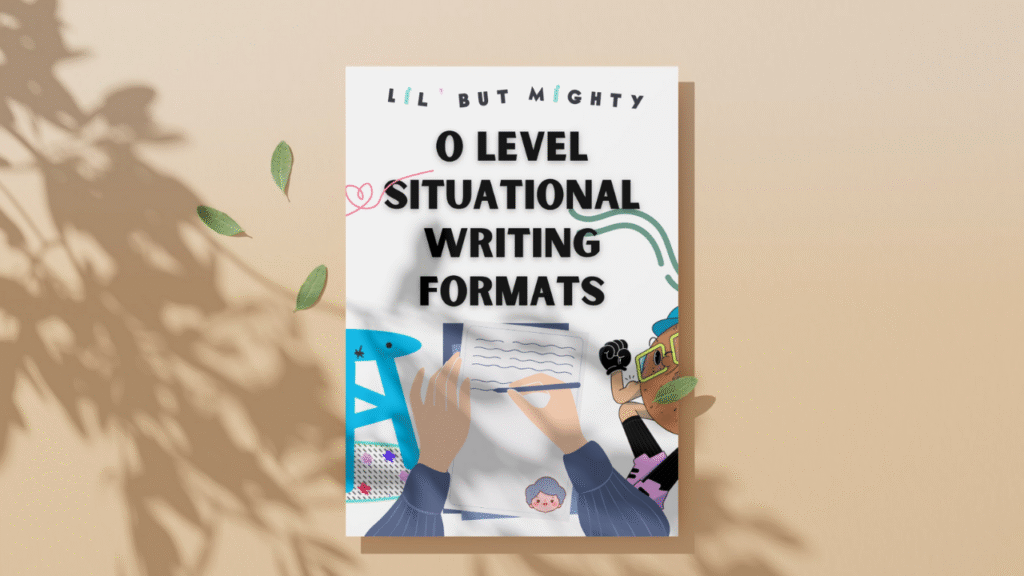
To aid you in your revision, I have included a breakdown of the common O Level English Situational Writing formats that is downloadable for your reference! In this handout, you will find the formats for
• Informal Letter
• Formal Letter
• Formal Email
• Proposal/ Report • Speech
• Article
Here is a sample of how it looks like!

Final Tips for Situational Writing Success:
✔ Plan Before Writing: Identify the purpose, audience, context and format before you begin.
✔ Be Concise and Clear: Use simple, clear, and effective language.
✔ Use the Right Tone: Adjust the level of formality based on the recipient.
✔ Follow the Correct Format: Marks will be deducted for incorrect structure.
✔ Check for Grammar & Spelling: Proofread your work before submission.
By mastering these formats and practising regularly, you can confidently approach any situational writing task and perform well in the O-Level examination! See you in my next post!

WordStruck Secondary English Telegram Channel
Welcome to Lil' but Mighty’s WordStruck official channel! 🎉
This community is dedicated to empowering students to excel in O-level English.
By 2026, we hope to support 1,000 students.🌟
Love,
Lil' but Mighty