5 Dialogue Punctuation Mistakes

Master Punctuation in Dialogue: 5 Dialogue Punctuation Mistakes You Might Be Making

Hi, everyone! I’m Mr Ryan from Lil’ but Mighty. Dialogue is one of the most powerful tools in a composition. It brings characters to life and moves stories forward. However, it also comes with a set of punctuation rules that trip up many students.

So today, we are taking a look at five most common mistakes students make when punctuating dialogue and how we can fix them.

Mistake #1: Missing or Misplacing the Speech Tag Punctuation

A speech tag is a word that tells us who is speaking and how. For example, said, gasped, yelled, explained, whispered or scolded.

When dialogue is followed by a speech tag, a comma must sit inside the closing quotation marks to link the two parts of the sentence. Many students forget the comma entirely, or place it outside the quotation marks.

Are these correct?

“We have run out of milk” she reported.

“We have run out of milk”, she reported.

They are both wrong! If the speech is not at the end of a sentence, ensure that you tuck a comma safely inside the quotation marks!

When the comma is safely tucked, the correct form looks like this:

“We have run out of milk,” she reported.

Keep your commas safe between the quotation marks!

Mistake #2: The ‘Capitalisation’ Trap (Using Speech Tags Correctly)

Here is the key principle to understand first: when a sentence contains both dialogue and a speech tag, the whole thing is considered one grammatical sentence. The speech tag is not a new sentence! It is the second half of the same one.

This matters because many students see an exclamation mark or question mark and assume a new sentence is starting. It is not!

Is this correct?

“Get lost!” The man yelled. This is, in fact, wrong!

“Mr Ryan!” you might exclaim, How can that be? Shouldn’t “The” be capitalised after an exclamation mark?” Well—

Even though the dialogue ends with an exclamation mark, “the” remains lowercase because it is in the middle of one complete sentence.

It should look like this:

“Get lost!” the man yelled.

Some more examples of sentences obeying this rule:

“Come here,” he said.

“What’s going on?” he asked.

Mistake #3: Starting with the Tag (Misunderstanding the “Gateway Comma”)

What happens if the speech tag comes before the dialogue?

Is this correct?

The man yelled, “get lost!”

It’s wrong! Wait, shouldn’t ‘get’ be in lowercase since it is in the middle of a speech sentence! It is a little tricky but you must remember that the starting word of a speech has to be capitalised. Thus, it should be:

The man yelled, “Get lost!”

Remember:

1. Always place a comma after the speech tag if it is placed in the beginning of a sentence

2. Always capitalise the first word of the speech / dialogue

Mistake #4: Confusing a speech tag with an action tag

This is perhaps the trickiest mistake. Students often follow dialogue with an action tag, which is a description of what the character is physically doing, and treat it as if it were a speech tag. The problem is, an action tag does not describe how someone is speaking, so it cannot act as a bridge from the dialogue.

Is this correct?

“I can’t help you,” he leaned back in his chair.

The above sentence is wrong! Why? There is no speech tag in the sentence! “Leaned back” is not a speech tag because it does not describe how the person is speaking and is instead an action tag.

Thus, the correct form should be:

“I can’t help you,” he said, leaning back in his chair.

A speech should always be followed by a speech tag instead of an action tag.

Mistake #5: The “Broken Sentence” Slip Up (Speech Tags in the middle of the Dialogue)

The next example may not appear as often and rules might vary. However, we will follow the Cambridge rules regarding this. Sometimes, a speech tag interrupts a single, continuous thought.

Is this correct?

“Look,” he said, “There is no good way to say this.”

Wrong! If the dialogue is one whole sentence split in the middle by a speech tag, do not restart the sentence with a capital letter.

Take a look at the correctly written sentence:

“Look,” he said, “there is no good way to say this.”

The dialogue is a whole sentence, only interrupted by the speech tag. Therefore, when continuing the dialogue, the word “there” is written in lower case.

Conclusion

By mastering these 5 mistakes, your compositions will not only be easier to read but you will also avoid losing precious language marks in your composition exams!

If you want to brush up on your punctuation for dialogue, you can check out our other 2 videos here!

Ketchup on Punctuation… Speech Marks!

Creative Writing & Compo | How to Punctuate Direct Speech

Also, you can download a free worksheet below to test your understanding of the rules you have just learnt!
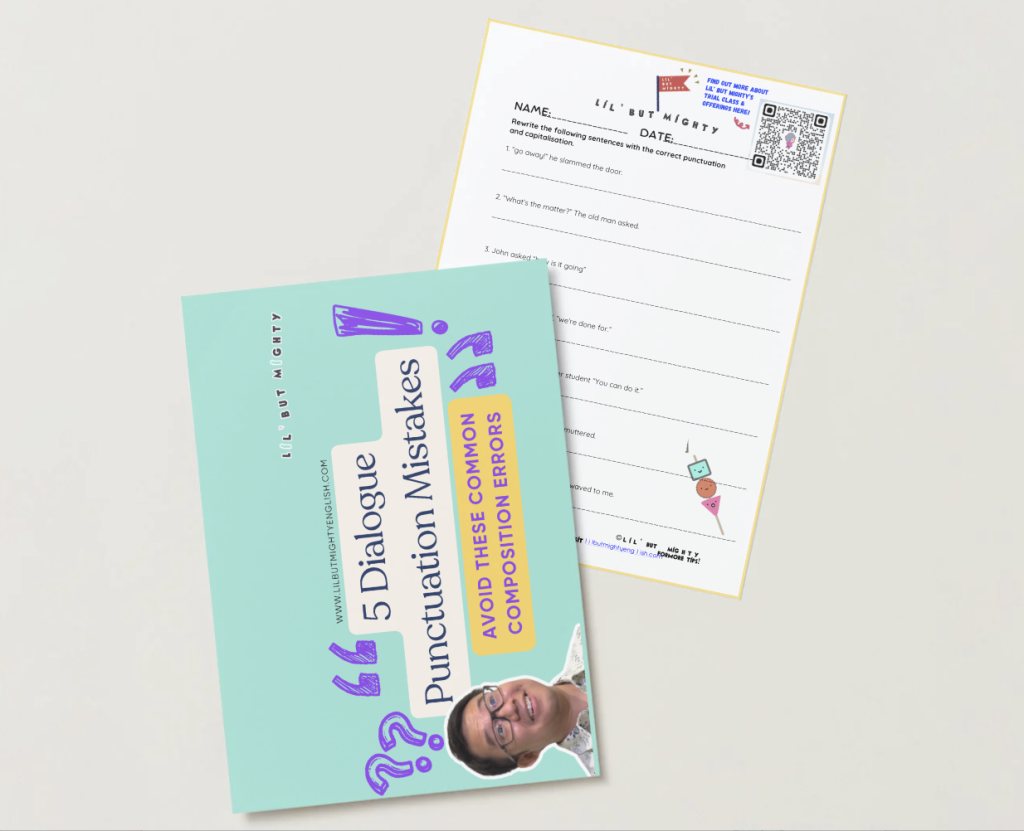

5 Dialogue Punctuation Mistakes

Download your Free Punctuation Practice Worksheet

We respect your privacy.

Mr Ryan Profile Pic
Mr Ryan

Mr Ryan has been teaching the English Language for the last 5 years, inspiring students to navigate the rules of the language and encouraging them to push the boundaries of their creativity. “Fun” and “Educational” are the two pillars that Mr Ryan aims to have in all his lessons, so that his students enjoy the lessons but also come away learning something that will help them!

Mr Ryan hopes that the students he teaches will continue to love English even after they graduate, perfecting their mastery of the language, and being confident in their employment of it for the rest of their lives.

Have something to share? Drop us a comment below!

Leave a Reply

Share

Other related posts

Creative Writing | 3 Easy Steps to Write Your Own Haiku!
Verbs: More than Just Action Words! | Part 3: Changes in Verb Forms
Ketchup on English! – is, are, was and were!
Audience In Visual Text | Visual Text Comprehension
Exploring Points of View (POV) in Composition Writing
Metaphors For? | Part II – Implied Metaphors
10 Beautiful Vivid Verbs to Boost Your Writing and Oral! | Primary School English
Metaphors For? | Part I – An Introduction to Metaphors
3 Family-Friendly Shows on Netflix (Educational & Entertaining)!
Verbs: More than Just Action Words! | Part 2: Tenses
2021 Father’s Day Contest Winners
Verbs: More than Just Action Words! | Part 1: Subject-Verb Agreement
10 Beautiful Words You Can Use in Narrative / Descriptive Writing | Secondary School
Ways To Create A Well-Rounded Character | Creative Writing
Understanding Purpose-Related Questions in Visual Text Comprehension
How Playing Video Games Can Improve Our English (With Practical Tips for Parents!)
Primary School Composition | Onomatopoeia – What’s That?
2021 Mother’s Day Contest Winners + Our Founder’s Journey (Mother’s Day Special)!
Composition Revision: Using Your 5 Senses in Your Writing
How to Create A Dynamic Piece of Writing Using Idioms
Ketchup on English! – Subject-Verb Agreement
4 steps to Create Suspense
That Simile Though 2 | Using Stronger Similes
The Ultimate Guide to P1 Registration in Singapore: Why 1km and 2km Matter
PSLE ORAL | Compiled Prelim 2021 Oral Topics + Questions!
If you’re looking at getting recent PSLE Prelim Oral topics and practice questions, this will be an excellent resource for you!
5 Steps to Convert a Newspaper Article into a Cloze Passage
I would like to share with you 5 steps on how authentic articles can be transformed into cloze passages easily. Read on here!
PSLE English | Oral Conversation: Free SG50 Sample Practice + Model Answers
In this blogpost we will be touching on the oral stimulus-based conversation topic of National Day and SG50! Read on here!
PSLE English | Oral Conversation: Filling your Story with Details Easily + Free Revision Cards
By simply using the 5W1H, your children will be able to lengthen their stories (hence, the conversation!). Read on here!
Primary School Situational Writing: Q&A + Formal vs Informal Writing Comparison Chart
To aid you in your situational writing revision, here is a comparison chart that shows the differences between formal and informal writing!
PSLE English Tips | Oral: Stimulus-Based Conversation Checklist
To help my children handle the Stimulus-Based Conversation examination, here are some instructions again about using the checklist!
A Little Encouragement | DIY Motivational Bookmark (Easy to personalise too!)
A bookmark with a quote to motivate is also a chance for them to see the power of words and how words can mean more than what they seem.
Situational Writing: Step-by-Step Guide + Free Revision Card
I believe a walkthrough on the process of doing situational writing is in order. Here are the requirements for content and language!
I Love Reading | 5 Ways to Motivate Reluctant Readers
One of the most important ingredients necessary for a child or anyone learning English is the habit of reading. Get motivated to read now!
PSLE English | Printable Ultimate Grammar & Synthesis Summary
Today, we are sharing two lists of essentials in our Ultimate Grammar and Synthesis Summary Printable. Download them free here!
How Well Do You Know Your Past Participles?
While we are familiar with the past, present and future tenses, the little less known but equally important tense is the past participles.
Primary Composition Writing | Starting Sentences with Introductory Clauses
Today, we'll be revising the use of sentence starters to help you create variety in your sentence structures. Read on here!
The Sentence Train | Lower Primary English
Today, we are going to learn what makes up a sentence. It will come in handy when you do the word order activity in school! Read on here!
PSLE English Tips | Oral: Reading Checklist
This Oral Reading Checklist can be used by children when they practise reading on their own. Download it now!
Language of COVID | 10 Words Added to the Dictionary
Using Personification to Show, Not Tell!
Expressing Character Feelings Too! | Using Show-Not-Tell (Part 2)
How to Choose a Book to Read: 8 Ways
How to Dress Up A Boring Paragraph | Creative Writing
Ketchup on English! – Halloween Special: Prepositions of Time!
Ketchup on English! – Verbs Are Not Just Action Words!
Expressing Character Feelings | Using Show-Not-Tell
Which Picture Should I Use? | Choosing the Best Picture to Use for Composition!
Oral: Reading Passage | Long Vowels – Have You Been Reading Your Vowels Correctly?
Previous
Next

Like what you are reading?

Subscribe now to receive news and tips hot off the press!

shape icon 06
shape icon 05