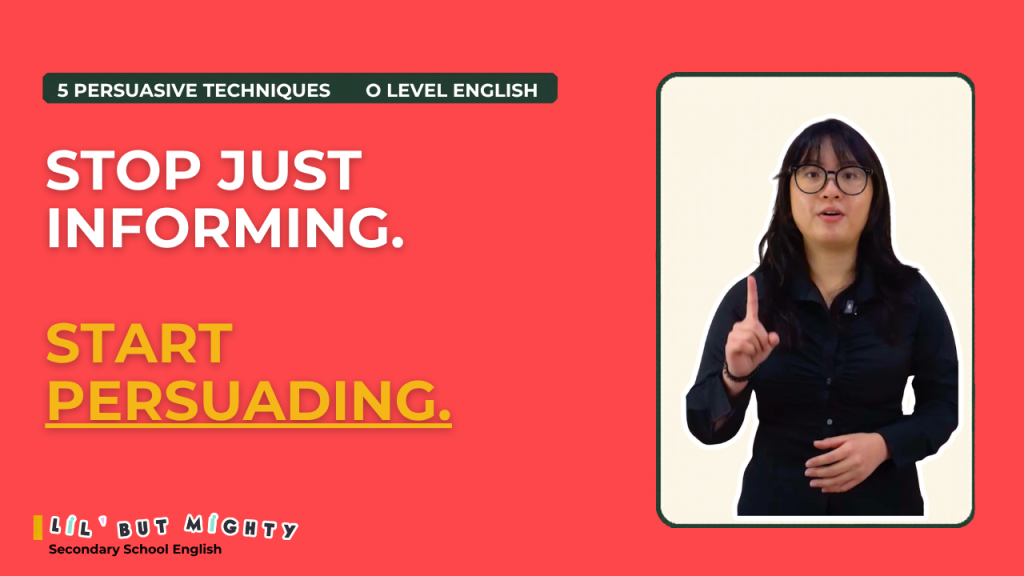
5 Effective Persuasive Language Techniques

5 Effective Persuasive Language Techniques to Elevate Your O Level Situational Writing!

Hey everyone, I’m Ms Cindy from Lil But Mighty, and if you’re doing O Level English, this video can seriously level up your situational writing.

In many situational writing tasks, you are not just informing. You are persuading. That means you are trying to influence what your reader thinks, feels, or does. You can see persuasive language all around you, in advertisements, speeches, social media posts, and even school announcements. The better you use it, the more convincing your writing becomes.

So today, I’m sharing five powerful persuasive techniques you can start using right away.

Like what you are watching? Please subscribe to our YouTube channel to receive our tips and strategies fresh from our studio!

Watch the video below!

1. Persuasive appeals

Let’s start with the foundation of persuasion. There are four main persuasive appeals, first introduced by the Greek philosopher, Aristotle.

Logos is logic. You persuade using facts, reasons, and evidence.

For example, Research shows a 20% increase in efficiency or using case studies to demonstrate real-world application and success.

Ethos is credibility. You persuade by sounding trustworthy and knowledgeable.

You can do so by sharing your experience in the chosen topic.

Pathos is emotion. You persuade by evoking emotional responses.

You can do so by sharing personal anecdotes or using vivid language.

Kairos is urgency. You persuade by showing why something matters right now.

For example:

Our planet is at a tipping point. With temperatures rising and glaciers melting faster than ever before, we cannot afford to wait.

2. Rhetorical devices

Rhetorical devices make your writing more powerful and memorable.

One example is figurative language. Metaphors, similes, and personification help create vivid images. For example:

‘Time is a thief’ is a metaphor.

‘Social media can be like a double-edged sword’ is a simile.

‘Hope emerged after the announcement’ is personification.

Another powerful tool is repetition.
Repeating key phrases helps your message stick.
For example, “We must act now. We must act decisively. We must act together.”

Then there is hyperbole, which means exaggeration for effect.
Saying “This is the opportunity of a lifetime!” makes something sound more urgent and impactful.

And don’t forget alliteration, where the same starting sound is repeated.
“Reduce, reuse, recycle” is easy to remember because of its rhythm.

Last of all, rhetorical questions. This is a question that does not need an answer. It is used to make the reader think.

For example, “Who wouldn’t want a brighter future?”

The answer is obvious, which guides the reader to agree with you. This is a very useful technique when you want your audience to mentally say yes.

3. Connotations

Words do not just have meanings. They also have feelings attached to them.

For example, saying “This policy is an investment in our future” sounds positive.
But saying “This policy is an increased government expenditure” sounds negative.

Both may describe the same thing, but the connotations change how the reader feels. Smart word choice can make your argument much more persuasive.

4. Inclusive language and direct address

Using words like “we”, “us”, and “our” helps create a sense of unity.
For example, “We all deserve better” makes the reader feel included.

Using “you” makes the message even more powerful.
Compare these two sentences:

“Everyone should do their part to stop climate change.”
“You should take action to stop climate change now.”

Which sentence do you think is more impactful? If you said the second one, you are right! The second sentence speaks directly to the individual, making them feel responsible and empowered to act.

5. Anecdotes

Anecdotes are short personal stories. They make your writing feel real.

For example, instead of just saying:

Dengue is a problem.

You could say:

Dengue continues to be a problem nationwide. In fact, recently, my neighbour next door was afflicted with dengue too. As I walk around my neighbourhood, it has become more common to see yellow or red dengue alert signs.

I hope you have learnt enough tools to use in your writing.

Remember, strong persuasive writing incorporates a range of language techniques. When you combine persuasive appeals, rhetorical devices, powerful word choice through the right connotations, and inclusive language, your situational writing becomes clear, convincing, and memorable.

Practise these techniques, and you will be well on your way to crafting persuasive and memorable pieces for your O Level situational writing!

Wordstruck Telegram profile

WordStruck Secondary English Telegram Channel

Welcome to Lil' but Mighty’s WordStruck official channel! 🎉
This community is dedicated to empowering students to excel in O-level English.
By 2026, we hope to support 1,000 students.🌟

Love,
Lil' but Mighty

Cindy Fu Teacher Profile
Ms Cindy

Ms Cindy is a patient and encouraging tutor who is dedicated to helping her students thrive in their English language learning. With her background in Philosophy, she brings a thoughtful and reflective approach to her teaching. Ms Cindy discovered her passion for education when she stepped in as a relief teacher, and she has since been committed to making her lessons both enjoyable and impactful.

Have something to share? Drop us a comment below!

Leave a Reply

Share

Other related posts

Creative Writing | 3 Easy Steps to Write Your Own Haiku!
Verbs: More than Just Action Words! | Part 3: Changes in Verb Forms
Ketchup on English! – is, are, was and were!
Audience In Visual Text | Visual Text Comprehension
Exploring Points of View (POV) in Composition Writing
Metaphors For? | Part II – Implied Metaphors
10 Beautiful Vivid Verbs to Boost Your Writing and Oral! | Primary School English
Metaphors For? | Part I – An Introduction to Metaphors
3 Family-Friendly Shows on Netflix (Educational & Entertaining)!
Verbs: More than Just Action Words! | Part 2: Tenses
2021 Father’s Day Contest Winners
Verbs: More than Just Action Words! | Part 1: Subject-Verb Agreement
10 Beautiful Words You Can Use in Narrative / Descriptive Writing | Secondary School
Ways To Create A Well-Rounded Character | Creative Writing
Understanding Purpose-Related Questions in Visual Text Comprehension
How Playing Video Games Can Improve Our English (With Practical Tips for Parents!)
Primary School Composition | Onomatopoeia – What’s That?
2021 Mother’s Day Contest Winners + Our Founder’s Journey (Mother’s Day Special)!
Composition Revision: Using Your 5 Senses in Your Writing
How to Create A Dynamic Piece of Writing Using Idioms
Ketchup on English! – Subject-Verb Agreement
4 steps to Create Suspense
That Simile Though 2 | Using Stronger Similes
Lil’ but Mighty Proudly Supports the HoneyKids Asia Spelling Bee 2026
PSLE ORAL | Compiled Prelim 2021 Oral Topics + Questions!
If you’re looking at getting recent PSLE Prelim Oral topics and practice questions, this will be an excellent resource for you!
5 Steps to Convert a Newspaper Article into a Cloze Passage
I would like to share with you 5 steps on how authentic articles can be transformed into cloze passages easily. Read on here!
PSLE English | Oral Conversation: Free SG50 Sample Practice + Model Answers
In this blogpost we will be touching on the oral stimulus-based conversation topic of National Day and SG50! Read on here!
PSLE English | Oral Conversation: Filling your Story with Details Easily + Free Revision Cards
By simply using the 5W1H, your children will be able to lengthen their stories (hence, the conversation!). Read on here!
Primary School Situational Writing: Q&A + Formal vs Informal Writing Comparison Chart
To aid you in your situational writing revision, here is a comparison chart that shows the differences between formal and informal writing!
PSLE English Tips | Oral: Stimulus-Based Conversation Checklist
To help my children handle the Stimulus-Based Conversation examination, here are some instructions again about using the checklist!
A Little Encouragement | DIY Motivational Bookmark (Easy to personalise too!)
A bookmark with a quote to motivate is also a chance for them to see the power of words and how words can mean more than what they seem.
Situational Writing: Step-by-Step Guide + Free Revision Card
I believe a walkthrough on the process of doing situational writing is in order. Here are the requirements for content and language!
I Love Reading | 5 Ways to Motivate Reluctant Readers
One of the most important ingredients necessary for a child or anyone learning English is the habit of reading. Get motivated to read now!
PSLE English | Printable Ultimate Grammar & Synthesis Summary
Today, we are sharing two lists of essentials in our Ultimate Grammar and Synthesis Summary Printable. Download them free here!
How Well Do You Know Your Past Participles?
While we are familiar with the past, present and future tenses, the little less known but equally important tense is the past participles.
Primary Composition Writing | Starting Sentences with Introductory Clauses
Today, we'll be revising the use of sentence starters to help you create variety in your sentence structures. Read on here!
The Sentence Train | Lower Primary English
Today, we are going to learn what makes up a sentence. It will come in handy when you do the word order activity in school! Read on here!
PSLE English Tips | Oral: Reading Checklist
This Oral Reading Checklist can be used by children when they practise reading on their own. Download it now!
Language of COVID | 10 Words Added to the Dictionary
Using Personification to Show, Not Tell!
Expressing Character Feelings Too! | Using Show-Not-Tell (Part 2)
How to Choose a Book to Read: 8 Ways
How to Dress Up A Boring Paragraph | Creative Writing
Ketchup on English! – Halloween Special: Prepositions of Time!
Ketchup on English! – Verbs Are Not Just Action Words!
Expressing Character Feelings | Using Show-Not-Tell
Which Picture Should I Use? | Choosing the Best Picture to Use for Composition!
Oral: Reading Passage | Long Vowels – Have You Been Reading Your Vowels Correctly?
Previous
Next

Like what you are reading?

Subscribe now to receive news and tips hot off the press!

shape icon 06
shape icon 05