Hi everyone! I’m Mr Aloysius, a Secondary English Curriculum Writer and Teacher at Lil’ but Mighty. In this post, I’ll be sharing insights and tips about preparing for the O-Level Argumentative Essay (2025).
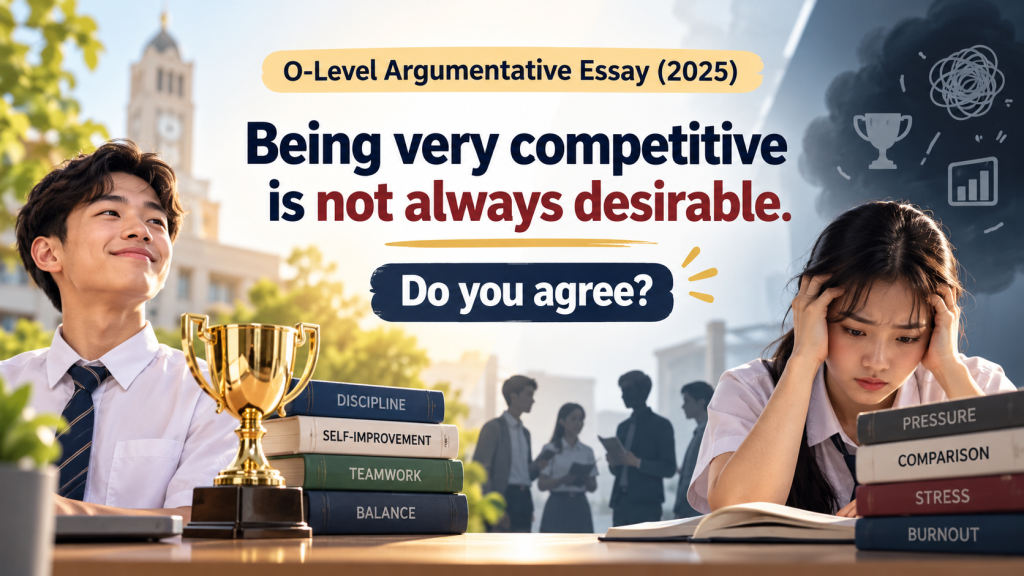
For the Paper 1, one of the O-Level argumentative essay (2025) questions asked students to discuss: “Being very competitive is not always desirable.” Do you agree? Why or why not? At first glance, this might seem like a simple question about whether competition is good or bad, but the key phrase is “very competitive”. Competition can push people to improve, yet someone who becomes too focused on beating others may experience stress or damage their relationships. So, rather than asking only, “Is competition good or bad?”, think about when competitiveness helps people and when it starts to go too far.
In this post, we’ll look at how to unpack the question, generate ideas and develop a balanced argument.
- Understanding the Question
Let’s start with “being very competitive”. If you are competitive, you want to do well and often want to perform better than the people around you. Think about two students who enter the same Mathematics competition. One enjoys the challenge and wants to see how well he can do. The other is determined to come first and gets upset whenever someone performs better. They are in the same competition, but they see it differently.
This is where the words “not always” become important. Wanting to win can encourage someone to work harder and improve. At the same time, a strong focus on winning can create pressure, especially when beating others becomes more important than improving yourself.
When you plan your essay, think about both situations. When can being competitive help someone improve? When can it start causing problems? This will give you more to discuss than simply deciding that competition is either good or bad.
- Using MMEPS to Find Ideas
The MMEPS (Moral, Mental, Emotional, Physical, Social) framework can help you look at an issue from different angles. You do not need to use every part of it in your essay. Instead, choose the areas that give you strong points that are clearly different from one another.
Moral: Competition can encourage people to follow rules and play fairly, especially when everyone is working towards the same goal. However, problems can arise when winning becomes more important than fairness. Someone who is desperate to get ahead may be tempted to cheat or treat others unfairly. When planning your ideas, think about this: What might happen if winning becomes more important than doing the right thing?
Mental: Competition can give people a clear goal and push them to put in more effort. For example, knowing that others are working hard may encourage a student to practise more and aim for better results. However, constantly comparing yourself with others can also create pressure. If someone becomes too worried about falling behind, they may spend more time thinking about losing than improving. Ask yourself: Does competition encourage me to improve, or am I becoming too worried about losing?
Emotional: Doing well in a competition can make people feel proud and encourage them to keep working hard. At the same time, constantly worrying about losing can make competition stressful. A person who keeps comparing his results with others may even begin to doubt himself. Ask yourself: Does competition make me want to improve, or does it make me afraid of failure?
Physical: This angle is especially useful when you are thinking about sports. Competition can encourage athletes to train harder and improve their performance. However, someone who is too focused on winning may push himself too hard and neglect rest. Think about it: Am I pushing myself to improve, or am I pushing myself too far?
Social: Competition can affect how people treat one another too. Friends can compete while still supporting each other, and friendly rivalry can even make activities more enjoyable. However, relationships may suffer when people start seeing everyone around them as a rival. For example, a student who is too focused on being the best may become less willing to help a classmate. Ask yourself: Can people compete with each other while still helping and respecting one another?
MMEPS is there to help you find ideas. Once you have chosen your strongest points, use PEEL to develop them!
- Planning Your Arguments
Once you have generated your ideas, choose the ones that you can explain most clearly. Look for points that are different enough to give you something new to discuss in each paragraph!
NOT AGREE: Why being competitive can be desirable
- Competition can motivate people to improve.
Having someone to compete against can encourage people to work harder and aim for better results. For example, two students preparing for a Mathematics competition may challenge each other to solve more difficult questions. When one student sees the other making progress, he may be motivated to practise more as well. In this situation, competition gives both students an extra push to improve.
- Competition can give people opportunities to learn from setbacks.
Since no one succeeds every time, competition can also give people opportunities to deal with disappointment. A setback can encourage someone to reflect on what went wrong and think about what to do differently next time. For example, a student who performs poorly in a school competition may think about what she could have done better and practise before trying again. If she learns from the experience instead of giving up, the setback can help her become more resilient.
AGREE: Why being very competitive can be undesirable
- Being too competitive can create unhealthy pressure.
A person who constantly compares himself with others may become more concerned about losing than making progress. Imagine a student who is determined to be the top scorer in his class. Even when his marks improve, he may still feel disappointed because someone else has scored higher. Over time, his focus may shift from “How can I improve?” to “How can I do better than everyone else?” As a result, being overly competitive may create stress and make it harder for the student to focus on improving.
- Being too competitive can affect relationships.
Being very competitive can also change the way people treat those around them. For instance, a student who is determined to be the best in his group may reject his teammates’ suggestions because he wants his own ideas to receive the most attention. This can frustrate the rest of the group and make it harder for them to work together. When winning becomes more important than working well with others, competitiveness can damage relationships.
- Singapore and Global Context
Competition is a familiar part of school life in Singapore. Students encounter it through examinations, school results and competitions, and may compare their performance with their peers.
Singapore’s latest PISA results give us some useful context. In PISA 2025, Singapore’s 15-year-olds ranked first in reading and second in mathematics and science among participating education systems. They also ranked second in the new computational problem-solving domain.
However, be careful about what you claim from these results. Do not write: “Singapore performs well in PISA because Singaporean students are competitive.” The results show that Singapore’s students performed strongly in the assessment. They do not show that competitiveness was the reason for this performance.
At the same time, strong academic performance does not mean that students experience no pressure. Earlier this year (2026), psychologists told Channel NewsAsia that they had seen up to a 20 per cent rise in cases involving exam-related stress every year since 2021. Some psychologists also observed that the pressure was increasingly coming from students themselves, as they worried about falling behind or disappointing their parents.
This gives you an important point to think about. High standards can motivate students to work hard, but too much focus on comparison and achievement can also create pressure. When using these examples, avoid claiming that one directly causes the other. Instead, use them to show that academic success and student pressure can exist at the same time.
Singapore has also made changes to reduce the pressure created by academic competition. Weighted assessments and examinations for Primary 1 and Primary 2 were removed in 2019, while the PSLE T-score was replaced by the Achievement Level system from 2021. More recently, fewer O-Level subjects will count towards JC admission from 2028, giving students more room to focus on their interests rather than trying to perform well in every subject.
At the same time, reducing the number of examinations does not necessarily make students less competitive. Some students have pointed out that if everyone has fewer subjects to take, they may still feel pressure to outperform others. Parents may also use the extra time for enrichment activities, so the pressure to get ahead could simply take a different form.
This is another important point to consider when discussing competitiveness. Changing the education system can reduce some sources of pressure, but students may still compare themselves with others and worry about falling behind. In other words, how competitive people are can affect how they respond to the opportunities and pressures around them.
Looking beyond Singapore’s shores, other countries provide useful examples too:
China’s Gaokao, the national university entrance examination, shows how intense academic competition can create pressure for students and families. In 2026, 12.9 million students registered for the examination, as competition for university places remains a major part of the education system.
South Korea’s Suneung provides another example. In 2025, more than 554,000 students took the university entrance examination, and flights across the country were temporarily halted during the English listening section so that aircraft noise would not disrupt the students. With such an important examination affecting not only students but also workplaces, airports and other parts of society, it shows how far-reaching high-stakes competition can become.
Competition can have positive effects as well. At the Olympics, athletes compete against some of the best in the world, yet this rivalry can push them to train harder and improve their performances. For them, having strong competitors can provide an extra reason to keep improving.
When you use examples like these, don’t stop after stating the fact. Explain what it shows and link it back to your argument. A strong example without explanation is still just a fact!
- Making Your Concluding Reflection More Evaluative
A common weakness in argumentative essays is ending by simply repeating the points from the body paragraphs. For example, a student might explain that competition can motivate people, cause stress and affect relationships, then conclude that being very competitive is not always desirable.
Your conclusion can do a little more! Once you have made your judgement, pause and ask yourself what follows from it. You could think about: what might happen in the future, take the idea further, or consider what could be done about the issue.
Technique 1: Look ahead
Think about what might happen if the issue continues. Sometimes, the effects of an issue do not stop where your essay does.
For instance, if students become used to measuring themselves against others, they may carry this habit into their future careers. Even when they are doing well, they may continue to feel that they are falling behind whenever someone else succeeds. The issue has now moved beyond school competitiveness and into the way they see their own progress in the working world.
Ask yourself: “Could this affect people in the future?”
Technique 2: Take the idea further
You can also ask what might happen if the situation becomes more serious. Being competitive may push someone to work harder at first, but what happens when winning gradually becomes the main goal?
A person who becomes too focused on getting ahead may find it harder to appreciate his own progress. Instead of being satisfied with improving, he may always be looking at what someone else has achieved and wondering how to overtake them.
Ask yourself: “What happens if this continues or becomes worse?”
Technique 3: Think about what could be done
Sometimes, your reflection can lead you to a possible response. If competition can motivate people but also create pressure, for example, perhaps the answer is not to remove competition altogether. People could still compete, but learn to see winning as one part of success rather than the only measure of it.
Ask yourself: “If this is a problem, what could people do about it?”
You do not need to use all three techniques in your conclusion. In fact, trying to squeeze all of them in can make your ending feel forced. Instead, choose the one that fits your argument and gives you something meaningful to say.
That is the point of a concluding reflection: you have already told the reader what you think, so now show them why your judgement matters.
- Common Pitfalls
a) Confusing competition with competitiveness
Competition is the situation in which people try to achieve the same goal while competing against one another. Competitiveness, on the other hand, describes a person’s desire to win or outperform others.
This distinction matters because the question is about being very competitive. You can still talk about competition in your essay, but keep asking what that competition does to the person taking part. Does it motivate them to improve, or does the desire to win start affecting the way they think and behave?
- b) Treating all competition as harmful
The phrase “very competitive” matters. A student can compete with a classmate and still respect that person. Wanting to win does not automatically make someone unreasonable or unfair, so do not spend the entire essay arguing that competition itself is harmful.
Instead, think about what happens when the desire to win becomes so strong that it starts affecting other parts of a person’s life. Someone who is determined to come first might push himself to work harder, for example, but he might also put too much pressure on himself or become less willing to support others.
Ask yourself: “Is the problem the competition itself, or the way someone responds to it?”
c) Making winning the only measure of success
Coming first is not the only possible benefit of being competitive. A person may work harder, become more disciplined or learn from a setback because the competition gives them something to strive towards, even if they do not end up winning.
When planning this kind of argument, ask yourself: “What does the person gain from competing, even if they do not win?” This can help you move beyond a simple “winning is good” argument and consider what the experience might teach or develop in someone.
d) Giving examples without explaining them
Do not stop at: “Students may become stressed because they compete with their classmates.”
Show how one thing leads to another. A student may keep comparing his results with those of his classmates, start worrying about falling behind and eventually become more concerned about losing than improving. That explanation makes the connection between competition and stress much clearer.
Remember, an example gives you evidence, but your explanation tells the reader why that evidence matters.
e) Forcing MMEPS into every paragraph
MMEPS is a tool for finding ideas, not a structure you have to follow. You do not need to use all five angles, and you certainly do not need to write one paragraph for each letter.
Choose the angles that give you strong, clearly different arguments. If two points are really saying the same thing, combine them or keep the one you can develop more fully. You want ideas that give you enough to explain, rather than squeezing every possible MMEPS angle into the essay.
- Wrapping Up
We hope that this has helped you better understand how to unpack this question! Being very competitive can push people to work harder and improve, especially when they see winning as a challenge to overcome. At the same time, the desire to win can create pressure or affect how people treat others when it becomes too strong. Remember that as you write, think about when competitiveness brings out the best in people, and when it starts to go too far!

WordStruck Secondary English Telegram Channel
Welcome to Lil' but Mighty’s WordStruck official channel! 🎉
This community is dedicated to empowering students to excel in O-level English.
By 2026, we hope to support 1,000 students.🌟
Love,
Lil' but Mighty