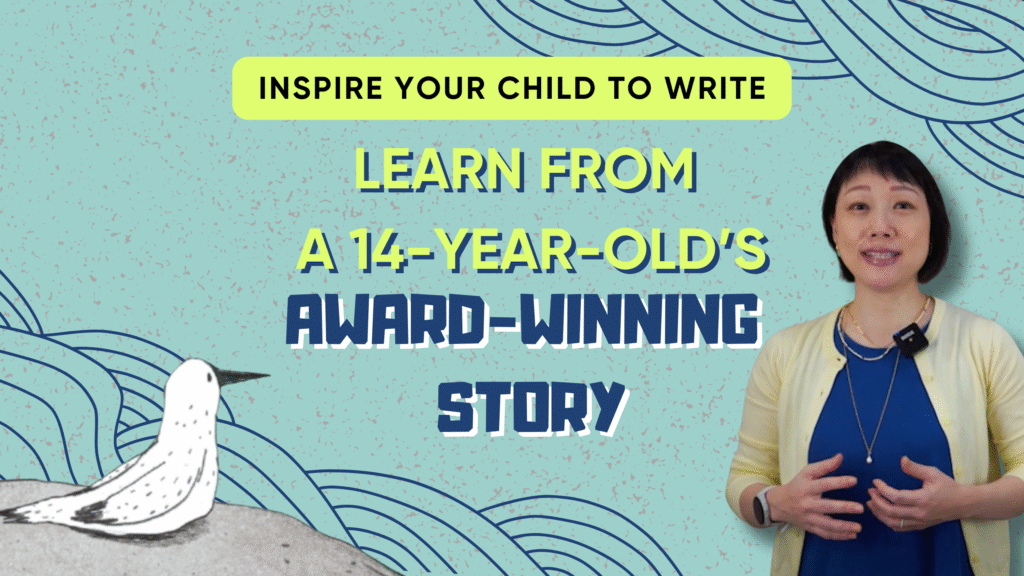
Hi! I’m Ms Kelly from Lil’ but Mighty and welcome to my very first video post! I hope that you’re just as eager as I am to get started. Today, I’m going to show you that children, although little, can become mighty writers and inspire your child to write!
Introduction: Writer’s Background
Did you know that a student wrote an essay on the topic “An Unlikely Friendship” when she was just 14 years old for the Commonwealth Essay Writing Competition and she won first prize? Her name is Chew Chia Shiao Wei and her story was so well loved that it has been published into an illustrated book. You can borrow it from the National Library!
Plot: Topic
Originally named “Unlikely Friends”, this story was eventually published under the title of “The Rock and the Bird”. What an exciting topic! It tells us straightaway that the 2 unlikely friends are a rock… and a bird!
Let us unpack how this topic is unraveled through different story elements! First of all, the juxtaposition of these 2 very different things highlights how unlikely the friendship is. We would never have guessed that a rock and a bird would be friends.
Not only that, their personalities are as different as chalk and cheese! The bird is flighty and noisy while the rock is peaceable and never talks aloud when it is alone.
Secondly, the story defines a “friendship” as a deep relationship between 2 living things that are not family, and we can certainly feel a strong sense of love and concern between the 2 as the story unfolds! The bird decides to do whatever it can to save the rock from being reduced to a grain of sand by the unrelenting waves, working day and night for an entire week. After realising that it cannot save the rock, it still makes a significant decision to return frequently to visit the rock so it would not be lonely. The bird shows us that friendship is demonstrated by significant actions and decisions.
Similarly, the rock grows out of its shell after being moved by the bird’s actions and looks forward to the bird’s visits so it could hear about the bird’s expeditions around the world. The rock also holds the bird dearly in its heart at the story’s end when it continues to think back of the times they have spent together even after the bird has passed away. The rock shows us that friendship is a desire to spend time together and having cherished memories that last a lifetime.
Plot: Structure
This deeply moving story follows the 7-paragraph structure that we use for compositions at LBM! To demonstrate this, let me dissect the plot for you now:
Paragraph 1: Introduction
The story starts off with detailed descriptions of the place and the main character. The rock (Main #1) is described as weathered and lonely. It does not think much. Rather, it prefers to listen to the waves. Sensorial descriptions tell us about waves rushing up to erode the rock and sand swirling in the water.
Paragraph 2: Main #1 met main #2
Then in paragraph 2, there is a brief moment of suspense when the writer describes the “blurred shape of a bird” blocking out the sunlight. The rock (Main #1) and the bird (Main #2) do not get along well in the beginning! They have a little altercation where the rock gently accuses the bird of being rude and the bird responds with anger and sarcasm.
Paragraph 3: Build-Up
We then transit to a moment of realisation about the fleeting nature of life when the bird asks the rock about how it would end up as a grain of sand since it could not move away from the waves. The dialogue between the 2 characters show us how the bird comes to the significant decision to spend immense effort to save the rock despite the rock’s bemusement.
Paragraph 4: Problem / Climax
The story reaches its climax when we read that the bird, being deeply sincere, spends an entire week using its beak to try to push the rock up the shore. It gets so innovative that it even wraps seaweed around the rock to use it as a rope to pull the rock up.
Paragraph 5: Extension of the Problem
The problem is not resolved because the rock finally breaks the news to the bird that it cannot be saved and thanks the bird for its friendship. The bird contemplates the implications of this fact and takes time to accept the situation. It flies away.
Paragraph 6: Consequences
We are delighted that in the consequences paragraph, the bird returns. It has decided to keep the rock company so it will not be lonely! The rock doesn’t say anything (much like its character), but is secretly happy. So begins a happy era where the bird goes on expeditions and returns to tell the rock of its experiences. The rock describes this period with the bird as “a vivid story of colours in the wind” as compared to the “sepia tinted” time it spends alone at the shore. We experience what friendship looks like during the time spent together between the two.
Paragraph 7: Conclusion
One day, after many years, the rock suddenly realises that its surroundings have changed. Through sensorial description, the rock tells us “the sky felt green and the sand was turning white” and the rock feels “cold and hot again” when the sea touches it. This is a pivotal moment when it understands that the bird has passed away and would never visit again. The conclusion spends equal amount of time showing the rock mourning the loss of its friend, time moving on and the fulfilment of the bird’s intention of befriending the rock – after centuries, the rock feels warm when it thinks of the bird that was “warmer than the sun itself”. It now has cherished memories that would accompany it forever.
Now that we have taken a first look at The Rock and the Bird and how the plot structure is established, be sure to look out for the next part where I will talk about the literary devices used. If you have enjoyed this video and want to inspire your child to write, do remember to like and subscribe!