English Revision

How can I prepare for the English paper?

Hello, everyone! This is Ms Nandy, a Specialist English Teacher at Lil’ but Mighty (Hougang branch). We are about 2 months away from the 2025 Primary School Leaving Examination (PSLE), and I’m here to answer a common question that is burning in the minds of both parents and students alike: how can I prepare for the English paper? Fret not – here are five easy tips to help you on this!

1. Study Smart: Set a Study Plan!

With not one but four subjects to study for, it is important to have proper time management. Create a study plan and allocate time to revise each subject. This will reduce stress and allow productive learning to take place. For English, there are four main papers that you will be sitting for:

Paper 1: Writing

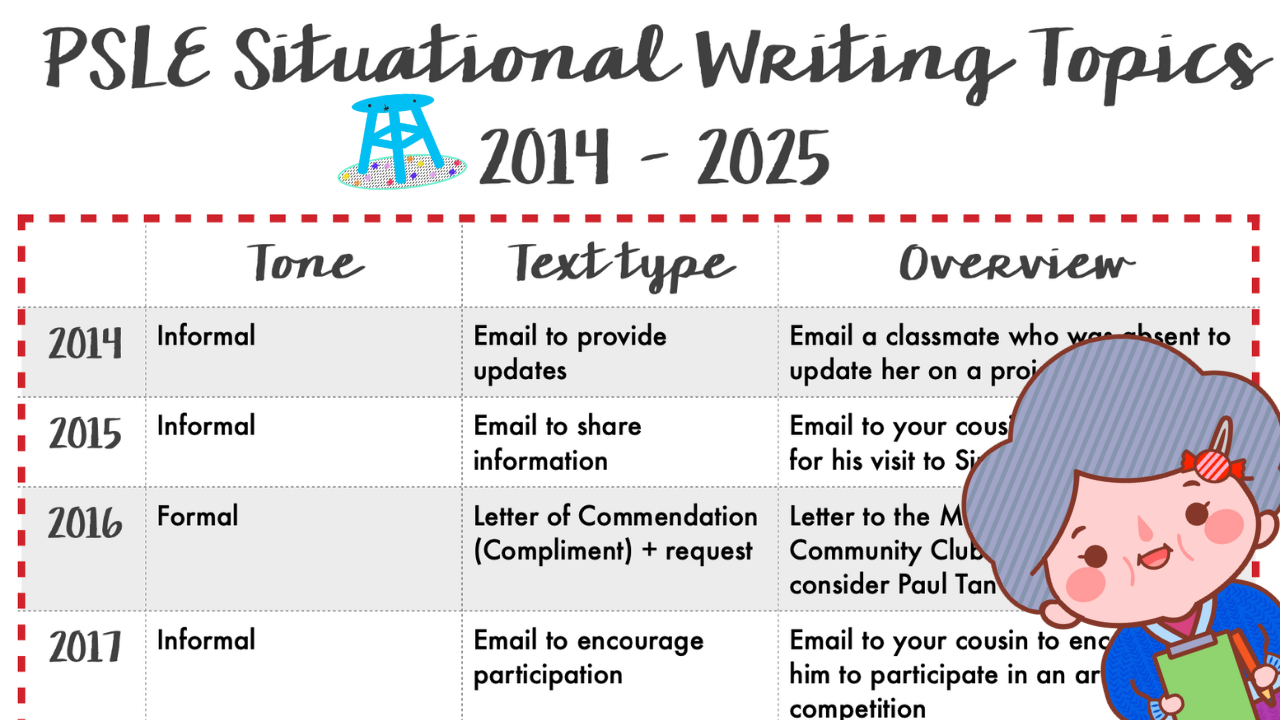
  • Situational Writing
  • Continuous Writing


Paper 2: Language Use and Comprehension

  • Booklet A (Grammar MCQ, Vocabulary MCQ, Vocabulary Cloze and Visual Text Comprehension)
  • Booklet B (Grammar Cloze, Editing, Comprehension Cloze, Synthesis and Transformation and Comprehension Open-Ended)

Paper 3: Listening Comprehension

Paper 4: Oral Communication

  • Reading Aloud
  • Stimulus-based Conversation


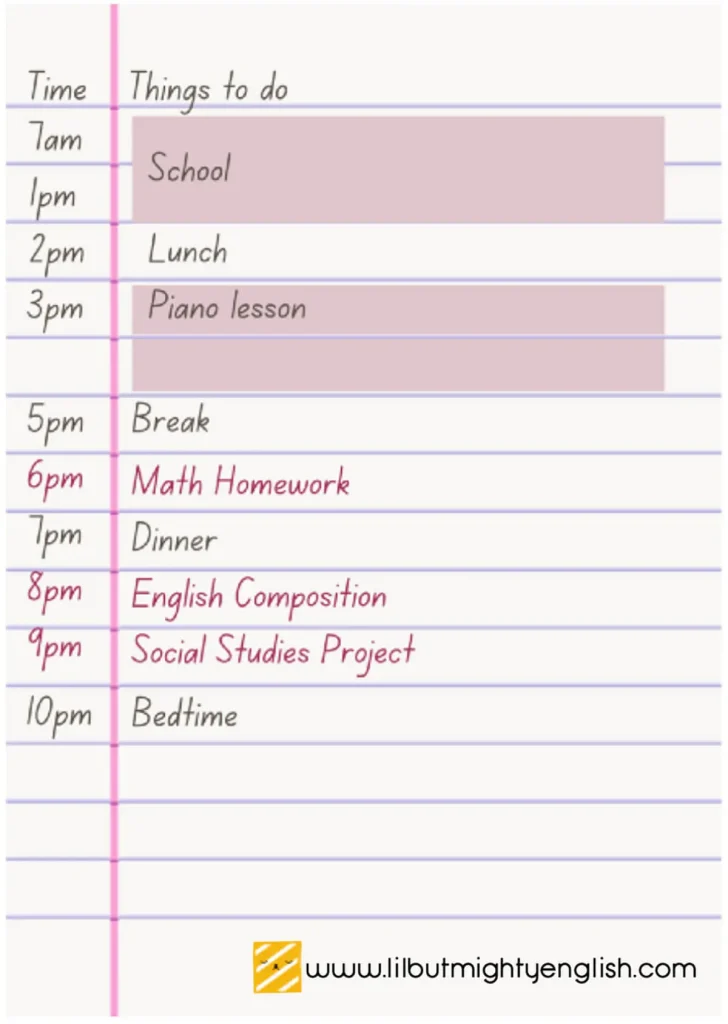
Out of the 4, Paper 1 and Paper 2 will need the most revision. We’re all human – there are sections that you may not be a fan of *cough-Compre-cough-Compo*. However, every mark counts and you need to ensure that you revise all the sections to score well. When crafting your study plan, rotate between the different components when you set aside time for English revision. You should also spend more time on the sections that you find challenging. You can refer to the sample study plan given below for some inspiration!
English Revision

2. Get Better at Grammar

Bear Hands

Grammar is a system of rules that allows us to assemble and structure our sentences correctly. Having a strong foundation in grammar will aid you not only through primary and secondary school but it also sets the foundation for your education path throughout your life. Most of the time, students answer questions by going with what sounds right rather than what is grammatically right. While this technique may work in some sections, it will cause a downfall in others! To do well in all aspects of the English paper, a good foundation in grammar is essential. Know your tenses and verbs well so that you can answer confidently and avoid making careless errors. When doing grammar questions, always analyse the given information and highlight your clues. LBM offers plenty of resources that you can refer to. You can check them out here!

3. Learn with Lists and Necessary Notes

English Revision

Notes and lists are very useful tools when it comes to preparing for the English exam. I usually encourage my students to have a folder with multiple dividers or a notebook for their English revision. Start making lists for any set of words that you can benefit from. Some common lists would be for irregular verb forms, vocabulary words, commonly misspelt words and word class! Below are two examples of lists you can create to help in your revision:

English Revision

You should also take down notes for the various rules and techniques that you will need to remember, especially for sections like Synthesis and Transformation, and Grammar MCQ!

4. Practice makes Progress

English Revision

The more your practise, the better you get! For English, it is good to work on past year examination papers as they are set in line with the PSLE syllabus. While doing these papers, you can simulate exam conditions as follows:

a)  Find a conducive corner at home

b)  Remove all distractions such as your mobile devices

c)  Set a timer – e.g. 1 hour 10 mins for Paper 1, 1 hour and 50 mins for Paper 2

d)  Focus and give it your best shot!

By doing the above, you are training yourself to work well under exam conditions while improving on your time management skills. Once you are done with your exam paper, get an adult to help you mark using the answer key. If you have any doubts on the questions that you answered wrongly, you can always approach your LBM teacher for clarification. You can also sign up for one of LBM’s self-paced online courses to improve in the sections that you are weak in! Check out the range that we offer here.

5. Grow your General Knowledge

grammar grandma

In the Paper 2 sections like Grammar Cloze, Editing and Comprehension Cloze, the passages are related to general knowledge. They can be about animals, natural disasters, or happenings around the world. To know how to answer some of the questions, growing your general knowledge is crucial. Try to read a short newspaper article every day about a different topic. Pick out collocations — which refer to how words go together or form fixed relationships — or phrasal verbs that you come across, look up their meanings and note them down. Watching the news on television or a video clip on a particular topic like global warming or extinction of a particular animal species will also be very useful! You may find yourself understanding the passage better by having such background knowledge, and this will consequently help you in selecting or coming up with the appropriate answers for the blanks or questions.

Preparing for the PSLE is not easy, but I hope the five tips above help you in achieving your goals and setting yourself up for success. Remember, hard work goes a long way. Good luck!

You can find Ms Nandy’s English Tuition classes at our Kovan branch here: Block 211 Hougang Street 21, #01-305 (Back entrance), Singapore 530211

Ms Nandy
Ms Nandy

Empowering young minds is a powerful job. I find satisfaction in teaching my students the power of words. No two students are the same and instead of measuring their achievements against the societal yardstick, I strive to help my students become better versions of themselves – not only academically but also on a holistic level. Nothing makes me happier than watching my students achieve good grades and grow more confident!

Have something to share? Drop us a comment below!

Leave a Reply

Share

Other related posts

Creative Writing | 3 Easy Steps to Write Your Own Haiku!
Verbs: More than Just Action Words! | Part 3: Changes in Verb Forms
Ketchup on English! – is, are, was and were!
Audience In Visual Text | Visual Text Comprehension
Exploring Points of View (POV) in Composition Writing
Metaphors For? | Part II – Implied Metaphors
10 Beautiful Vivid Verbs to Boost Your Writing and Oral! | Primary School English
Metaphors For? | Part I – An Introduction to Metaphors
3 Family-Friendly Shows on Netflix (Educational & Entertaining)!
Verbs: More than Just Action Words! | Part 2: Tenses
2021 Father’s Day Contest Winners
Verbs: More than Just Action Words! | Part 1: Subject-Verb Agreement
10 Beautiful Words You Can Use in Narrative / Descriptive Writing | Secondary School
Ways To Create A Well-Rounded Character | Creative Writing
Understanding Purpose-Related Questions in Visual Text Comprehension
How Playing Video Games Can Improve Our English (With Practical Tips for Parents!)
Primary School Composition | Onomatopoeia – What’s That?
2021 Mother’s Day Contest Winners + Our Founder’s Journey (Mother’s Day Special)!
Composition Revision: Using Your 5 Senses in Your Writing
How to Create A Dynamic Piece of Writing Using Idioms
Ketchup on English! – Subject-Verb Agreement
4 steps to Create Suspense
That Simile Though 2 | Using Stronger Similes
PSLE ORAL | Compiled Prelim 2021 Oral Topics + Questions!
If you’re looking at getting recent PSLE Prelim Oral topics and practice questions, this will be an excellent resource for you!
5 Steps to Convert a Newspaper Article into a Cloze Passage
I would like to share with you 5 steps on how authentic articles can be transformed into cloze passages easily. Read on here!
PSLE English | Oral Conversation: Free SG50 Sample Practice + Model Answers
In this blogpost we will be touching on the oral stimulus-based conversation topic of National Day and SG50! Read on here!
PSLE English | Oral Conversation: Filling your Story with Details Easily + Free Revision Cards
By simply using the 5W1H, your children will be able to lengthen their stories (hence, the conversation!). Read on here!
Primary School Situational Writing: Q&A + Formal vs Informal Writing Comparison Chart
To aid you in your situational writing revision, here is a comparison chart that shows the differences between formal and informal writing!
PSLE English Tips | Oral: Stimulus-Based Conversation Checklist
To help my children handle the Stimulus-Based Conversation examination, here are some instructions again about using the checklist!
A Little Encouragement | DIY Motivational Bookmark (Easy to personalise too!)
A bookmark with a quote to motivate is also a chance for them to see the power of words and how words can mean more than what they seem.
Situational Writing: Step-by-Step Guide + Free Revision Card
I believe a walkthrough on the process of doing situational writing is in order. Here are the requirements for content and language!
I Love Reading | 5 Ways to Motivate Reluctant Readers
One of the most important ingredients necessary for a child or anyone learning English is the habit of reading. Get motivated to read now!
PSLE English | Printable Ultimate Grammar & Synthesis Summary
Today, we are sharing two lists of essentials in our Ultimate Grammar and Synthesis Summary Printable. Download them free here!
How Well Do You Know Your Past Participles?
While we are familiar with the past, present and future tenses, the little less known but equally important tense is the past participles.
Primary Composition Writing | Starting Sentences with Introductory Clauses
Today, we'll be revising the use of sentence starters to help you create variety in your sentence structures. Read on here!
The Sentence Train | Lower Primary English
Today, we are going to learn what makes up a sentence. It will come in handy when you do the word order activity in school! Read on here!
PSLE English Tips | Oral: Reading Checklist
This Oral Reading Checklist can be used by children when they practise reading on their own. Download it now!
Language of COVID | 10 Words Added to the Dictionary
Using Personification to Show, Not Tell!
Expressing Character Feelings Too! | Using Show-Not-Tell (Part 2)
How to Choose a Book to Read: 8 Ways
How to Dress Up A Boring Paragraph | Creative Writing
Ketchup on English! – Halloween Special: Prepositions of Time!
Ketchup on English! – Verbs Are Not Just Action Words!
Expressing Character Feelings | Using Show-Not-Tell
Which Picture Should I Use? | Choosing the Best Picture to Use for Composition!
Oral: Reading Passage | Long Vowels – Have You Been Reading Your Vowels Correctly?
Previous
Next

Like what you are reading?

Subscribe now to receive news and tips hot off the press!

shape icon 06
shape icon 05