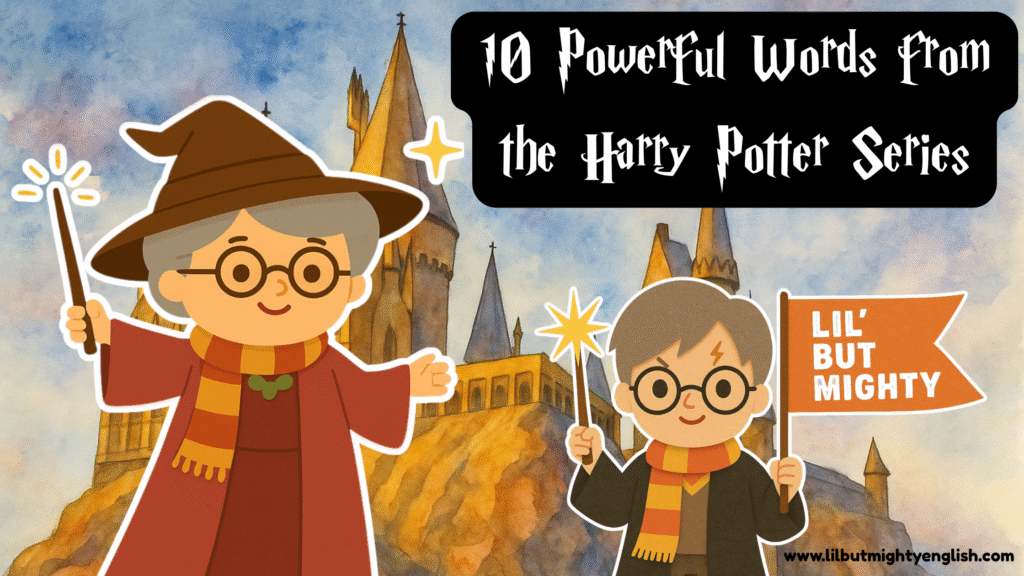
The Harry Potter series is more than just an enchanting escape—it’s a linguistic goldmine for English learners! J.K. Rowling’s rich prose introduces sophisticated vocabulary, vivid descriptions, and engaging dialogue, making it an incredible resource for anyone to enhance their English skills. Through this beloved series, you’ll not only immerse yourself in a world of magic but also expand your vocabulary, improve comprehension, and refine your writing. It’s a great way to discover 10 powerful words from Harry Potter.

Hello everyone! I’m Ms Vani, a Specialist English Teacher at Lil’ but Mighty (Bukit Timah Branch), and welcome to my first post. I’ll be doing a five-part series on how Harry Potter can elevate your English, providing a treasure trove of phrases and words to incorporate into your own language use. The first part of this series will focus on magical vocabulary—words that bring the wizarding world to life while enhancing your ability to express yourself creatively. Stay tuned for a spellbinding linguistic adventure!
Magical Vocabulary: Words That Add Depth and Precision
J.K. Rowling’s word choices are vivid and purposeful, offering readers a variety of vocabulary that can enrich essays, creative writing, and even everyday conversation. Learning these words will help you express your ideas with greater clarity, emotion, and sophistication.

Here are 10 powerful words from Harry Potter that you can use to enhance your writing and speaking skills:
1. Enigmatic (adjective) – mysterious, puzzling, or difficult to understand
📌 How to use it: Use enigmatic when describing a person, object, or situation that is full of mystery or hard to figure out.
✅ Example: Professor Dumbledore’s enigmatic smile made Harry wonder what he was really thinking.
2. Menacing (adjective) – threatening or suggesting danger
📌 How to use it: Use menacing to describe something that seems scary, dangerous, or harmful.
✅ Example: The dark and menacing forest loomed over them, making every step feel even more dangerous.
3. Imposing (adjective) – grand, impressive, or commanding in appearance
📌 How to use it: Use imposing to describe a place, person, or thing that looks strong, powerful, or important.
✅ Example: Hogwarts stood as an imposing fortress, its towering turrets glowing against the night sky.
4. Immaculate (adjective) – spotlessly clean, perfect, or flawless
📌 How to use it: Use immaculate when describing something that is completely clean, neat, or without any mistakes.
✅ Example: Hermione always kept her books and notes in an immaculate order, while Ron’s were messy and covered in ink stains.
5. Fleeting (adjective) – lasting for a very short time
📌 How to use it: Use fleeting when talking about something that happens quickly and then disappears.
✅ Example: Harry caught a fleeting glimpse of the Golden Snitch before it vanished behind a cloud.
6. Resilient (adjective) – able to recover quickly from difficulties; strong and determined
📌 How to use it: Use resilient when talking about someone who doesn’t give up, even when things are tough.
✅ Example: Despite facing many challenges, Harry remained resilient in his fight against Voldemort, never giving up hope.
7. Ominous (adjective) – giving the feeling that something bad is going to happen
📌 How to use it: Use ominous when describing a dark, scary, or threatening situation.
✅ Example: The sky turned a deep shade of purple, and an ominous silence filled the air, making the students uneasy.
8. Whimsical (adjective) – playful, imaginative, or unpredictable
📌 How to use it: Use whimsical to describe something fun, magical, or a little strange in an amusing way.
✅ Example: The Weasleys’ house, The Burrow, had a whimsical charm, with its crooked walls, and floating pots and pans.
9. Elaborate (adjective/verb)
(Adjective) – very detailed and complicated
(Verb) – to explain something in detail
📌 How to use it: Use elaborate as an adjective to describe something with a lot of details. Use it as a verb when you want to say more about a topic.
✅ Example (adjective): The Yule Ball decorations were elaborate, with shimmering lights and magical snowflakes falling from the ceiling.
✅ Example (verb): Hermione asked Harry to elaborate on his plan to sneak into the restricted section of the library.
10. Bewildered (adjective) – completely confused or puzzled
📌 How to use it: Use bewildered to describe someone who doesn’t understand what is happening and feels lost.
✅ Example: Ron looked bewildered as he stared at his broken wand, unsure of how it had snapped in two.
Why Use These Words?
Using these words in your writing and speaking will make your English sound more natural, precise, and expressive. Instead of saying something is “very scary,” try menacing or ominous. Instead of saying someone is “very strong,” try resilient. The more you practise, the easier it will be to use these words in everyday situations!

📝 Magical Vocabulary Quiz: Test Your Knowledge!

Let’s see how well you’ve understood and can apply these magical words! Choose the correct answer or fill in the blanks with the right word.
1. Which word best describes something mysterious and difficult to understand?
A) Immaculate
B) Enigmatic
C) Resilient
D) Elaborate
2. Fill in the blank:
The sky turned dark, and an __________ silence filled the air as the storm approached.
(Hint: This word means something gives the feeling that something bad is going to happen.)
3. Ron stared at Hermione’s perfectly neat notes and sighed, looking at his own crumpled, ink-stained pages. Hermione’s notes were truly __________.
A) menacing
B) imposing
C) immaculate
D) fleeting
4. Fill in the blank:
Despite all the difficulties he faced, Harry remained __________ and never gave up on his mission to defeat Voldemort.”
(Hint: This word means strong and able to recover from challenges.)
5. Which sentence uses the word “whimsical” correctly?
A) The old haunted house gave off a whimsical feeling that sent shivers down my spine.
B) The wizard’s shop was full of whimsical items, from floating candles to talking teacups.
C) The menacing teacher gave us a whimsical look before announcing a pop quiz.
D) Hogwarts Castle was imposing and whimsical in a terrifying way.
Let’s see how many of the questions you have managed to answer accurately!
1. Which word best describes something mysterious and difficult to understand?
The answer is of course (B) Enigmatic!
2. Fill in the blank:
The sky turned dark, and an __________ silence filled the air as the storm approached.
If your answer is ‘ominous’, then you are definitely correct! The clue ‘the sky turned dark’ and the fact that the storm was approaching tell us that something bad is about to happen.
3. Ron stared at Hermione’s perfectly neat notes and sighed, looking at his own crumpled, ink-stained pages. Hermione’s notes were truly __________.
Hermione’s notes were definitely (C) immaculate because compared to Ron’s crumpled, ink-stained pages, hers were flawless. (We wouldn’t expect less of Hermione, would we?)
4. Fill in the blank:
Despite all the difficulties he faced, Harry remained __________ and never gave up on his mission to defeat Voldemort.
Did you guess that the word is ‘resilient’? Well done! The phrases ‘despite all the difficulties’ and ‘never gave up’ tell us that Harry was indeed strong and determined in wanting to defeat He-Who-Must-Not-Be-Named.
5. Which sentence uses the word “whimsical” correctly?
The correct sentence is: B) The wizard’s shop was full of whimsical items, from floating candles to talking teacups. Imagine walking into a shop full of such items – it would be a little strange but in an amusing and magical way!
💬 How many did you get right? Let me know in the comments! 😊 ✨
Here are 10 powerful words from Harry Potter to level up your vocabulary: Wand, Muggle, Patronus, Horcrux, Quidditch, Gryffindor, Slytherin, Dementor, Polyjuice, and Apparition. Which one is your favourite?
Till my next post, have fun with learning new and exciting vocabulary!
You can find our English Tuition at 170 Upper Bukit Timah Road, #B2-02 Bukit Timah Shopping Centre, Singapore 588179