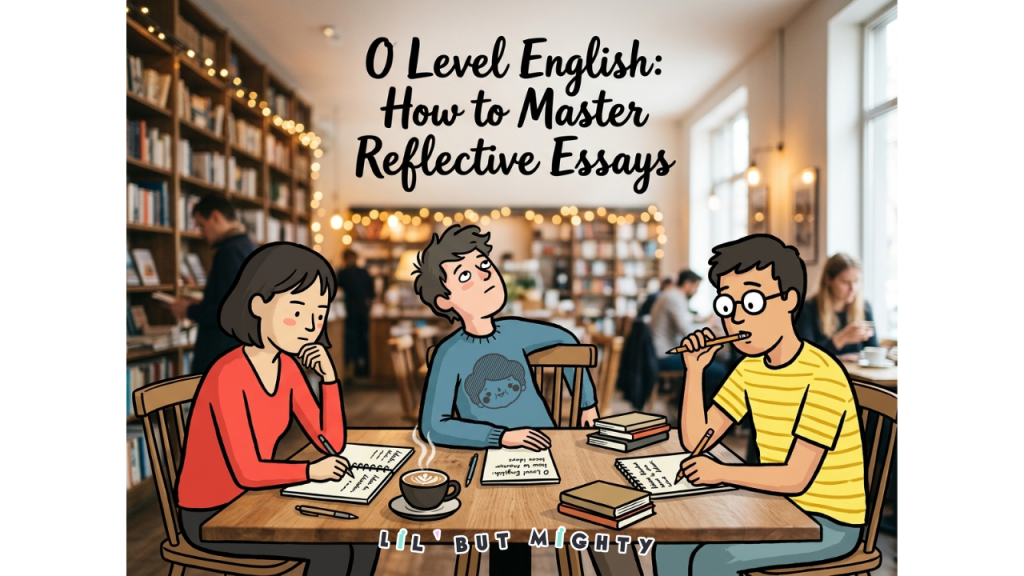
For many students taking the GCE O-Level English paper, reflective writing might feel vague and unpredictable. Unlike narrative essays, you cannot rely on dramatic plots. So what exactly are examiners looking for? Hi everyone, I am Teacher Cindy from Lil but Mighty, and today, I want to help you shed some light on how to write reflective essays!
What is a Reflective Essay?
A reflective essay is a unique form of writing where you explore personal experiences, analyse their impact and share the lessons learned.
Reflective essay questions include the world ‘you’ and requires the writer to share personal thoughts and feelings about a certain topic. Here is an example of a reflective essay question:
Some people enjoy being in a crowded place, while others prefer somewhere quieter… Describe your perfect place when you want to relax.
O Level 2022
Some reflective essays call for a range of other writing styles such as narrative and descriptive writing while others focus purely on garnering reflections.
For more information on other types of essays in the O Level examination, you may visit this blog post here.
However, regardless of the requirements, the reflective essay requires you to reflect upon your experiences and write from a personal point of view. Hence, reflective writings can be more fluid in structure and style. If possible, pick a topic that allows you to write about something unique and will show off your personality.
Reflective essay questions can be divided into three categories: self, events and relationships. Before we delve into that, let’s take a look at what is expected of you in a reflective essay.
Working on the Elements of Reflective Writing
- Focus on or pinpoint the issue in question
- Think about two or three particularly memorable incidents to help you explain your point
- Formulate your own opinion about that issue
- Describe your feelings about the issue
- Elaborate on the reasons for your opinion and emotions (e.g why do you think or feel that way?)
- Use descriptive language (use of adjectives, literary devices) to recount
- Include the use of dialogue to make your writing more engaging
- Reflect on what have you learnt from the experience at the end of the essay
- Explain how it changed you: How has this experience influenced your behaviour, beliefs, or future decisions?
With the above in mind, let’s explore the three categories of reflective essay questions. Grab a notebook now and prepare to jot down notes to explore how to address the 9 points above based on the examples of questions listed below!
About yourself
You are the person who understands yourself best, which can make writing about your own experiences both a straightforward and challenging task.
Reflective essay topics often inspire a flood of potential ideas, but it’s essential to refine your focus to a single, impactful response—one that will truly captivate your readers. Here are some examples of topics to reflect about yourself:
1. How have you overcome adversity?
2. What has been your greatest accomplishment to date?
3. What is your biggest fear?
4. What would you consider to be your greatest weakness?
5. What do you like most about yourself?
Let’s examine Q1. Here is an example of how we can quickly think about
|
Element |
Points |
|
1. Pinpoint issue |
Failing a mathematics exam and loss of confidence |
|
2. Memorable incidents |
Receiving results, Mother’s reaction, restructuring routine |
|
3. Own opinion |
Tackling adversity is about response, not the event itself |
|
4. Feelings described |
Cold palms, doubt, denial |
|
5. Reasons explained |
Fear of continuous failure, bleak future |
|
6. Descriptive language |
“numbers swimming”, “fractured identity”, “persistent shadow” |
|
7. Dialogue used |
“Let’s move forward and not dwell on this.” (Mother’s advice) |
|
8. Lesson learnt |
Overcoming adversity requires resilience which comes from honest reflection and commitment to change |
|
9. How it changed you |
Approach setbacks through reflection rather than self-criticism |
About Events
Events present a treasure trove of reflective essay topics to choose from. After all, life is just a series of events, and the ones you remember most vividly are the ones that will make the best essays. When writing about events, vivid details can make the reader feel that they are right there with you. Try to include why the event is significant or what you learned from it. Here are some examples of topics to reflect about events:
- Share about your most exciting vacation.
- What is your favourite holiday memory?
- Tell of a time when you got lost.
- What was your first job experience?
- Share about a time you won an award.
|
Element |
Points |
|
1. Pinpoint issue |
Struggling academically before improvement (Most Improved Award) |
|
2. Memorable incidents |
Leaving test sections blank, teacher’s dialogue, award ceremony |
|
3. Own opinion |
Growth is more meaningful than comparison |
|
4. Feelings described |
Initial embarrassment / frustration, pride, humility |
|
5. Reasons explained |
Lack of motivation, attitude change after teacher intervention |
|
6. Descriptive language |
“Applause rose like a sudden wave”, “fog began to lift” |
|
7. Dialogue used |
“You’re capable of more than this.” / “Why is this still so hard?” |
|
8. Lesson learnt |
Improvement matters more than talent |
|
9. How it changed you |
Now focus on progress rather than comparison |
About relationships with others
Life is not a journey you take alone. The bonds you build with other people affect the type of person you become. When writing an essay using these types of reflective essay topics, you will want to show the interaction between you and the other person, and how the person has altered your life. Here are some examples of topics to reflect about your relationships with others:
- Who do you admire the most?
- What is the most hurtful thing someone has said to you?
- Share about a time when you had to break off a friendship.
- What is the top quality you look for in a friend?
- Describe your relationship with a family member.
|
Element |
Points |
|
1. Pinpoint issue |
Valuing honesty in friendship |
|
2. Memorable incidents |
Group project, friend’s honest but harsh comment |
|
3. Own opinion |
Honesty is more valuable than agreement |
|
4. Feelings described |
Defensive, stung, unsettled |
|
5. Reasons explained |
Honest feedback improves growth |
|
6. Descriptive language |
“Anchors a relationship”, “illusion shattered” |
|
7. Dialogue used |
“I think you can do better.” |
|
8. Lesson learnt |
Integrity strengthens trust |
|
9. How it changed you |
Now respond with reflection, not defensiveness |
Reflective Essay Structure
A clear structure will help your essay flow and make it easier for readers to follow your thoughts. Here’s a common format:
a) Introduction
- Start with a hook to grab the reader’s attention (e.g. a question, quote, or vivid description).
- Provide a brief overview of the experience or topic you will reflect on.
- End with a thesis statement that highlights the key insight or lesson learned.
***Be specific about the question that the following examples are addressing
Example:
Standing on the stage, I could feel my palms sweating and my heart racing. It was the moment I had dreaded and anticipated for weeks. Little did I know, this speech would not only boost my confidence but also change how I viewed failure.
b) Body
- Describe the experience: Recount the event or situation in detail. Use sensory descriptions to make it vivid.
- Analyse the impact: Reflect on how the experience affected you, what emotions you felt, and why it was significant.
- Connect to a broader idea: Relate your personal experience to larger themes or lessons.
Example:
As I stood there, stumbling over my words, I felt the familiar grip of self-doubt tightening. Yet, when I glanced at the supportive smiles in the audience, a spark of determination ignited within me. I realised that making mistakes in front of others was not the end of the world but an opportunity to grow.
c) Conclusion
- Summarise the key points and insights.
- Reflect on how the experience has changed you or your perspective.
- End with a thought-provoking statement or call to action.
Example:
Looking back, that moment on stage taught me that fear is often the first step toward courage. It reminded me that growth comes from embracing discomfort, and now, I welcome challenges with a newfound sense of resilience.
Use Reflective Language
Reflective essays are personal and introspective, so your writing style should match. You should use:
- First-person perspective: I realised… / I felt… / My perspective changed…
- Vocabulary to describe feelings: Exhilarated / apprehensive / humbled / overwhelmed
- Descriptive language: Paint vivid pictures with words to immerse the reader
- Analytical phrases: This made me realise… / I came to understand… / It occurred to me…
Final Thoughts
I hope you can apply the above tips in your writing! Reflective essays are a chance to explore your inner world and share meaningful experiences with others. By choosing a personal topic, using a clear structure, and reflecting deeply, you can create a powerful essay that leaves a lasting impression. Try your hand now to start reflecting and let your insights shine!
WhatsApp us: https://wa.me/+6596460930

WordStruck Secondary English Telegram Channel
Welcome to Lil' but Mighty’s WordStruck official channel! 🎉
This community is dedicated to empowering students to excel in O-level English.
By 2026, we hope to support 1,000 students.🌟
Love,
Lil' but Mighty