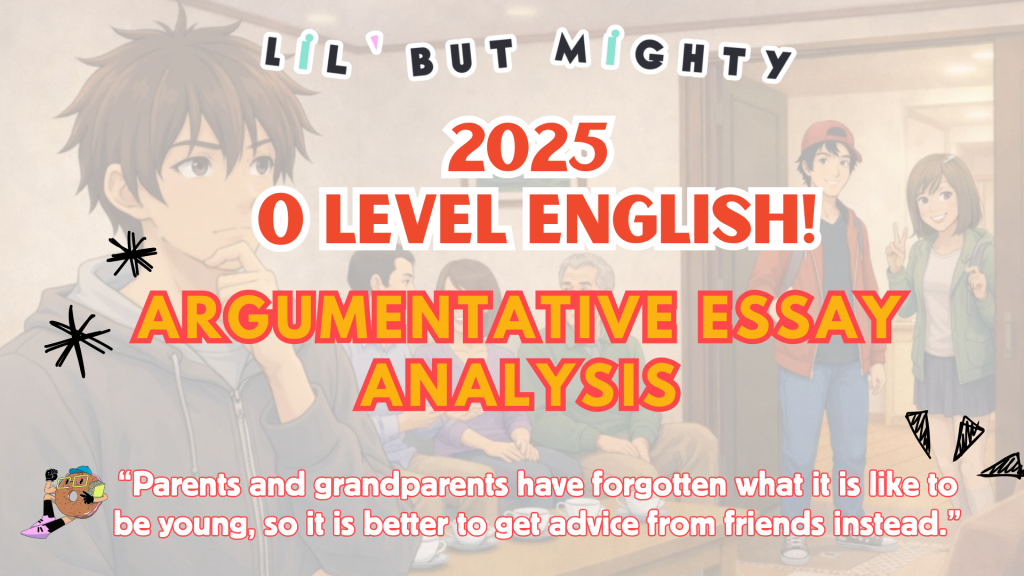
Hi everyone! I’m Mr Aloysius, a Secondary English Curriculum Writer and Teacher at Lil’ but Mighty (Tampines). For the 2025 O-Level Paper 1, one of the essay questions required students to discuss:
“Parents and grandparents have forgotten what it is like to be young, so it is better to get advice from friends instead.” How far do you agree?”
At first glance, this question seems straightforward: surely teenagers prefer talking to friends. But high-band argumentative essays go beyond personal opinion: they balance emotion with reason and logic. The key is to evaluate, not take sides.
This post unpacks the question, and guides you through how to plan and write a quality response.
What Sets Argumentative and Expository Essays Apart?
Students often ask about the difference between argumentative and expository essays. Here’s a simple breakdown:
Argumentative essays are about persuasion. Your main goal is to convince the reader that your viewpoint is logical and valid. This means you’ll present your own claims but also consider opposing views, showing why they may be less convincing or flawed. Strong argumentative essays usually feature:
- Clear opinions or stances on an issue
- Use of evidence and examples to justify your position
- Counter-arguments with thoughtful rebuttals
- A formal, rational tone balanced with occasional emotional appeal
Expository essays, on the other hand, are focused on explaining or clarifying a topic. There’s no attempt to sway the reader’s beliefs—instead, your job is to lay out information in a clear, neutral manner. Think of it as teaching someone about a subject, free from bias or personal opinion. Key features include:
- Objective descriptions and explanations
- Logical organization of facts and details
- No requirement to take a side or argue a position
- A neutral, straightforward tone
In short, if you’re appealing to someone’s mind and asking them to agree with you, you’re writing an argumentative essay. If you’re simply enlightening them about how something works, what it means, or why it matters (without taking sides), you’re crafting an expository essay.
Quick Summary
Question Focus: Whether young people should rely more on friends or on older family members for advice.
Purpose: To argue clearly and maturely, showing balanced perspectives about both generations.
Key Techniques:
- PEEL (Point–Example–Explain–Link) for argument structure.
- MMEPS (Moral, Mental, Emotional, Physical, Social) for developing depth.
- Topic sentences that guide the reader through each argument.
- Balanced tone: Confident but respectful.
Tone: Rational, reflective, and empathetic: show understanding of different perspectives.
Common Pitfalls:
- Overgeneralising (“All parents are outdated”).
- Sounding like a rant rather than an argument.
- Failing to acknowledge why older generations can still give good advice.
Understanding the Question
The question contrasts two sources of advice (friends versus parents and grandparents) and asks you to evaluate how far you agree.
- The clause “have forgotten what it is like to be young” implies emotional distance or generational gap.
- “Better to get advice from friends instead” requires evaluation: Better in what sense? More relatable? More accurate? Easier to accept?
A top-band essay must address both sides. Even if you personally feel that friends understand you more, you must acknowledge that older generations still provide experience and long-term perspective. Balance between empathy and experience: friends may empathise, while adults provide experience and foresight.
A simple way to think about this question is to ask: Under what circumstances is friends’ advice better, and when is adults’ advice still superior?
Evaluative Planning with MMEPS
The evaluation should be grounded in MMEPS. Each argument must show contrast: what friends can provide versus what parents or grandparents can still offer.
- Mental: Relatability vs Perspective
Friends understand the mental pressures of youth. They attend the same schools, face similar assessments, and navigate the same digital environments. Their advice often feels immediately relevant.
However, adults provide something teenagers cannot replicate. They have lived through both successes and failures. Their perspective is shaped by long-term outcomes and learning from mistakes.
Evaluative example:
While a friend may offer relatable coping strategies for exam stress, a parent can explain how to manage pressure over time. This comparison shows that relatability helps in the moment, but perspective shapes long-term resilience.
- Moral: Shared confusion vs tested judgement
Teenagers often share the same uncertainties about right and wrong. Their moral compass is still forming. A friend can listen and relate, but may reinforce impulsive or risky decisions.
Parents and grandparents use moral frameworks shaped by real consequences. Their advice is grounded in what they have seen or personally experienced.
Evaluative example:
Even when peers mean well, they may encourage choices driven by emotion rather than ethics. Adults, however, can warn against actions that carry serious consequences. This suggests that moral guidance is better provided by those with tested judgement, not those still finding it.
- Emotional: Comfort vs accountability
Friends excel at empathy. They listen without judgement and validate feelings. This emotional support can be comforting, especially when the issue is personal or sensitive.
Adults offer a different form of emotional care. It is less about validation and more about stability. Parents and grandparents can provide accountability, boundaries, and reassurance.
Evaluative example:
Although peers can soothe temporary distress, they may lack the emotional distance to challenge unwise choices. Adults can separate emotion from action, which leads to clearer decisions.
- Physical: Shared experiences vs protective instinct
Friends understand the physical environment teenagers live in. They know school routines, daily habits, and common stressors. Their suggestions often match a teenager’s lifestyle.
Adults view physical decisions with a protective lens. Their instincts are shaped by responsibility. They tend to consider safety, health, and long-term impact more carefully.
Evaluative example:
A peer might advise joining a late-night outing because it feels fun and harmless. A parent will consider safety, fatigue, and commitments the next morning. The difference shows when advice should lean toward caution.
- Social: Peer dynamics vs life transitions
Friends understand teenage social systems. They can guide you through friendship tensions, school culture, and online behaviour. Their advice feels current because they operate within the same social norms.
Parents and grandparents draw from a broader understanding of human relationships. They have lived through shifting friendships, work relationships, and family responsibilities. They recognise potential challenges that teenagers overlook.
Evaluative example:
A friend may help you navigate a disagreement on social media, but a parent can explain how to repair trust in deeper, long-term relationships. This broader perspective is something most peers cannot offer.
Effective Condensed Evaluative Comparisons
- While friends understand your emotions because they experience the same struggles, they often need guidance themselves, whereas adults can warn against risks based on real results.
- Even if older generations appear disconnected from youth culture, their guidance is stronger in situations where teenagers have not experienced the consequences yet.
- Although friends offer relatable and comforting advice, adults provide the clarity that comes from lived experience.
- Friends may help you feel understood, but parents help you think more clearly.
- Peer advice fits the present moment. Adult advice prepares you for the future.
Writing a Balanced Introduction
Teenagers often feel that the adults in their lives no longer remember what it is like to be young. Friends seem more relatable, while parents and grandparents may appear distant or outdated. Yet adult advice is shaped by experience, and peer advice is shaped by empathy, so both offer different forms of value. In my view, the best guidance depends on the situation, and a balance of perspective and relatability leads to clearer and safer decisions.
This introduction works for several reasons:
- Balanced framing: It avoids taking sides immediately. Instead, it recognises the strengths of both groups. This shows maturity and evaluative awareness.
- Clear contrast: The introduction sets up a natural comparison – relatability from friends versus perspective from adults. This immediately makes clear the direction of the essay.
- Logical stance: The final line gives a clear, nuanced position, that the best advice depends on context. This sets up a well-reasoned discussion rather than a personal recount.
Developing Body Paragraphs using PEEL
Body Paragraph 1 – Friends Understand the Present (Agree)
Point: Teenagers often turn to friends because peers share the same environment.
Explain: They face similar pressures from school, social media, and identity, which increases emotional relatability. A 2022 survey on youth mental health in Singapore noted that older teenagers are more likely to confide first in peers because they fear judgment from adults, or perceive that the adults do not understand them. This immediacy creates trust. A friend understands the insecurity arising from an Instagram post not getting enough likes, or the tendency to overthink when a text message is not replied to. Such empathy helps teenagers feel heard rather than corrected.
Example: Once, I sent a query in my class group chat and watched it being sidelined without a single reply. Everyone carried on discussing something else, and the silence felt overbearing to me. My friend sensed how insecure I became and reminded me that people often get distracted or forget to respond. She told me not to overthink it, and that if it mattered, I could always resend the message. Her reassurance helped me see that the silence was not judgment, but simply a moment of being overlooked in a busy chat.
Link: This shows why peer advice often feels relevant for immediate struggles that are emotional, and works wonders in helping one feel supported.
Body Paragraph 2 – Parents and Grandparents Bring Perspective (Disagree)
Point: Parents and grandparents may not understand every trend, but they bring stability that peers cannot replicate.
Explain: Their guidance is shaped by consequences they have already lived through. Advice about balancing academics, health, and friendships is based on real outcomes, not assumptions. Studies on youth burnout in Singapore show rising stress among students who push themselves without boundaries. Adults recognise these dangers earlier because they have experienced similar patterns at work or home.
Example: When my mother insisted that I rest during exam season, I dismissed it as outdated advice. She often reminded me to pace myself, space out revision, and avoid leaving everything to the last minute. I brushed it off because I assumed I could handle the pressure and believed that working longer automatically meant working better. This confidence was misplaced. By the time the year-end exams approached, I struggled to focus, felt mentally drained, and experienced several emotional breakdowns. My mother later explained that she had faced similar problems early in her career when she pushed herself without structure. Her point was not about control, but about time management and self-discipline. Her experience showed why adult guidance can prevent mistakes, which teenagers may otherwise make when relying only on peers at the same life-stage.
Link: This shows how adult guidance adds long-term clarity that peer support cannot always provide.
Body Paragraph 3 – Evaluating the Generational Gap (Analysis)
Both friends and adults provide valuable guidance, but their strengths work best in different situations. Friends offer empathy and emotional understanding, which helps when dealing with immediate pressures such as school stress, social conflicts, or personal insecurities. Parents and grandparents bring perspective and foresight, which is crucial when decisions carry long-term consequences or involve risks that teens may not fully anticipate. The generational gap does not mean that adults cannot relate; it means their advice may be delivered differently, often through caution rather than shared experience. Teenagers benefit most when they recognise that peer support can help them manage present challenges, while adult guidance helps them plan and avoid preventable mistakes. Effective decision-making often comes from knowing when to seek empathy and when to seek experience.
Body Paragraph 4 – Conclusion
In conclusion, friends understand the pressures teenagers face, so their advice can feel more honest and immediate. However, it is not fair to assume that parents and grandparents have forgotten their youth. It is important to recognise vast life experience, while acknowledging also that their communication styles are different. Their advice is shaped by consequences we have not faced yet, which makes it useful when choices affect our future. Hence, it is not simply better to choose one group over the other. It depends on the situation. For emotional support, friends help most. For long-term guidance, adults are usually clearer. The smartest move is thus to listen to both. I will always remember the words of wisdom someone shared with me: “Take advice from people who know how you feel, and also from people who know where you are going.”
—————————
I hope that you are much clearer about how to unpack the question, how you can do evaluative planning to help you craft your essay in a structured manner and also how to develop the various parts of your essay to tackle this question effectively! In Part 2 of decoding the O Level Argumentative essay 2025, we will share with you common pitfalls you must avoid and also useful authentic resources that will make a difference to your writing.
Argumentative Writing Using Current Affairs & Avoiding Pitfalls: “Parents and grandparents have forgotten what it is like to be young, so it is better to get advice from friends instead.” O-Level Argumentative Essay (2025)
Hi everyone! I’m Mr Aloysius, a Secondary English Curriculum Writer and Teacher at Lil’ but Mighty. In Part 2 of decoding the O Level Argumentative essay 2025, we will be sharing common pitfalls to avoid, as well as useful authentic resources that will make a difference to your writing.
Using Current Affairs and Real-World Examples
Real-world examples strengthen an argumentative essay because they show that your reasoning is grounded in reality, not personal opinion. For this question, your examples should highlight the tension between relatability from friends and long-term clarity from adults. Each example should be accurate, relevant, and used to evaluate, not just describe.
- Mental Health and Emotional Support
A 2022 survey on youth mental health in Singapore noted that older teenagers are more likely to turn to friends or try to resolve problems on their own without the help of their parents. Reasons included: desire for independence, not wanting to look “vulnerable”, or the perception that their parents would not take them seriously. This shows that friends can possibly offer immediate emotional comfort, especially in areas of stress, relationships, or school pressure.
However, the same report emphasised that stable adult support improves long-term outcomes. The survey reported that about 60 per cent of the youth acknowledged they would turn to both parents and friends when under stress. This provides the argument that emotional relatability may begin with peers, but clarity and stability still come from older generations.
How to use it:
While friends may understand the emotional pressure of examinations or social issues, sustained support often requires adults who can intervene, advise, or provide resources.
- Digital Safety and Online Behaviour
Reports by the Singapore Police Force indicate a rise in youths who fall for misinformation and scams, specifically e-commerce scams, job scams, and phishing scams. They were mostly scammed via messaging platforms, online shopping platforms, and social media. Teens often follow advice from peers about online behaviour, yet they are also the group most vulnerable to digital risks.
A Milieu Insight survey conducted in 2024 found that over 60 per cent of youths under 18 have encountered fake news, especially from social media platforms such as Instagram or TikTok. Peer-driven influence can normalise unsafe practices, such as unverified sharing of information or messages to humour their friends.
This same survey emphasised the important role parents play in protecting their children from the dangers of fake news, particularly the use of artificial intelligence to create deepfakes for deception.
How to use it:
Friends may empathise with the desire to fit in online, but their advice may lack caution. Parents, who understand long-term risks, often provide the clearer and safer perspective.
Sources:
https://mothership.sg/2025/08/youths-adults-scam-victims-spf/
- Health, Vaping, and Risk-Taking Behaviours
Multiple Singapore news reports in 2025 have documented a sharp rise in teen vaping, often introduced or normalised by peers. Indeed, social workers shared in a report that vaping is “normalised and perceived as acceptable in peer groups”, such as school mates or boyfriends/girlfriends. Many teens pick up the habit through friends who downplay its risks, with the misconception that it is a “safer alternative to smoking”.
Adults, on the other hand, emphasise long-term harm such as addiction and respiratory issues. Many of the addicted teens were also referred to sources of help by concerned and worried parents.
This supports the evaluation that friends can validate feelings, but adults warn about consequences beyond the moment.
How to use it:
Peer advice may be comforting, but in situations involving health or safety, teens benefit more from experienced guidance.
- Money, Career, and Future Planning
Financial literacy reports and commentaries call for parents’ increased involvement in guiding their children to understand money’s value, especially in this cashless society. Indeed, one such report shares the following: “Researchers call this financial socialisation: the process by which children pick up values, attitudes and skills about money through family influence.”
Indeed, financial literacy is “not just about balancing dollars and cents”, but also teaching “boundaries and the scarcity of money, and how to prioritise their needs and wants through dollar-cost-averaging”. Through conversations and watching their parents’ actions, youths are able to learn values of discernment, discipline and long-term planning. Adults, especially parents, have navigated job markets, bills, commitments, and failures. Their advice is grounded in consequences, not just feelings.
Friends can offer sympathy about academic pressure or career uncertainty, but they usually lack the lived experience to advise beyond the next few months. However, the increasing popularity of /r/SGExams (an online Reddit forum on anything student-related in Singapore) has led many youths to turn to anonymous ‘friends’ (Redditors) for advice on examination tips, rants about academic struggles and even school admission choices. Behind the cloak of anonymity, youths may feel more assured and comfortable sharing their deepest struggles and insecurities, without the fear of being judged.
How to use it:
This helps you argue that some advice requires foresight that only experience provides, making adult guidance more reliable.
https://endowus.com/insights/financial-literacy-for-kids
- Friendship Conflicts and Social Pressures
Studies by youth organisations in Singapore show that teenagers commonly seek peer advice on friendship or social conflict. They feel that peers “get it” because they experience the same pressures from group dynamics and expectations. This is also particularly evident in cyberspace, particularly /r/SGExams. Beyond just academic tips, youths would also turn to this platform to seek advice about friendship struggles, romantic uncertainties and other ‘slice-of-life content’, posting personal snippets about their lives.
However, it is important to note that peer advice can reinforce bias, since friends may take sides, escalate emotion, or encourage avoidance instead of problem-solving.
How to use it:
This supports a balanced argument. Friends help with empathy and relatability, but adults provide neutrality, emotional distance, and fairness.
Sources:
Common Pitfalls
- One-sided or superficial arguments
Some students argue that “parents don’t understand” without explaining why. This creates a flat, teenage rant rather than a reasoned evaluation. Examiners expect you to compare perspectives, not dismiss one side. A strong answer shows when friends give better advice and when adults do. It recognises context instead of assuming adults have “forgotten” their youth.
- Weak reasoning and vague generalisations
Another common issue is relying on statements like “friends always know how I feel” or “adults always nag.” These claims sound immature because they ignore exceptions. Instead, you should explain why peer advice helps with emotional issues, and why adult advice matters for long-term decisions. Use simple, believable scenarios, not dramatic stories. Avoid turning this into a personal recount.
- Emotional tone that replaces logic
Some answers slip into frustration or exaggeration (“My parents never understand anything”). This weakens your argument because it feels defensive instead of thoughtful. A better approach is to analyse the communication gap, or critique the generational gap. Explain how tone, phrasing, and assumptions affect how advice is received. Show empathy for both sides rather than blaming one group.
- Ignoring evaluation and comparison
This question requires more than listing points. Some essays give separate paragraphs on “friends” and “parents” without explaining when each group is more reliable. Examiners look for judgement. You must compare reasons in the same paragraph, weigh their strengths, and explain the circumstances under which each group gives better guidance. Without evaluation, the essay becomes descriptive rather than argumentative.
Conclusion
This argumentative essay question invites more than a “friends versus parents” generational debate. Instead, it seeks empathy and discernment, exploring how understanding can bridge that gap. Whether you side more with peers or with adults, remember: maturity is not choosing one over the other, but recognising that wisdom often lies somewhere in between!

WordStruck Secondary English Telegram Channel
Welcome to Lil' but Mighty’s WordStruck official channel! 🎉
This community is dedicated to empowering students to excel in O-level English.
By 2026, we hope to support 1,000 students.🌟
Love,
Lil' but Mighty