Dorothy’s Grammar Quest: Tackling Tricky Subjects and Verbs (Part 1)
- Grammar, Primary School English
Home » PSLE Cloze Passage
PSLE Cloze Passage tests more than just vocabulary knowledge. To do well, students need to use context clues, understand sentence structure, and choose words that fit both meaning and grammar accurately. Many students recognise familiar words, but still lose marks because they pick an answer that does not fit the sentence or the passage as a whole.
This guide brings together the key skills, strategies, and next steps students need to become more confident and accurate in PSLE Cloze Passage.
PSLE Cloze Passage tests whether students can choose the most suitable word for each blank in a passage. To do that well, students need to understand how grammar, vocabulary, and context work together.
A strong cloze passage performance usually includes:
Cloze Passage is not just about choosing a word that looks familiar. It is about choosing the word that fits the meaning, tone, and grammar of the sentence most accurately.
A strong understanding of Cloze Passage helps students:
Many students find Cloze Passage difficult because they focus too quickly on the blank itself without paying enough attention to the full sentence or passage. They may recognise a suitable-looking word, but still choose the wrong answer because they do not check whether it truly fits the grammar and meaning.
Students often struggle because they:
This is why Cloze Passage can feel frustrating. It is not only about vocabulary size. It is also about context reading, grammar awareness, and careful decision-making.
A strong Cloze Passage performance is not about getting lucky with a familiar word. It is usually about reading carefully and choosing the word that best fits both meaning and structure.
Strong cloze answers often have these qualities:
Students usually do better when they understand that Cloze Passage is about fit and meaning, not just word recognition.
Students usually improve faster in Cloze Passage when they focus on specific reading and grammar skills instead of guessing from word familiarity.
Students also benefit from learning how to avoid rushing to fill the blank, use sentence clues before and after the gap, recognise common vocabulary patterns, and check whether the completed sentence sounds natural.
One of the most important skills in Cloze Passage is using context clues. These clues help students work out what kind of word is needed and whether an answer fits naturally.
Context clues may come from:
Students often do better when they stop looking at the blank as an isolated question and start seeing it as part of a larger meaning pattern.
Students should understand what the sentence is saying before trying to fill the blank.
Students should notice clue words, grammar signals, and meaning patterns that help narrow the answer.
Students should ask whether the blank needs a verb, noun, adjective, connector, or another type of word.
Students should choose the word that best matches the idea of the sentence and the passage.
Students should check whether the sentence sounds natural, grammatical, and accurate in context.
If needed, students should look at the surrounding sentences to confirm the answer fits the flow of ideas.
This step-by-step approach often helps students slow down, think more clearly, and choose more accurately.
Students often lose marks in Cloze Passage because of repeated habits that weaken their answer choices.
Some students also think the hardest-looking word must be the correct answer. In reality, the best answer is usually the one that fits most naturally and accurately in context.
A stronger approach is to combine:
Cloze Passage becomes much easier when students break it down into smaller, more manageable skills.
Students usually improve most when cloze practice becomes structured and purposeful.
Regular focused practice helps students recognise patterns more quickly and choose more accurately over time.
Cloze Passage does not only help students in one part of Paper 2. It also strengthens broader English skills.
When students improve in Cloze Passage, they often become better at:
That is why Cloze Passage is best viewed as a core vocabulary-and-grammar-in-context skill, not just one exam component.

Build stronger cloze passage skills through our Primary English regular classes, where students receive structured guidance in vocabulary use, context reading, and accurate answer selection.
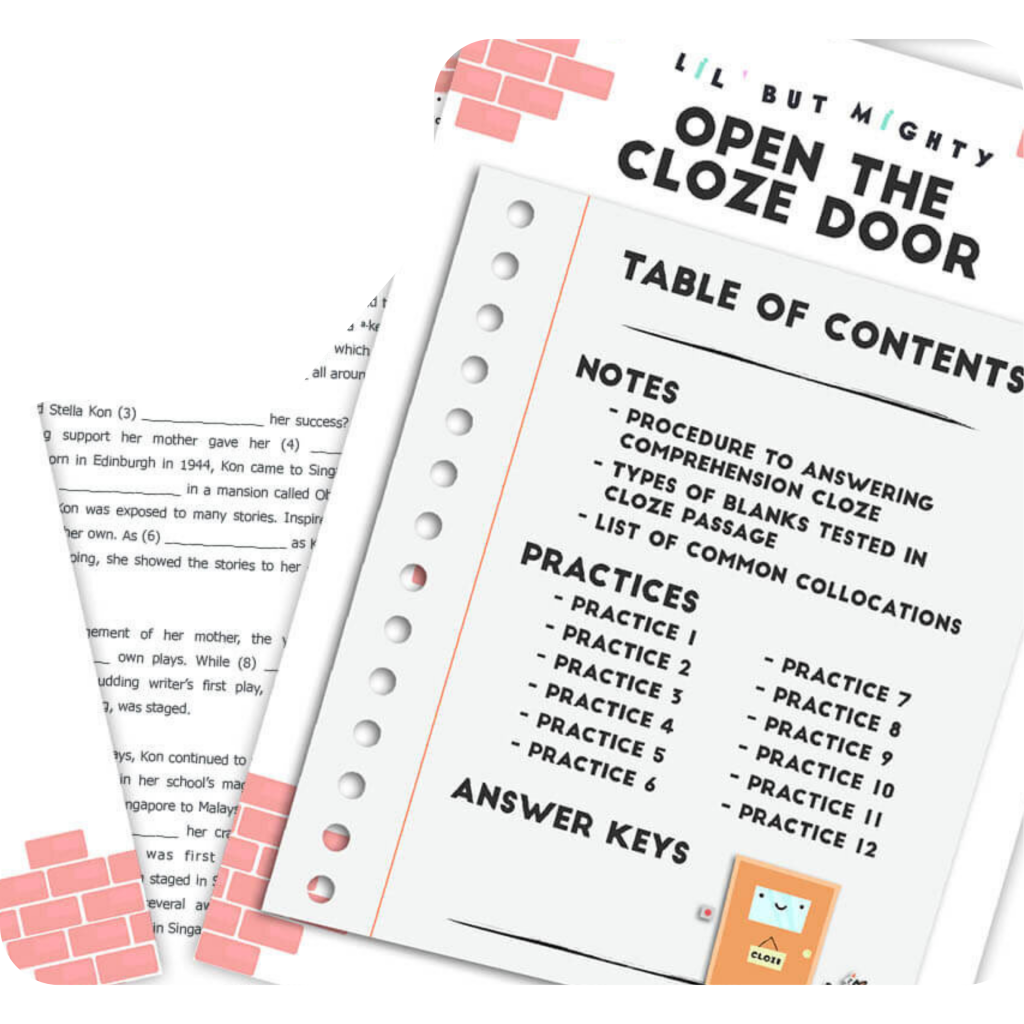
Build confidence step by step with guided lessons, worked examples, and focused practice in context clues, grammar fit, and vocabulary precision.
Get targeted support in vocabulary awareness, context reading, and cloze passage strategies to help students improve more confidently.
Students who want to improve in Cloze Passage often also benefit from focused help in related areas.
Cloze Passage can feel frustrating when students recognise the words but still struggle to choose the best answer in context. The right support helps students read more carefully, understand how grammar and vocabulary work together, and make more accurate choices with greater confidence.
At Lil’ but Mighty, support in Cloze Passage can help students strengthen:
Students are tested on whether they can choose the most suitable word by using vocabulary, grammar, and context clues together.
It is difficult because students need to understand the sentence, read the wider context, and choose a word that fits both meaning and grammar accurately.
Students improve by strengthening vocabulary in context, using grammar to test fit, reviewing wrong answers carefully, and practising regularly.
Vocabulary matters, but grammar awareness and context reading are just as important.
Students usually benefit most from improving context reading, grammar fit, and answer checking before trying more advanced vocabulary strategies.
Whether your child needs help with vocabulary use, context reading, grammar fit, or overall Paper 2 confidence, the right support can make Cloze Passage clearer, more manageable, and more effective.
Explore our full PSLE English guide for help with grammar, writing, oral, listening, and other key exam components.