Tackling Tricky Subjects and Verbs

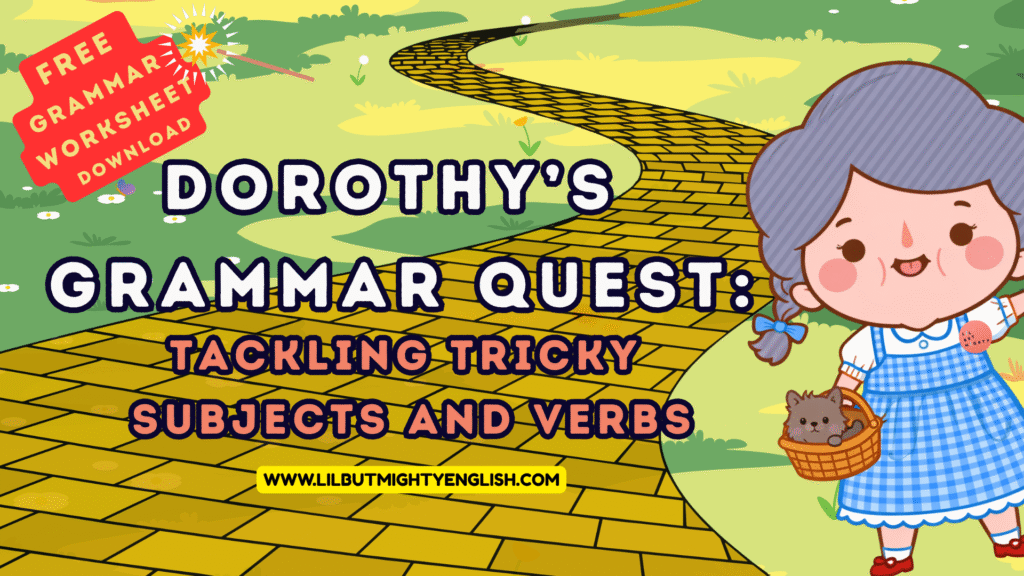
Dorothy’s Grammar Quest: Tackling Tricky Subjects and Verbs (Part 1)

Hi there, Grammar Explorers! I am Teacher Sharon, an English language specialist with Lil But Mighty. In this blog post, we will explore tricky subjects and their corresponding verbs.

Have you ever come across a sentence and stopped to ask: Should it be ‘is’ or ‘are’? Also, why do we say, ‘Each of them was happy’ and not ‘Each of them were happy’?

Today, we are going on a journey to the Land of Subject-Verb Agreement, guided by Dorothy and her friends from The Wizard of Oz to help you demystify these tricky subjects. Along the way, we will see how modifiers and extra information can sometimes confuse even experienced writers.

Let’s get started by learning the difference in nouns, pronouns and subjects, and how verbs (especially helping verbs!) must agree with them.

1. Know the Difference — Noun vs Pronoun vs Subject

• A noun names a person, place or thing e.g. teacher, school, whiteboard, bird

• A pronoun replaces a noun e.g. he, she, they, it

• A subject is the word or group of words that agrees with the verb and performs the action or holds the state described. Very often, it is a noun or pronoun.

Nouns and pronouns may not always be the subject in the sentence.

Example:

Each of her friends was determined not to give up despite the difficulties they faced.

Nouns: friends, difficulties

Pronoun: they

Subject: Each

Verb: was

Even though the noun “friends” is plural, the subject “each” is singular. The verb must match the subject, not just the nearest noun.💡 Tip for students: When you see phrases like “along with,” “as well as,” “including,” or “of the”, these are often modifiers, not part of the main subject. Ignore them when deciding the verb.

2. What Are Helping Verbs?

Helping verbs, also called auxiliary verbs, help us show tense (past, present, future) or possibility. They must agree with the subject. Common helping verbs: is, are, was, were, has, have, had, do, does, did, am

Example:

Dorothy was trying to get to the storm shelter.

‘was’ is the helping verb

‘trying’ is the main verb

It tells us the action was ongoing in the past.

‘was’ is the helping verb

‘Dorothy’ is the subject. It is singular.

The helping verb ‘was’ agrees with the subject ‘Dorothy’.

Helping verbs can also form questions or negatives:

• Was Dorothy trying to find the shelter?

• Dorothy was not trying to give up.

💡 Tip for students: Always pair the correct helping verb with the subject, not with the nearest noun in a prepositional phrase.

Let’s read Dorothy’s story below. Try to pick an answer before reading the explanation!

Practice Questions from Dorothy’s Story

1. During the tornado, Dorothy, together with her dog, ______ to get to the storm shelter.

(a) was trying

(b) were trying—

Subject: Dorothy (Singular)

Modifier: ‘…together with her dog, …’ (prepositional phrase with extra information, not part of the subject)

Answer: (a) was trying

2. Each of her friends ______ determined not to give up.

(a) is

(b) are

Subject: Each (Singular)

Modifier: ‘…of her friends…’ (prepositional phrase modifying the subject)

Answer: (a) is


Quick Recap

Always find the true subject — don’t be tricked by nouns in prepositional phrases or modifiers.

Match the verb (or helping verb) to the subject — singular or plural!

Look out for extra phrases that describe the subject but don’t change the verb.

That’s it for Part 1! I hope you have found today’s blog post helpful. You are now one step closer to being a Subject-Verb Agreement Champion! Stay tuned for Part 2, where we explore:

What to do with uncountable nouns

How to spot compound subjects

And even more grammar quizzes from Dorothy’s story!

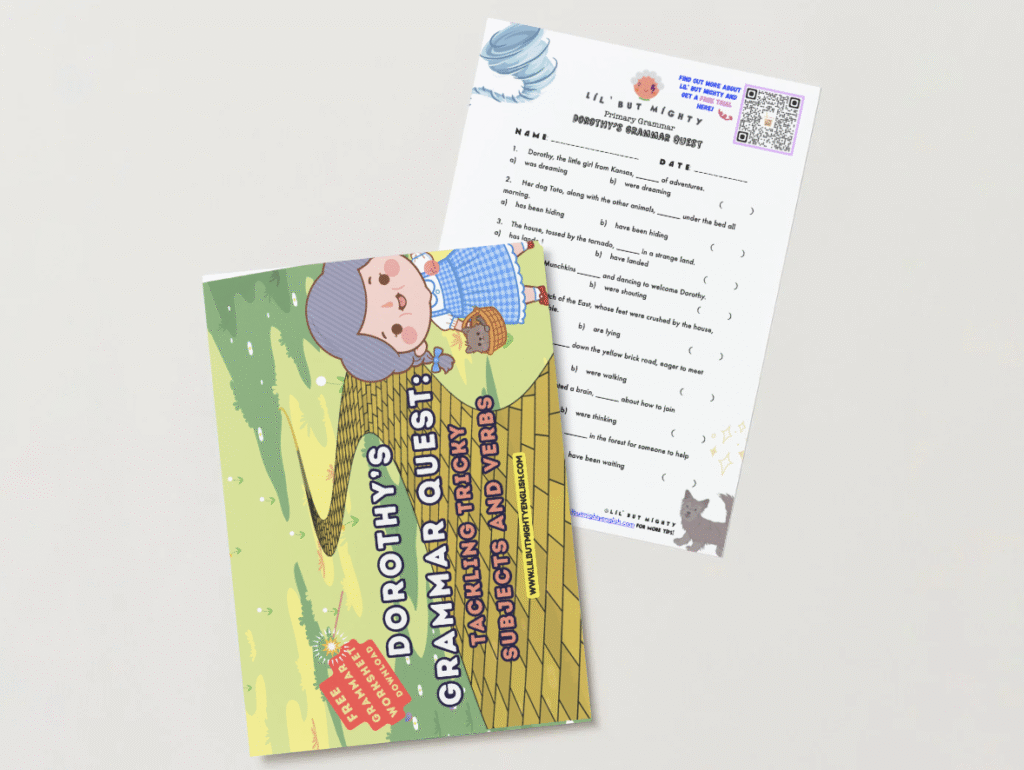
If you want more grammar practice and learn more of Dorothy’s story, you can download a free worksheet below!
Tackling Tricky Subjects and Verbs

Download your Free Dorothy’s Grammar Quest

We respect your privacy.

Mrs Sharon Profile Picture
Ms Sharon

Ms Sharon’s child-centric approach to teaching English makes her lessons fun-filled and easy to follow along. “Learning is more than absorbing facts; it is acquiring understanding.” – William Arthur Ward. She loves keeping her students on their toes by dropping questions out of thin air to test their understanding. Ms Sharon believes that learning takes place when her students are actively applying what they have learnt boldly. She hopes to inspire her students to have the thirst for knowledge that goes beyond the classroom.

Have something to share? Drop us a comment below!

Leave a Reply

Share

Other related posts

Creative Writing | 3 Easy Steps to Write Your Own Haiku!
Verbs: More than Just Action Words! | Part 3: Changes in Verb Forms
Ketchup on English! – is, are, was and were!
Audience In Visual Text | Visual Text Comprehension
Exploring Points of View (POV) in Composition Writing
Metaphors For? | Part II – Implied Metaphors
10 Beautiful Vivid Verbs to Boost Your Writing and Oral! | Primary School English
Metaphors For? | Part I – An Introduction to Metaphors
3 Family-Friendly Shows on Netflix (Educational & Entertaining)!
Verbs: More than Just Action Words! | Part 2: Tenses
2021 Father’s Day Contest Winners
Verbs: More than Just Action Words! | Part 1: Subject-Verb Agreement
10 Beautiful Words You Can Use in Narrative / Descriptive Writing | Secondary School
Ways To Create A Well-Rounded Character | Creative Writing
Understanding Purpose-Related Questions in Visual Text Comprehension
How Playing Video Games Can Improve Our English (With Practical Tips for Parents!)
Primary School Composition | Onomatopoeia – What’s That?
2021 Mother’s Day Contest Winners + Our Founder’s Journey (Mother’s Day Special)!
Composition Revision: Using Your 5 Senses in Your Writing
How to Create A Dynamic Piece of Writing Using Idioms
Ketchup on English! – Subject-Verb Agreement
4 steps to Create Suspense
That Simile Though 2 | Using Stronger Similes
PSLE ORAL | Compiled Prelim 2021 Oral Topics + Questions!
If you’re looking at getting recent PSLE Prelim Oral topics and practice questions, this will be an excellent resource for you!
5 Steps to Convert a Newspaper Article into a Cloze Passage
I would like to share with you 5 steps on how authentic articles can be transformed into cloze passages easily. Read on here!
PSLE English | Oral Conversation: Free SG50 Sample Practice + Model Answers
In this blogpost we will be touching on the oral stimulus-based conversation topic of National Day and SG50! Read on here!
PSLE English | Oral Conversation: Filling your Story with Details Easily + Free Revision Cards
By simply using the 5W1H, your children will be able to lengthen their stories (hence, the conversation!). Read on here!
Primary School Situational Writing: Q&A + Formal vs Informal Writing Comparison Chart
To aid you in your situational writing revision, here is a comparison chart that shows the differences between formal and informal writing!
PSLE English Tips | Oral: Stimulus-Based Conversation Checklist
To help my children handle the Stimulus-Based Conversation examination, here are some instructions again about using the checklist!
A Little Encouragement | DIY Motivational Bookmark (Easy to personalise too!)
A bookmark with a quote to motivate is also a chance for them to see the power of words and how words can mean more than what they seem.
Situational Writing: Step-by-Step Guide + Free Revision Card
I believe a walkthrough on the process of doing situational writing is in order. Here are the requirements for content and language!
I Love Reading | 5 Ways to Motivate Reluctant Readers
One of the most important ingredients necessary for a child or anyone learning English is the habit of reading. Get motivated to read now!
PSLE English | Printable Ultimate Grammar & Synthesis Summary
Today, we are sharing two lists of essentials in our Ultimate Grammar and Synthesis Summary Printable. Download them free here!
How Well Do You Know Your Past Participles?
While we are familiar with the past, present and future tenses, the little less known but equally important tense is the past participles.
Primary Composition Writing | Starting Sentences with Introductory Clauses
Today, we'll be revising the use of sentence starters to help you create variety in your sentence structures. Read on here!
The Sentence Train | Lower Primary English
Today, we are going to learn what makes up a sentence. It will come in handy when you do the word order activity in school! Read on here!
PSLE English Tips | Oral: Reading Checklist
This Oral Reading Checklist can be used by children when they practise reading on their own. Download it now!
Language of COVID | 10 Words Added to the Dictionary
Using Personification to Show, Not Tell!
Expressing Character Feelings Too! | Using Show-Not-Tell (Part 2)
How to Choose a Book to Read: 8 Ways
How to Dress Up A Boring Paragraph | Creative Writing
Ketchup on English! – Halloween Special: Prepositions of Time!
Ketchup on English! – Verbs Are Not Just Action Words!
Expressing Character Feelings | Using Show-Not-Tell
Which Picture Should I Use? | Choosing the Best Picture to Use for Composition!
Oral: Reading Passage | Long Vowels – Have You Been Reading Your Vowels Correctly?
Previous
Next

Like what you are reading?

Subscribe now to receive news and tips hot off the press!

shape icon 06
shape icon 05