Flashback

Flashback Introduction for Composition: 2 Simple Ways to Avoid Cliche and Impress Examiners!

“Hmm! I remember the time… Oh sorry, I didn’t realise that the video had already started filming.”

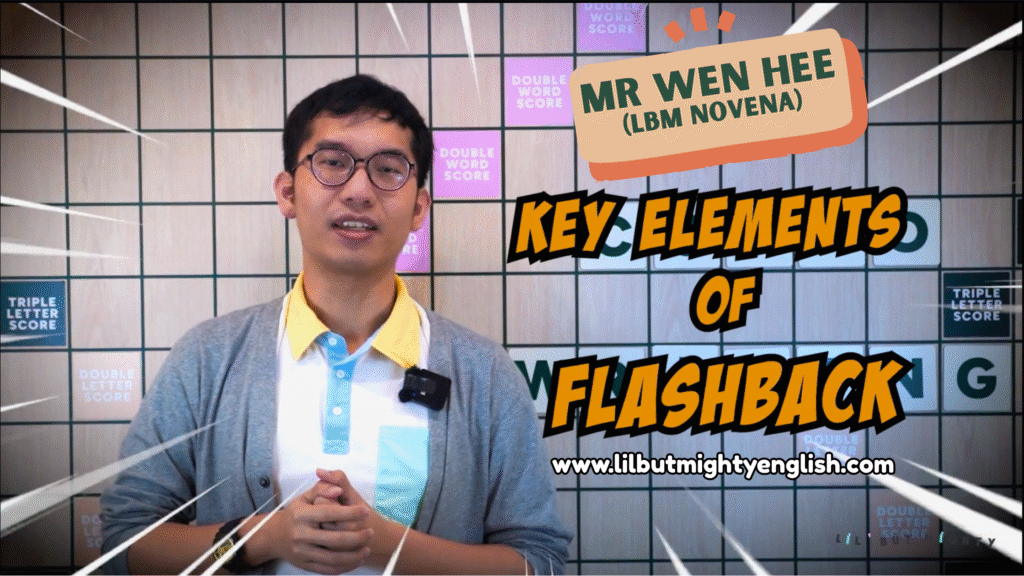
Welcome back, this is Teacher Wen Hee from Lil’ but Mighty (Novena branch) here! I’m sure many of you have recollection of past experiences, whether they are happy memories, sad ones or of any other moments in general. Some of you might even have heard of the term, ‘Flashback’, so why not tap on these memories or experiences to craft creative stories for your compositions?

As the final part of this video series, I’m here to share with you how to avoid being cliche in your introductions and instead have an eye-catching flashback right from the start!

Are you ready? Let’s begin!

Crafting a flashback is as simple as 1,2,3 once you understand the key elements needed to structure a clear and distinct paragraph that effectively highlights either a positive or negative experience related to the given topic.

Method 1: Using Place/ Sound Descriptions

Do you still remember the ways to craft interesting introduction from the previous series such as Place/Sound descriptions? It’s finally time to put some of them to use—as we craft one Positive and one Negative flashback that you can use across a wide range of composition topics. Here is an example each!

flashback

The key is to have a clear start with a weather/sound/place description that evokes a clear emotion of your main character. Next, use another description to set up a proper transition to the past. Take note that you will not need to use all 3 types of description in your flashback. It will be exam-smart to keep your flashback succinct and focus on injecting descriptions in the actual events of the story.

If you find using time and place descriptions too tedious, here is another way that you can create a flashback.

Method #2: Using a Given Object Picture

Here’s a hint for you, every flashback has a trigger. What would help you to kill two birds with one stone if an object is a trigger? That’s right, to utilise one of the three pictures given to you if it is an object/item as a trigger that reminds you of a particular past experience. Below are some examples:

flashback

This method is slightly easier but you need to be mindful of the pictures given for the topic. As much as using the picture as your flashback trigger will help to ensure that you fulfil the composition requirement, the picture must be logically used. If you find it a challenge to weave the picture meaningfully into your story, then consider exploring other objects or ways of beginning your story instead.

I hope that the above tips have been helpful and I am sure you will be able to modify and craft out your own creative flashbacks! I would like to end off with a reminder if you are to use a flashback for your compositions in your introduction, you have to remember to “return to reality” nearing the end of your story. The rationale is that you would need to bring your audience back to the present or reality in order for them not to be stuck in the past experience that you were sharing!

Here is a simple sample of a generic “Return to Reality” that you can apply to most stories that began with a flashback like the example above. If you would like more examples, do leave a comment and I may possibly make another post on this particular component!

flashback

This brings me to the end of this serious of saying goodbye to cliche introductions! If you enjoyed this video, do check out our other blog posts and videos for other useful English tips. Don’t forget to like, share and subscribe. Stay happy and keep on doing your best each day! See you!

Wen Hee Profile
Mr Wen Hee

Teacher Wen Hee is a seasoned teacher who always strives to come out with innovative methods to keep his students engaged whilst having fun in class. He strongly believes that learning is a continuous process and hopes to impart this important life skill to his students.

Have something to share? Drop us a comment below!

Leave a Reply

Share

Other related posts

Creative Writing | 3 Easy Steps to Write Your Own Haiku!
Verbs: More than Just Action Words! | Part 3: Changes in Verb Forms
Ketchup on English! – is, are, was and were!
Audience In Visual Text | Visual Text Comprehension
Exploring Points of View (POV) in Composition Writing
Metaphors For? | Part II – Implied Metaphors
10 Beautiful Vivid Verbs to Boost Your Writing and Oral! | Primary School English
Metaphors For? | Part I – An Introduction to Metaphors
3 Family-Friendly Shows on Netflix (Educational & Entertaining)!
Verbs: More than Just Action Words! | Part 2: Tenses
2021 Father’s Day Contest Winners
Verbs: More than Just Action Words! | Part 1: Subject-Verb Agreement
10 Beautiful Words You Can Use in Narrative / Descriptive Writing | Secondary School
Ways To Create A Well-Rounded Character | Creative Writing
Understanding Purpose-Related Questions in Visual Text Comprehension
How Playing Video Games Can Improve Our English (With Practical Tips for Parents!)
Primary School Composition | Onomatopoeia – What’s That?
2021 Mother’s Day Contest Winners + Our Founder’s Journey (Mother’s Day Special)!
Composition Revision: Using Your 5 Senses in Your Writing
How to Create A Dynamic Piece of Writing Using Idioms
Ketchup on English! – Subject-Verb Agreement
4 steps to Create Suspense
That Simile Though 2 | Using Stronger Similes
PSLE ORAL | Compiled Prelim 2021 Oral Topics + Questions!
If you’re looking at getting recent PSLE Prelim Oral topics and practice questions, this will be an excellent resource for you!
5 Steps to Convert a Newspaper Article into a Cloze Passage
I would like to share with you 5 steps on how authentic articles can be transformed into cloze passages easily. Read on here!
PSLE English | Oral Conversation: Free SG50 Sample Practice + Model Answers
In this blogpost we will be touching on the oral stimulus-based conversation topic of National Day and SG50! Read on here!
PSLE English | Oral Conversation: Filling your Story with Details Easily + Free Revision Cards
By simply using the 5W1H, your children will be able to lengthen their stories (hence, the conversation!). Read on here!
Primary School Situational Writing: Q&A + Formal vs Informal Writing Comparison Chart
To aid you in your situational writing revision, here is a comparison chart that shows the differences between formal and informal writing!
PSLE English Tips | Oral: Stimulus-Based Conversation Checklist
To help my children handle the Stimulus-Based Conversation examination, here are some instructions again about using the checklist!
A Little Encouragement | DIY Motivational Bookmark (Easy to personalise too!)
A bookmark with a quote to motivate is also a chance for them to see the power of words and how words can mean more than what they seem.
Situational Writing: Step-by-Step Guide + Free Revision Card
I believe a walkthrough on the process of doing situational writing is in order. Here are the requirements for content and language!
I Love Reading | 5 Ways to Motivate Reluctant Readers
One of the most important ingredients necessary for a child or anyone learning English is the habit of reading. Get motivated to read now!
PSLE English | Printable Ultimate Grammar & Synthesis Summary
Today, we are sharing two lists of essentials in our Ultimate Grammar and Synthesis Summary Printable. Download them free here!
How Well Do You Know Your Past Participles?
While we are familiar with the past, present and future tenses, the little less known but equally important tense is the past participles.
Primary Composition Writing | Starting Sentences with Introductory Clauses
Today, we'll be revising the use of sentence starters to help you create variety in your sentence structures. Read on here!
The Sentence Train | Lower Primary English
Today, we are going to learn what makes up a sentence. It will come in handy when you do the word order activity in school! Read on here!
PSLE English Tips | Oral: Reading Checklist
This Oral Reading Checklist can be used by children when they practise reading on their own. Download it now!
Language of COVID | 10 Words Added to the Dictionary
Using Personification to Show, Not Tell!
Expressing Character Feelings Too! | Using Show-Not-Tell (Part 2)
How to Choose a Book to Read: 8 Ways
How to Dress Up A Boring Paragraph | Creative Writing
Ketchup on English! – Halloween Special: Prepositions of Time!
Ketchup on English! – Verbs Are Not Just Action Words!
Expressing Character Feelings | Using Show-Not-Tell
Which Picture Should I Use? | Choosing the Best Picture to Use for Composition!
Oral: Reading Passage | Long Vowels – Have You Been Reading Your Vowels Correctly?
Previous
Next

Like what you are reading?

Subscribe now to receive news and tips hot off the press!

shape icon 06
shape icon 05