Hello everyone! Welcome to your O Level Toolkit! For those of you fresh out of primary school, you may be wondering what you can expect of O Level English. So today, let us take a look at an overview of O Level English Components.
Well, fret no longer! Below, you can find an overview of all the O Level English components you will encounter. An in-depth coverage of each of the different components can also be found in the other parts of your O Level Toolkit, so do take the time to explore our resources yourself!
To begin, let’s take a look at an overview of the O Level English components tested across the FOUR papers secondary students will need to sit for.
If you are curious about any of these components and wish to explore them in greater depth, follow the links within the table, which will take you to their corresponding chapters in our handy O Level Toolkit! 🙂
Major Changes to the O Level English Syllabus (Starting 2023)
Feeling a bit nervous about new rules and changes? Don’t worry, we’re here to break them down for you!
Here’s a quick overview of the major updates you’ll see in the O Level English syllabus from 2023 onwards:
- Emphasis on 21st-Century Skills: The syllabus has been refreshed to nurture more than just academic English. Now, there’s a stronger focus on critical thinking, media literacy, and practical communication—important skills for thriving in today’s ever-changing world.
- Situational Writing Gets Practical: The types of tasks you’ll tackle in Situational Writing are now more closely tied to real-life scenarios. You’ll find yourself crafting emails, blog posts, reports, and other practical documents instead of only formal letters.
- Comprehension Paper Revamped: The comprehension section has been reorganised into three distinct texts—a visual, a narrative or descriptive passage, and a non-narrative text. This new approach lets you flex different reading and analytical muscles all in one go.
- Oral Communication Adjustments: For those dreading “Reading Aloud,” good news—this section has been removed! The focus is now on the Planned Response and Spoken Interaction tasks, which may be connected by a common theme.
As you scroll through the Toolkit, keep these changes in mind—they’ll help you stay ahead of the curve as you prepare for success!
What Does the O Level English Syllabus 2025 Look Like?
Now, let’s dive into what you can expect from the O Level English syllabus for 2025 in Singapore. Whether you’re starting Secondary 3 or just planning ahead, knowing the latest syllabus structure will help you chart your study path with confidence!
Who Oversees the O Level English Exams?
Singapore’s O Level English examination is jointly administered by the Singapore Examinations and Assessment Board (SEAB), the University of Cambridge Local Examinations Syndicate, and the Ministry of Education (MOE). The most recent version of the syllabus is called Syllabus 1184.
The Four Key Papers
Your O Level English grade comes from performance across four different papers, each one targeting a specific language skill:
- Paper 1 – Writing (70 marks):
- Section A: Editing (spot and correct grammatical errors)
- Section B: Situational Writing (write a practical text, such as an email, blog entry, or report based on a given scenario)
- Section C: Continuous Writing (select a topic and develop it into a longer essay)
- Paper 2 – Comprehension (50 marks):
- Requires you to answer questions about multiple texts, including one with visuals, a narrative or descriptive passage, and a non-narrative text. The final section usually ends with a summary-writing task.
- Paper 3 – Listening (30 marks):
- Section A: Respond to a variety of audio recordings (each played twice)
- Section B: Complete a note-taking exercise from a recording (played once)
- Paper 4 – Oral Communication (30 marks):
- Part 1: Planned Response – deliver a short response to a video prompt
- Part 2: Spoken Interaction – discuss a related topic with examiners
What’s New in 2025?
In line with the latest educational goals, the revised syllabus emphasises skills like critical thinking and media literacy—abilities that go beyond traditional rote learning. Here’s what’s changed:
- Situational Writing now focuses on practical, real-world text types—think emails or blogs instead of old-school letters.
- The Comprehension paper has a streamlined structure featuring a combination of visual, narrative, and non-narrative texts for broader coverage.
- For Oral Communication, the Reading Aloud section has been removed, and the exam now centres on prepared responses and follow-up discussion.
Key Learning Outcomes
According to SEAB, students will need to:
- Write clearly for different purposes, audiences, and situations, using correct grammar and vocabulary.
- Understand a wide range of texts (including visuals) at different levels: literal, inferential, and evaluative.
- Extract and summarise key information from mixed-format sources.
- Listen attentively and interpret meaning from a variety of audio texts.
- Speak fluently and persuasively, and take part in discussions with clarity and confidence.
With these updates, the O Level English syllabus aims to prepare you for the demands of modern communication, fostering not just academic achievement but also real-life readiness. And remember—if you’d like a closer look at any specific component, just click on the relevant links in our https://lilbutmightyenglish.com/o-level-english-essential-toolkit/ for step-by-step guides and pro tips! 😊
Paper 1: Writing
Marks: 70
Weightage: 35%
Duration: 1 hr 50 mins
Structure of Paper 1
Paper 1 consists of three sections, each designed to test different aspects of your writing skills for the O Level English syllabus. Here’s what you can expect in each section:
Section A: Editing (10 marks)
You’ll be given a short text with various grammatical errors. Your task? To spot and correct them!
Tips to ace this section:
- Check the tense of each sentence carefully—tense slips are common!
- Read every sentence slowly and attentively. Rushing increases the chances of missing errors.
- Practice, practice, practice. The more editing questions you try before the exam, the sharper your eye for mistakes will become.
Section B: Situational Writing (30 marks)
This section asks you to respond—usually in 250 to 350 words—to a specific situation, often based on a visual text or scenario. You’ll be required to communicate your message clearly and appropriately for the task, audience, and purpose. Think of it as putting your real-world writing skills to the test.
Section C: Continuous Writing (30 marks)
Here, you’ll choose one topic out of four and write a longer composition (about 350 to 500 words). The topics may range from narrative and descriptive essays to argumentative pieces.
Pro tip:
- Read all four topics carefully before deciding.
- Pick the one you feel most confident in—whether it’s spinning a compelling story or making a persuasive argument.
- Plan your ideas before you start writing to ensure your answer is well-organized and engaging.
By understanding the requirements and expectations of each section, you’ll be well on your way to tackling Paper 1 with confidence!
Skills Assessed in Paper 1 Sections
Let’s take a closer look at what each component in Paper 1 evaluates:
Editing
Here, you’re tested on your command of grammar and your eye for detail. You’ll need to spot errors in tense, subject-verb agreement, punctuation, and sentence structure within a given passage. This section assesses your ability to apply grammatical rules and improve the clarity of writing—a bit like acting as the spell-check for the English language.
Situational Writing
This part measures your skill in responding appropriately to real-world scenarios, such as writing letters, emails, reports, or other functional texts. Examiners look for your ability to understand the requirements of the task, organize information effectively, and adopt the right tone and style for the situation. Clarity, relevance, and coherent argumentation are key.
Continuous Writing
For this component, your creative and critical thinking abilities are put to the test. You’re expected to generate ideas, select the most compelling ones, and develop them into a cohesive essay. The focus is on your capacity to construct logical arguments, use descriptive language, and vary your sentence structures. Your overall organisation and ability to engage the reader matter just as much as your language accuracy.
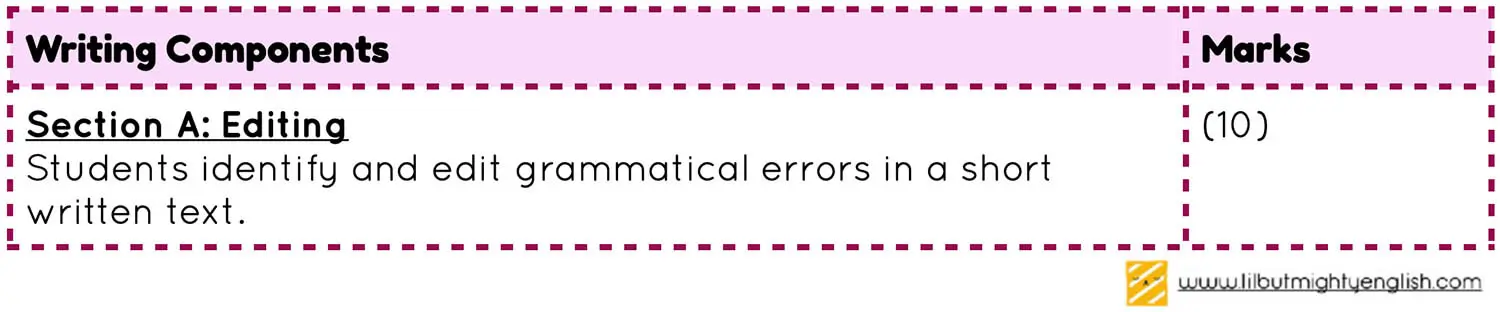
(Click here to learn how to approach Secondary School Editing!)

(Want to find out more about the types of Situational Writing? Click here!)
What practical text types are now emphasised in Situational Writing?
With the revised syllabus, students can expect to tackle a variety of real-world writing tasks. These include practical forms such as emails (to teachers, organisations, or friends), blog posts reflecting opinions or recounting events, and reports analysing situations or making recommendations. Letters—both formal and informal—can also make an appearance, alongside speeches and proposals tailored to different audiences. This updated focus ensures you’ll practise writing that’s genuinely useful beyond the classroom.

(Curious about the different types of essays you may be asked to write for Continuous Writing? Click here!)
Paper 2: Comprehension
Marks: 50
Weightage: 35%
Duration: 1 hr 50 mins
Paper 2 is where your reading muscles get their real workout! This section is all about demonstrating sharp comprehension skills—inferring meaning, evaluating viewpoints, and mastering the art of summarising information. You’ll also need to use precise answering techniques to scoop up all those precious marks.
How the Structure Has Changed
The structure of the comprehension paper has been updated to include three distinct texts:
- One visual text
- One text that is either narrative or descriptive
- One non-narrative text
This new arrangement makes it clearer what to expect and ensures a broader range of reading and reasoning skills are tested.
Paper 2 is where your reading comprehension skills truly get put to the test. This is your chance to show how well you can infer meaning, evaluate and engage critically with different viewpoints, and demonstrate a knack for summarising information clearly. To score well, mastering answering techniques and understanding the structure of this paper is key.
Paper 2 is divided into three main sections:
Section A (5 marks)
This section features Texts 1 and 2, one of which includes a visual. You’ll face questions that test your comprehension and language skills, often requiring you to interpret both written and visual information.
Section B (20 marks)
Here, you’ll find Text 3, which is narrative-based. The questions will focus on both comprehension and vocabulary—think of it as the classic story passage, but with a twist that aligns with the O-Level English syllabus.
Section C (25 marks)
This section centres on Text 4—a non-narrative text. Expect a mix of comprehension questions, plus a summary task where you’ll be asked to condense information into about 80 words (excluding the provided introductory words). This is a new challenge if you’re coming from primary school, so practicing this format is especially important.
From visuals to narratives and non-narratives, Paper 2 is all about versatility—sharpening your skills across a variety of texts and question types.
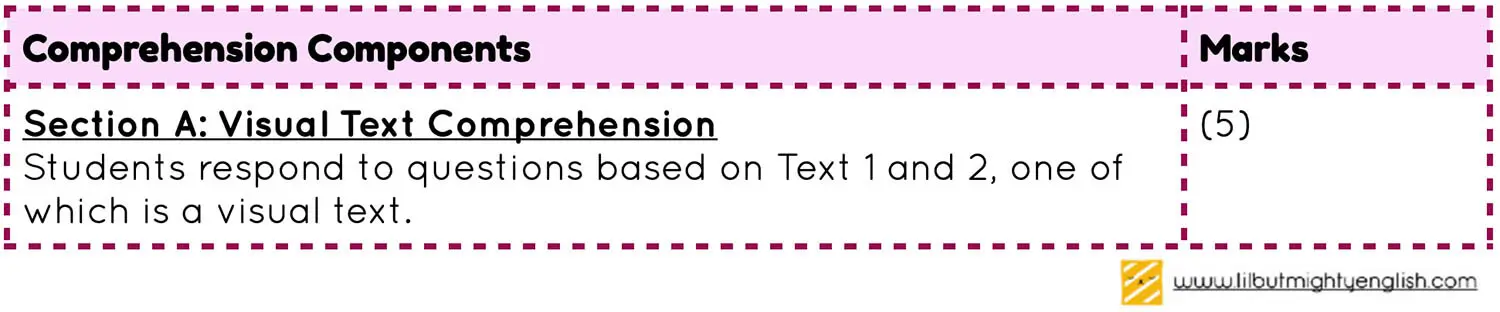
(Wondering how the Visual Text Comprehension in secondary school is like? Stay tuned for a future blog update!)
(Curious about the kinds of questions that you can be asked in a Narrative Comprehension in secondary school? Find out here!)

(As the Non-Narrative Comprehension is not something you encounter in primary school, read an example passage here and check out the kinds of questions you can encounter!)
Section C: The Summary Writing Task Explained
For Section C of Paper 2, you’ll be working with a non-narrative passage (often labelled as “Text 4”). Here, you’ll need to tackle two types of questions:
- Comprehension Questions: These check your understanding of the given passage—the usual fare!
- Summary Writing Task: This is a distinctive challenge. You’ll be asked to produce a concise summary (around 80 words, not counting a short introduction that will be provided for you). Your goal is to select and express only the most relevant points from the passage, using your own words as much as possible.
A helpful tip: Practice paraphrasing ideas in a short, punchy style, and always stick within the given word count. Pay attention to accuracy, clarity, and coherence so that your summary captures all key details without going off track.
Paper 3: Listening
Marks: 30
Weightage: 10%
Duration: About 30 mins
The Listening paper is all about putting your ears to the test—and yes, you’ll need to stay sharp! This component is divided into two sections, each designed to assess your ability to understand and process spoken English in different ways.
Section A
This section carries 22 marks. You’ll listen to a variety of audio recordings, each played twice, and respond to several listening tasks based on what you hear. The recordings might range from conversations and interviews to announcements—so expect a mix.
Section B
In contrast, Section B is worth 8 marks and takes a slightly different approach. Here, you’ll be required to complete a simple note-taking exercise based on an audio recording. But take note: this recording will only be played once, so you’ll need to focus and jot down the key points as you listen.
The types of listening texts have become more diverse in recent years, reflecting real-world situations and exposing you to different accents, tones, and contexts.

(If you are curious and wish to test your listening skills through an example of one such listening task, consider downloading our O Level Toolkit here!)

Paper 4: Oral Communication
Marks: 30
Weightage: 20%
Duration: About 20 mins (includes 10 mins of prep time)
What to Expect
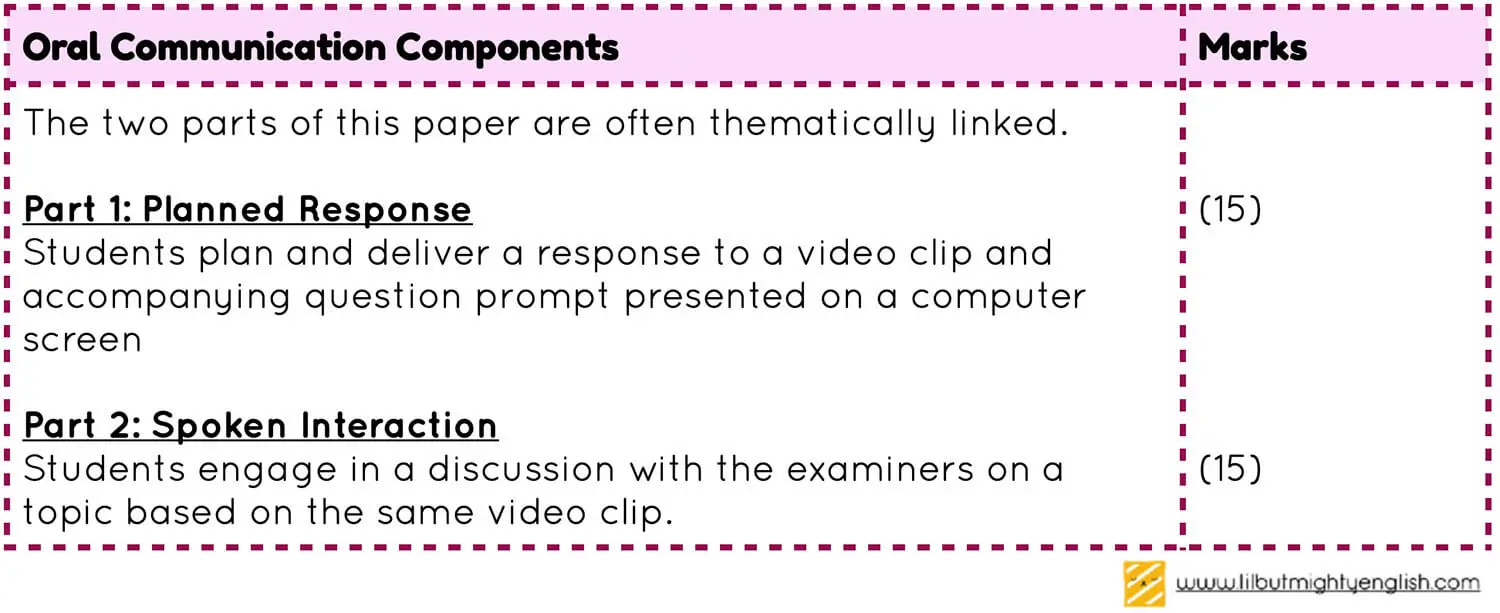
Part 1: Planned Response (15 marks)
You’ll watch a short video clip and receive a prompt, both presented on a computer screen. Your task is to deliver a well-structured response of up to 2 minutes, showcasing your ability to analyse, organise, and present ideas clearly.
Part 2: Spoken Interaction (15 marks)
Next, you’ll engage in a discussion with the examiners on a topic broadly related to the video clip from Part 1. This is your opportunity to demonstrate your conversational skills, express opinions clearly, and respond thoughtfully to questions.
What’s New in the Oral Communication Paper?
One significant update you’ll want to note: the Reading Aloud component is no longer part of Paper 4. Instead, you will begin with the Planned Response task, immediately followed by the Spoken Interaction segment. These two parts may be connected by a common theme, making it important to listen carefully and respond thoughtfully throughout the assessment.
This streamlined format puts more emphasis on your ability to articulate ideas and engage in meaningful discussions—whether you’re drawing on personal experiences or presenting well-structured arguments.
Understanding the Planned Response and Spoken Interaction
Both components of Paper 4 are designed to assess your ability to think on your feet and articulate your thoughts clearly.
Planned Response:
In the first part, you’ll have roughly two minutes to respond to a video clip and its prompt, which appear on a computer screen. Consider this your chance to gather your thoughts, organize your ideas, and speak clearly—almost like delivering a mini presentation. The key is to structure your answer around the main issue or theme raised in the video, while demonstrating your understanding and personal insight.
Spoken Interaction:
Next, you’ll engage in a friendly discussion with the examiner(s). This section allows you to delve deeper into ideas connected to the video, sharing your perspectives and exchanging viewpoints. Think of it as having an informed conversation where expressing opinions, justifying your stance, and building on ideas are all important. The atmosphere is often conversational—less like an interrogation, and more like demonstrating your ability to converse thoughtfully on the spot.
(Example Planned Response and Spoken Interaction tasks plus model responses are available for you to try out on our O Level Toolkit. Why not download it here?)
Effective Strategies for O Level English Exam Preparation
Preparing for the O Level English exam doesn’t have to feel like deciphering Shakespeare on a Monday morning. With the right approach and a bit of planning, you can head into exam day feeling ready (and maybe even a little bit excited). Here’s how to set yourself up for success:
Get Cozy With the Syllabus
First things first—make friends with the exam syllabus. Go beyond a quick skim; really get to know what’s expected. The syllabus lays out exactly what you’ll be tested on, so highlight the requirements for each paper. This helps you spot your strong suits and the areas that need a little more TLC.
Hone Your Time Management Skills
You wouldn’t attempt a 3-minute maggi mee in 30 seconds, so don’t let time slip away in your exam either. Practise answering sample questions within the set time limits. If you find yourself stuck on a question, move on and circle back later. Building this habit ensures you’ll cover all sections and have the opportunity to showcase what you know.
Develop a Smart Exam Game Plan
A little strategy goes a long way. Before launching into answers, pause to read each question carefully—no teleporting to conclusions just yet! Annotate passages, underline keywords, and map out brief outlines for essays or structured responses. This not only clarifies your thoughts, but also makes your responses sharper and more targeted.
Practise, Practise, and Then Practise Some More
If there’s one magic remedy for exam nerves, it’s practice. Work through as many past-year papers as you can find (the Cambridge Assessment website is a goldmine). Simulate exam conditions by timing yourself and resist the urge to peek at your notes. Review your answers to identify common mistakes and areas to improve, turning weak points into new strengths.
Stay Curious and Resourceful
If you hit roadblocks, don’t hesitate to ask your teachers for feedback. You could also team up with friends for peer-review sessions or seek reputable online resources—BBC Bitesize and Grammarly’s blog are great places to start. Varied perspectives help you grasp tricky grammar rules and refine your writing style.
Remember, success in the O Level English exam is not about last-minute cramming but about developing habits and skills over time. By combining consistent practice with thoughtful preparation, you’ll find yourself approaching exam day with calm confidence.
Why Time Management Matters
Imagine sprinting through your favourite Netflix series, only to realise you’ve accidentally skipped half the key scenes. That’s exactly what poor time management can do to your performance in the O Level English exams—important moments (and marks) lost in the rush!
By pacing yourself wisely during each section, you give every question the attention it deserves. It’s not just about speed; it’s about allocating your minutes smartly:
- Prioritise: Tackle questions you’re comfortable with first to build confidence and secure marks.
- Don’t Dwell: If a challenging question emerges, earmark it for later—burning precious minutes won’t help anyone.
- Watch the Clock: Use the reading and planning time effectively—perhaps even setting mini-deadlines for each section.
- Review Time: Reserve a few minutes at the end for a quick check—catch those pesky errors before they trip you up.
The art of timing isn’t about rushing, but rather ensuring you have the opportunity to showcase what you know—in full, and in your best voice.
Why Practising With Past-Year Papers Matters
Now, you might be asking, “Do I really need to slog through all those stacks of past-year papers?” Absolutely! Regular practice with previous O Level papers does more than just familiarise you with question types—it helps you get comfortable with the exam format and spot patterns in how questions are set. You’ll train your mind to think on its feet, sharpen your timing, and reduce surprises on the big day.
Here’s why it’s such a game-changer:
- Build Exam Confidence: The more papers you attempt, the more at ease you’ll be when you sit for the real thing.
- Refine Time Management: Practising under actual exam conditions helps you pace yourself, so you won’t end up rushing through the final section.
- Identify Weak Spots: Patterns will emerge—maybe summary questions trip you up, or perhaps narrative comprehension needs extra work—giving you clear areas to work on.
- Master Format and Expectations: Each paper has its quirks! Familiarising yourself means you won’t be thrown off by formatting, page layouts, or question phrasing.
So, grab a few past-year papers (Cambridge, Ten Year Series, you name it!), set your timer, and challenge yourself. You’ll be amazed how much more confident—and prepared—you’ll feel, come exam day.
A Shift Toward 21st-Century Skills and Critical Thinking
If you’ve glanced at the latest O Level English syllabus, you’ll notice it’s not just business as usual—the changes go beyond simple updates. The revised syllabus genuinely aims to nurture skills that matter in today’s world, such as critical thinking, adaptability, and media literacy.
Here’s how these updates make a real difference:
- Wider Range of Practical Text Types: Situational Writing now covers formats like emails, blog posts, and reports. Instead of purely academic exercises, you’re practicing communication in ways you’ll actually encounter outside the exam hall—think of collaborating on a project via email or sharing your opinion on a public platform like Medium.
- Comprehension, Upgraded: The comprehension section now weaves together a visual text, a narrative or descriptive piece, and a non-narrative text. This structure encourages you to make connections between information presented in different ways—an essential skill when navigating everything from social media feeds to news articles.
- Oral Communication with Purpose: The focus has shifted toward meaningful spoken interaction, with the Reading Aloud component retired to make room for tasks that test how you plan, articulate, and respond in real-life conversations. You’ll find yourself drawing on reasoning skills and quick thinking—hallmarks of effective communication in any environment.
Ultimately, these changes aren’t just about passing exams; they’re about helping you become a sharper thinker and a more confident communicator, ready to engage thoughtfully with the information-rich world we live in.
The Importance of O Level English for Your Future
You might be wondering—why all this fuss about English at the O Levels? Well, let’s put it this way: mastering O Level English isn’t just about ticking off another subject on your timetable. English is the foundation for success in almost every area of life in Singapore, from acing your JC or polytechnic applications to excelling in university and landing that dream job later on.
A strong performance in O Level English can truly open doors. Think about it: universities and employers alike look out for your command of English, since it’s the primary language of instruction and business in Singapore. Whether you’re thinking of becoming a doctor at SGH, a lawyer in Raffles Place, or a digital marketer for an MNC, your English skills will pave the way.
Moreover, English is more than just a subject—it’s a critical life skill. From writing persuasive emails to understanding official documents or expressing yourself confidently in interviews, success often hinges on how effectively you communicate.
So, while the exams may seem daunting now, remember that your efforts in English will continue to pay off, long after you leave the exam hall!
And there you have it! An overview of the various O Level English components you will need to tackle at Secondary 4. Do consider exploring your very own O Level Toolkit here to get a better grasp of how to approach each of these components!